






“The followers of the Pentecostal Church embody a weary soul—one whose exhaustion dictates what must be done. Fatigue is the angel that touches a king’s fingers, while other kings sleep soundly and drift through dreams. Healthy fatigue is nothing less than a cure. The weary individual resembles Orpheus, surrounded by the fiercest of beasts until they share in his exhaustion. Fatigue gives the scattered ones the key to salvation. Every night Philip Marlowe refused sleep and unraveled mysteries with uncanny precision. And it was the exhausted Orpheus who won Eurydice’s heart. Fatigue makes us younger than we have ever been. It is larger than the self, and within its stillness, everything becomes extraordinary.”
This is how Peter Handke sees fatigue, casting a romantic glow over it, or perhaps mourning the weary and exalting them, the way one exalts the tormented for their endurance and tells them their suffering is sacred. Just as “the poor shall inherit the kingdom,” the exhausted are promised “the key to salvation.” But if they had the choice, would the weary choose exhaustion? Would the poor choose poverty?
In an age where the human being finds himself compelled to carry Sisyphus’s boulder again and again toward the summit, chasing meaning or pursuing a happiness too elusive to grasp, strength gives way with every attempt to climb, and what is lost along the way can never be recovered: the wasted years, the vanished dreams. Here, fatigue and exhaustion become a private prayer belonging to no one but the one who carries it; yet it is an unwelcome prayer, a grueling act, a stifled moan. These broken bodies and worn souls find no other path than to keep company with their weariness and to rebel against it at once, sacrificing themselves for the other, for the dream, for some fragment of meaning. And perhaps cinema, more than any other art form, is uniquely capable of making us feel this exhaustion from the inside.
Fatigue as Sacred Act
In Diary of a Country Priest (1951), directed by Robert Bresson and adapted from the novel of the same name, we watch a young priest’s attempts to tend to the soul of a rural village suffocating under anxiety and doubt, while he himself is quietly devoured by a fatigue that deepens with each passing day. It is a fatigue that hollows him out in solitude as he writes in his journal; alone, undone by estrangement, tormented by questions, and yet perpetually more consumed by others than by himself, straining to believe he is their redeemer, aching for them far more than he ever aches for himself.
While the village tongues pass around rumors of his drunkenness, Bresson renders the priest’s ordeal, physical and spiritual alike, with extraordinary delicacy, tracinghis endless contemplations and interior states, never stating them outright, as though his fate is to be the one who listens to everyone’s suffering without ever finding a single soul to hear his own.
In one scene, the priest collapses unconscious from sheer exhaustion into the filth of a barn, and a young woman finds him, wiping his soiled face clean to reveal once more those innocent, tormented features, before helping him back to his home, where he will be alone again. His life reads as a contemporary re-imagining of Christ’s passion, except he is not crucified. What takes him in the end is cancer, a disease that had quietly settled inside him while he neglected his own body. And just before his last breath, he whispers to a friend, his face drenched in sweat yet his spirit radiant with peace: “What does it matter?.. Grace is everywhere.” Fatigue, in the end, appears as the priest’s salvation, and mercy was the last thing he ever asked for.
War as a Symbol of Man’s Eternal Fatigue
In one of the greatest films ever made about World War II, Come and See (1985), directed by Elem Klimov, we are drawn into the experience of war from a poetic angle, following a boy named Flyora who is conscripted or simply seized into the army with brutal abruptness, suddenly torn from the innocent life he had known with his family and thrown into a world far more savage and merciless than anything he had ever imagined.
Where Robert Bresson made the priest’s face a mirror of grace amid pain and dread, Elem Klimov makes Flyora’s face a map of existential fatigue born from the horrors of war. At the film’s opening, we see a face fresh and full of life; even after his conscription, it all seems to him like a game. He watches the soldiers and armored vehicles around him, befriends a girl, and they play together, until the bombs begin to fall and shatter the quiet that had once defined the natural world into a madness that never lets up. As destruction and terror pursue him and kill everything around him, that angelic face begins to erode, until the boy looks like an old man, his face filled with dread, fear, and despair before the enormity of the carnage.
The fatigue here Is not merely the physical exhaustion of running through forests and marshes. It is a fatigue that cracks something deep inside the boy. The camera follows Flyora with fluid intimacy, sinking with him into the mud, documenting his features through close-ups that track the transformation of his skin into wrinkles and his eyes into hollow openings filled with numbness and terror. The fatigue Flyora carries is the weight of a truth he witnessed without being remotely prepared for it; it is the fatigue of a man forced to stand as witness to the annihilation of his entire world. Klimov wields nature itself—the swamps, the waterlogged forests, the rain—as instruments that deepen our sense of the war’s brutality. The famous scene in which Flyora and the girl Glasha cross the marsh is the film’s peak of exhaustion; their feet swallowed by thick, clinging mud in a long take that makes us feel every inch of their struggle. This physical torment is a direct reflection of the spiritual one. War in this film is like the swamp: it offers no quick escape. It makes every movement heavy and every minute feel like a day, time charged with terror rather than quiet contemplation. We find ourselves feeling the fatigue of suppressed breath and the deafening sound of explosions, until the act of watching becomes its own journey through sensory exhaustion. The existential fatigue reaches its peak at the film’s end, when Flyora stands before a portrait of Hitler and opens fire. It is the first time he chooses to act; the first time he screams back at the darkness, summoning every image of slaughter and ruin and civilizational collapse he has survived.
In this film, war escapes its historical frame and becomes a condition of forced Sisyphean repetition. The human being carries the boulder of terror again and again, and each time it falls, it takes with it another fragment of his humanity. Even as spectators, removed from the front, we watch each war around us unfold and leave its wreckage, and something in us goes with it and does not return. The fatigue in Klimov’s cinema is the silent scream of the victim who no longer has the luxury of tears. This is a film that proves the hardest thing about war is not dying, but living; drawing close enough to witness the shape of its horror, which those scenes carve into memory and leave there forever.
But It Is Only Fatigue
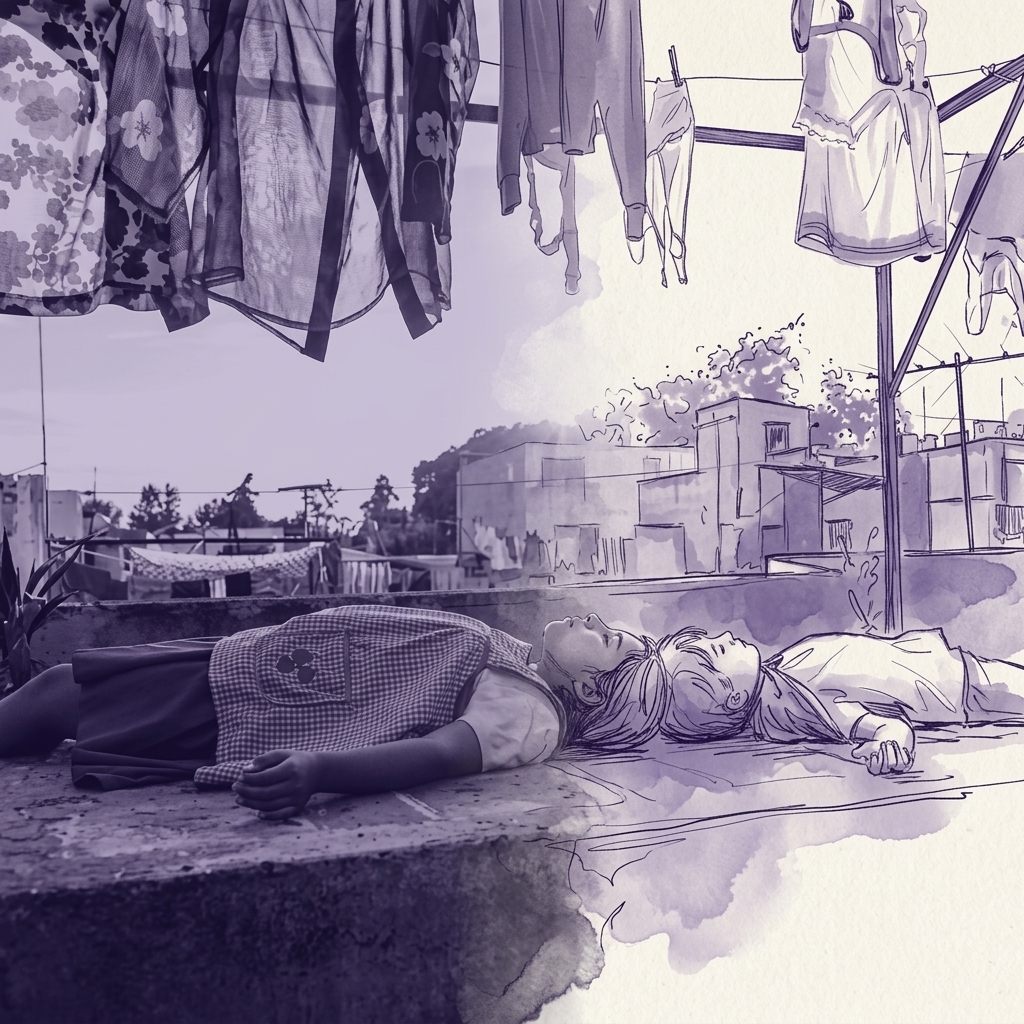
In Roma (2018), directed by Alfonso Cuarón and the recipient of three Academy Awards, fatigue does not appear as a physical symptom of a long and grueling workday. It manifests instead as a tedious life that endlessly reproduces itself in circles, wrapping around the characters and the places they inhabit. The film places us inside an emotional weight; a weight we feel in the sound of footsteps, in the movement of water flooding the tiles to clean them, and in the silence that presses down on the breath of the film’s protagonist, Cleo, played by Yalitza Aparicio. She is the nanny, the housekeeper, the quiet engine driving all of this heaviness. Cuarón does not portray her exhaustion through complaint, or tears, or dialogue, but through the slow accumulation of images. We see her from the very first scene scrubbing the courtyard; an ordinary, daily task. Fatigue here is the architecture of Cleo’s life. She tends the household, wakes the children, washes and cooks and cleans. Cleo does not own her body; it is an instrument in service of others, and this severing of self from action produces an immense spiritual weight visible in her eyes, which carry an ancient sorrow, as though she grew tired of existing before she ever began to live. This weight deepens with the betrayal of the man who left her with a swollen belly, that particular numbness that sets in when a body becomes a vessel for new life while the life inside it is already exhausted.
The heaviness of the child growing inside a body already worn down, the abandonment after the father vanishes, leaving her alone in a cinema to discover on her own that he is gone and that she must face her fate without him; the feeling of being a lesser citizen, someone not entitled to dream of stability or a partner to share a life with. Cuarón employs extremely slow panoramic shots, the camera moving from left to right or right to left with measured, unhurried calm. This cinematic rhythm imposes a temporal weight on the viewer; we do not move quickly from one event to the next but are forced to wait alongside the characters, even in the furniture store scene where student protests erupt outside and what should have been a moment of quiet joy for Cleo twists into something frightening and cruel, the panoramic shot carrying us through that shift from stillness into storm.
The decision to shoot In black and white gave the film an atmosphere of relentless, muted hardship, where even a passing laugh feels like something that will be paid for later. The unhurried camera movements, the extraordinary control over the background performers, the astonishing sound design, all of it built a world so completely real that it placed Cleo, with everything she feels, squarely on the side of life. Her fatigue means nothing to the world around her, and that is precisely what makes us feel it. Cinema pauses at the ordinariness of exhaustion, at the suffering that passes unnoticed around us while time does not stop for it, and insists that it matters.
Cleo’s fatigue reaches its breaking point when she is called upon to save the children from drowning despite not knowing how to swim. In that moment she becomes something beyond a dutiful caretaker; she becomes a true mother, driven not by obligation but by something fiercer, throwing herself into the waves for children who are not even hers. She becomes a mass of pure will against the water. When she pulls them to safety and the family gathers around her with warmth and relief, she loses control and breaks open: “I didn’t want her to be born.” It is the only eruption from a volcano that has been dormant throughout the entire film, the exhaustion of a person ground down by injustice, by poverty, by the endless requirement to be strong. Roma ends with Cleo climbing the iron staircase carrying the laundry basket, returning to her routine. It is the most honest image the film could have chosen for the continuity of exhaustion. And yet, just as the priest in Bresson’s film whispered “Grace is everywhere,” we find in Roma that this very fatigue is what grants Cleo her own kind of sanctity. She is not merely a victim; she is the spine that keeps the world from collapsing. Her heaviness is what gives others their lightness, and her exhaustion is the price paid for life to go on, or so we tell ourselves when we want to give people like her another reason to keep enduring. Yes, it is a sacred fatigue, but it is a sacredness that does nothing for them, that offers no key to salvation, and that stands in direct contrast to the romantic portrait of exhaustion that Handke once painted.
An Elegy for the Unknown
Another fatigue reveals itself in the complete life lived on the margins of the world, the life of a logger, and another dream among the dreams of the earth’s exhausted, in Train Dreams (2025), directed by Clint Bentley, who co-wrote the screenplay with Greg Kwedar, and starring Joel Edgerton, adapted from a 2011 novella of the same name by Denis Johnson. Robert Grainier rides the train with his fellow workers from one region to the next, felling trees and laying railroad tracks, while death stalks them at every turn like the figure of Death in The Seventh Seal, sometimes through the dangers of the work itself, and sometimes through the lawlessness that governs these men, some of whom practice their cruelty and racism on the others. All of this unfolds in the embrace of nature, rendered in a poetic style reminiscent of Terrence Malick’s contemplative gaze at rustling leaves, at the firm roots and swaying branches of trees that seem to resemble human lives, lives that however long they endure are always waiting for the saw or the forest fire to reduce them to ash.
The fatigue here is an entire exhausted life, the life of people on the margins who live and dream small dreams and steal whatever scraps of joy they can, only for those dreams to die quietly in the end even if the dreamers themselves survive. Amid the hardships Robert faces in his work with steadiness and silence, and despite the exhausting thoughts that carry death within them and crowd his mind and shatter his stillness, he finds meaning in a woman he meets, someone through whom life begins to make sense. He marries her, they build their small home together, and they let the harshness of their days pass through the yard of that house. Robert then witnesses the murder of his co-worker, the man who worked beside him felling trees, killed by a group of racists who dispose of him simply because he is Chinese. The United States in the late nineteenth century saw sweeping campaigns of deportation and displacement against Chinese immigrants, most prominently in the 1880s, driven by the Chinese Exclusion Act of 1882. That era was defined by violence and forced departures that drove thousands away, drastically reducing the Chinese population in America through discrimination and racist policy. Robert recalls from his childhood witnessing the arrest of Chinese men without understanding why, and when his colleague is murdered before his eyes, he asks the same question he could never answer as a boy: “What did he do?”
The nightmare of his colleague’s murder never leaves him. This particular exhaustion of the mind does not dissolve easily; it pursues him through his sleep, whispering that the life he has accepted will not simply pass without consequence, that something must happen, that the death claiming his companions one by one will come for him too.
Returning from work one day, he sees the sky thick with smoke from a massive fire. He runs toward the place where he lives only to find it consumed by flames. In an instant, Robert loses his home, his wife, and his daughter. He searches for them for years, clinging to the hope that they are still alive, going through the motions of that exhausted life as though it were an obligation, because the death that he had braced himself to lose everything to had taken the entire table away and left him unable to play at all. He lives what only resembles life in an attempt to accommodate loss, haunted by memories and hallucinations and dreams of his daughter whose return he waits for across years of absence, sometimes believing she has truly come back before she vanishes and the searching begins again. He spends what remains of his days in that deadly waiting, until he finally decides to leave the forest and travel to the city, where he moves through the world like a child encountering life for the first time despite the white that has long since threaded through his hair. He sees the shape of modernity after the wars, a world entirely unlike the one he knew, and he boards a plane for the first time, becoming like a bird looking down from the sky, and with every tilt and turn of it a memory arrives of everything he has been through and everything he has lost, until he is simply alone, exhausted by solitude and estrangement. Robert dies in silence and stillness, and we learn of it through a narrator’s voice that gives us the impression of anonymity, of dying in the shadows, because just as he began his journey with no one, that is exactly how it ends. It is an elegy for those who exhaust themselves through life without the world ever remembering them, who groan in silence and die in silence, in the forgotten edge of the world.
What connects all of these characters is not a particular form of fatigue, nor is it that fatigue manifests as a physical pain that strikes and wears down their bodies. It is fatigue in its most encompassing sense, a fatigue that constructs a general architecture they have never known anything outside of. We might read it at first glance as a second or third layer of drama serving their conflicts or governing the plot, but that structure is a world far larger than the drama itself, a world in which countless people live alongside loneliness and estrangement and the loss of identity and the loss of those they love and the devastation of wars. Fatigue in these films is not an incidental event but the very structure inhabited by those at the base of the world’s hierarchy. Fatigue is not an illness. It is existential pain, disorientation, silence, a slow burning inside the soul, and stories told from the margins.