



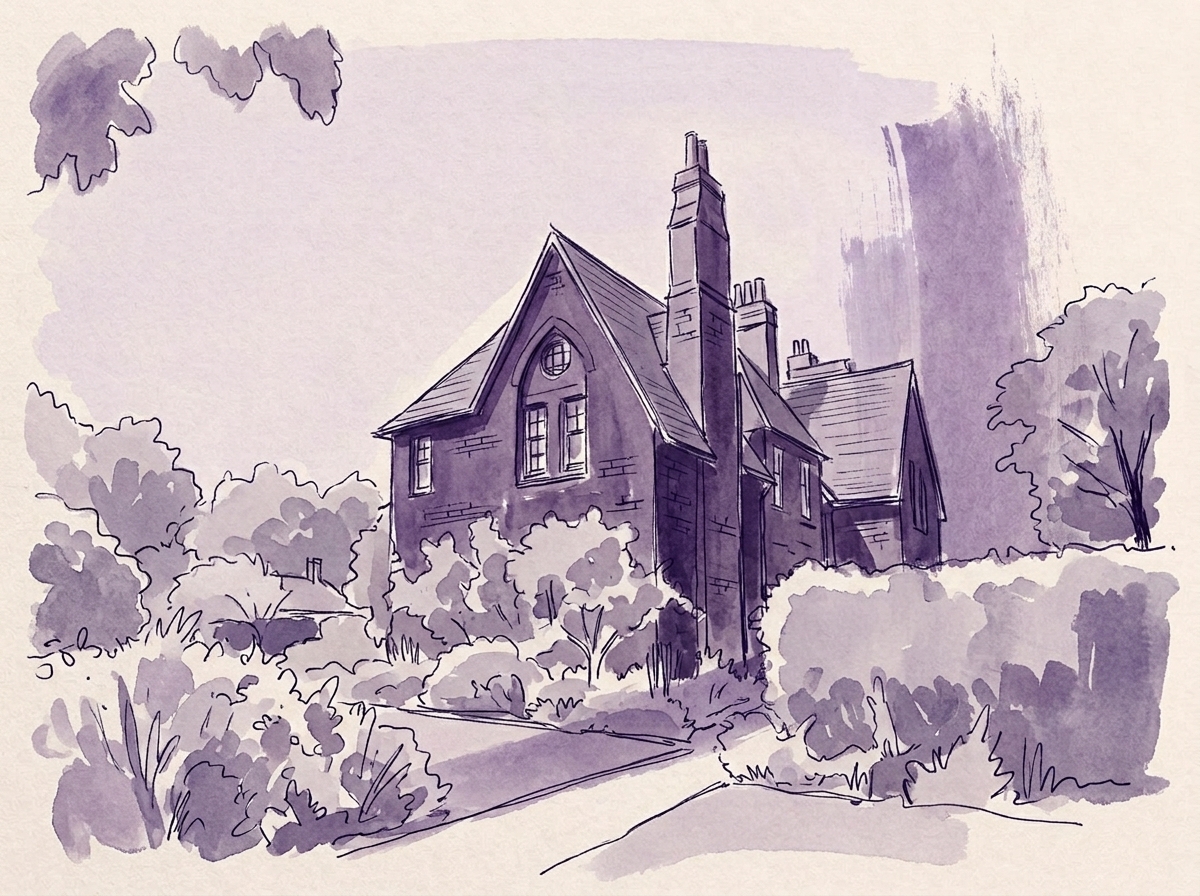



Near the valley of the River Cray in Bexleyheath, once part of Kent, now folded into London , the English poet and designer William Morris, together with the architect Philip Webb, built his famous home in 1860: the Red House. Its very structure carried something of his philosophy of architecture, art, and life. It was a house that opened onto nature rather than turning its back on it, a garden in quiet harmony with the rooms it framed, its ornaments and works of art shaped entirely by human hands, the hands of Morris, his wife Jane, and the artists and craftsmen who worked alongside them.
The Red House won wide admiration in its own time, and its fame only grew after its owner’s death, until it became one of the founding landmarks of the Arts and Crafts movement, a widely recognized emblem of the artistic authenticity to which Morris devoted his life. In a sense, the house was an aesthetic manifesto built of brick, wood, and glass, a place that reached past mere dwelling toward something larger.
In a line quoted by Jan Marsh in her book on Morris and the Red House, Morris writes: “With the arrogance of youth, I set myself to reform the world by beauty. If I have succeeded, in ever so small a way, in one small corner of the world, among the men and women I love, I shall count myself blessed, blessed and blessed, and the work will go on.”
Simple as it is, this line seems a key to something many of us overlook: that transformation in the world often begins in a single small corner, among the people we love and share our lives with, more often than it begins in great cities or great decisions. One small corner, no more, no less. In this narrow space, Morris came to understand that beauty is not a distant dream we wait on power, wealth, or fortune to deliver, but a work that begins where we already stand, and grows only as far as we give it patience and love.
A sincere wish to change the world around us often walks with us, but we soon collide with its vastness and its harshness, and slip into a quiet despair. We drown ourselves in images of other cities: shaded streets, glowing houses, balconies spilling with flowers, tidy cafés, gardens that seem to have arrived whole, without effort. We picture some other place, unlike our own, one that doesn’t reek of ugliness and disorder, another house unlike our own dull one, and we wish we could emigrate to the country of our dreams, where beauty wraps around everything the eye meets and the hand touches. But the deeper question is this: how long will we go on treating beauty in other people’s places as theirs alone, and looking at our own cities and homes as a fixed fate, beyond any hope of revision?
The need for beauty, in its simplest material forms, is a pressing human need, not an excess of ornament, and not a privilege reserved for the well-off. Have you ever noticed how the sight of a balcony filled with flowers in the middle of a bleak, working-class neighborhood lifts us out of ourselves, if only for a moment, and stirs in us the wish to begin something similar? The owner of that balcony knew how to start from his own small corner. So did the young woman in a modest flat with no balcony at all, who set small pots of plants along her windowsill and dressed her room with whatever she could make or choose with love. This is how beauty gives itself, to whoever seeks it, and to whoever begins before every condition has been met.
Many of us make excuses: no courtyard, no balcony, windows without a ledge to hold a pot, not quite enough money for beautiful things, a talent that seems to have deserted us until we no longer know where to start. And yet beauty is content with a small space and a modest cost. It can begin with tidying a corner, rescuing an old chair, planting something, hanging a picture, making a small thing with one’s own hands. The plants and flowers that dress courtyards and balconies are only one of its most radiant forms, among the purest, and among the most capable of breathing life into a place.
Very often our problem is not poverty alone, as we tend to believe; plenty of middle-class homes and neighborhoods go without anything that refreshes the soul among the many forms of beauty, and plenty of the people who live in them have the means to begin but lack the desire, or simply the habit. They see beauty in other people’s countries and other people’s homes, delight in it, dream of it, and then resent the fate that left them in surroundings unlike their dreams. And there, more often than not, the matter ends: in regret.
The sheer volume of watching has made us do less. We stare for long stretches at images of houses, gardens, and cafés on our screens, gathering quick flashes of refreshment whose effect fades almost as soon as it arrives, leaving behind a quiet ache. Over time, our bond with living beauty, the kind we don’t merely see but take part in making grows thin. The mind and the soul need a labor in which the hand finds its own pleasure, an effort that reminds us we are still capable of creating, even within modest limits. A beautiful thing made with our own hands draws us closer to ourselves, clears the haze from the truths we hold dear, and opens our eyes to the possibilities of joy that life still holds.
All that remains is to renew our connection to beauty, and to give ourselves the time to sit with it as something capable of lifting the mood of the soul. Then to watch our own small inclinations, to listen for the passing thought before speed buries it, and let it ripen in our minds until it becomes, day by day, a tangible piece of work we can look upon with pride and invite others to see. And then a rare happiness is born in us: the happiness of creation.
In the mid-nineteenth century, the English art critic John Ruskin turned on the Industrial Revolution and the grave harm it had done to both the environment and society. Factory workers, in his view, were among those most damaged by a world that had reduced the human being to a cog in a machine. Mechanical production, Ruskin believed, had robbed the worker of the pleasure and satisfaction handwork carries within it, and had robbed people, too, of goods with any real aesthetic worth , so that homes filled up with things poorly made and false, lacking the human touch that gives a lifeless object even a trace of soul.
Ruskin was a fierce defender of beauty in all its forms, convinced of its deep hold on the human soul. For him, beauty reached past mere visual pleasure to become a bond between matter and conscience, between labor and dignity, between the human being and the world they inhabit. In this sense, he held that what we make, see, and touch takes part in shaping our morals and our taste, and that constant ugliness wounds the eye and the soul alike.
William Morris was deeply marked by Ruskin’s ideas, and followed in his footsteps: defending beauty against the mute machine, and taking care to make it available to ordinary people. He began with his own dream, turned it into a house, and then expanded it into a whole vision of design, work, and life. His defense of art was bound up with his defense of social justice; he believed a dignified life is completed by bread, and by what lies beyond it , a house that pleases the eye, work that preserves the dignity of the hand, everyday things carrying the mark of the human, rising above the harshness of the factory alone. For this, Morris left a lasting mark on the history of British design, as he did on social and political thought, calling for a world in which a share of beauty and dignity would belong to everyone.
Perhaps it is not within our power to change our dull cities all at once, or to build houses that embody our philosophies the way Morris did. But it is within our power to begin from the small corner we already possess: a window, a table, a shelf, a doorway, a narrow balcony, a modest room. We can give it our effort, listen for the passing thought as it goes by, and stay patient with it until it takes shape, color, scent, and trace. And when we do, we find we have opened a horizon we didn’t know was there, and planted our own seed in the wide field of beauty. It won’t be long before that seed blooms, a joy for us, and for whoever beholds it.
William Morris writes in Hopes and Fears for Art: “History, so called, has remembered the kings and warriors, because they destroyed; art has remembered the people, because they created.” He reminds us that life in past ages was not made up only of massacres and turmoil, as the history books sometimes suggest, for the hammer once struck the anvil, the chisel turned about the oak beam, and a little beauty was born each day, carrying with it a little human happiness.
Perhaps this is the true legacy all of us can share in: to leave, in our own small corner, a trace that says we passed through the world trying to make it a little gentler, a little more radiant, and a little more human.