






Human beings have been distinguished from other species, not only by their rationality and capacity for thought, but precisely by their linguistic faculty— that is, their ability to express their inner lives, thoughts and emotions through words. This has been regarded as the great divine gift to humanity, the granting of the Word.
Reflecting on the infamous myth of the Tower of Babel, it posits that divine punishment was served in the removal of that Word taking the form of a unified language. This led to a diminishing of communication with one another, and consequently, to the complete loss of connection with existence itself.
Turning to theology, we notice in the Qur’an, Surat Al-Baqarah (its second longest chapter) that immediately after the creation of Adam, the Lord gave him the Word. This was an honor bestowed upon Adam, for he thereby acquired what even the angels themselves were denied:
“And He taught Adam the names of all things.”
Only from that moment did Adam attain his existence and his agency.
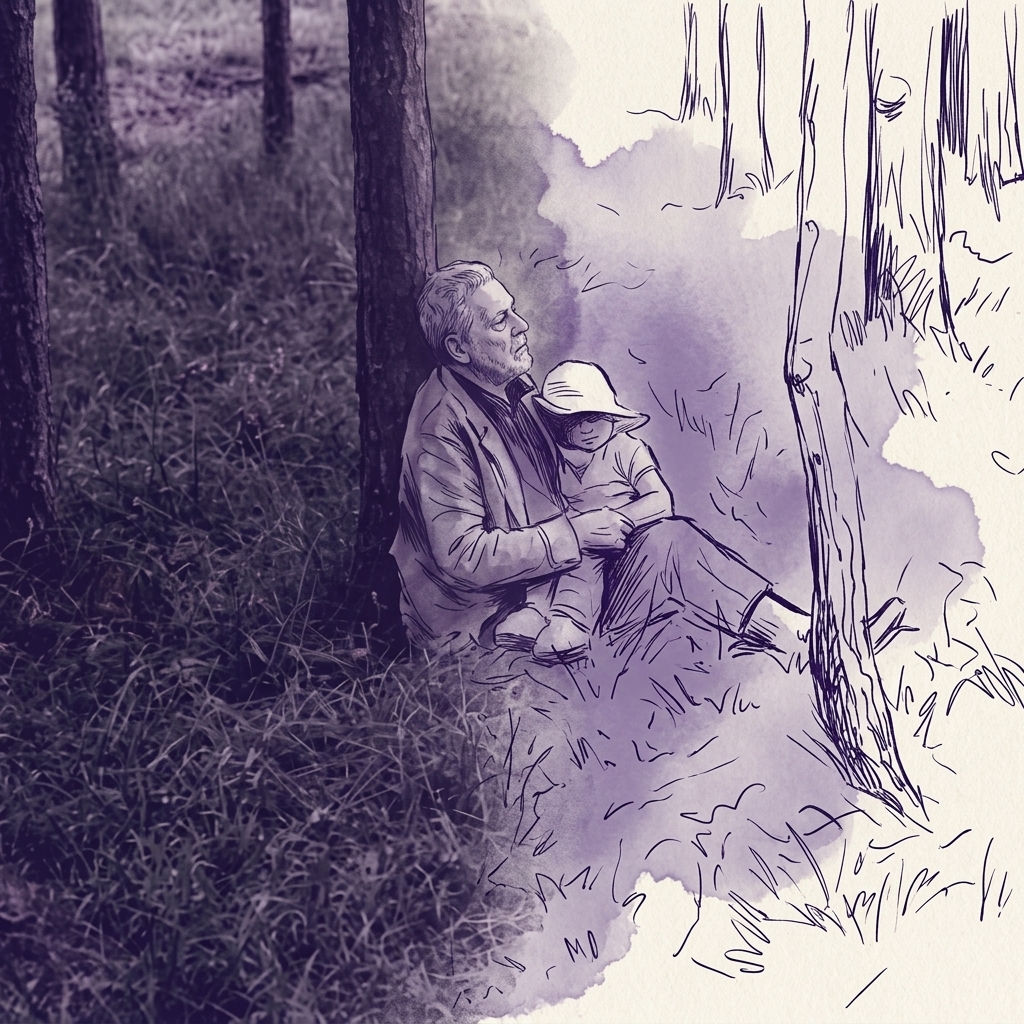
In Andrei Tarkovsky’s final film, The Sacrifice (1986), a small child rests his head against the dry tree that his father believed would one day bear fruit and lush leaves– a belief born of hope in humanity. The last words spoken by the child, and the sentence which concludes Tarkovsky’s filmography, perhaps condensing his philosophy and vision, are:
“In the beginning was the Word. Why, Father?”
The child’s question is delivered as a reproach, not to his father, but to God, as if suffering has accompanied human beings from the very conception of speech. Tarkovsky draws the boy’s inquiry from the Gospel of John:
“In the beginning was the Word, and the Word was with God, and the Word was God.”
The child’s criticism therefore appears as an implicit indignation of the origin stories of the Word. It points to this central problem of the human condition, which Tarkovsky embodies in the film’s protagonist, Alexander, who is mute for the majority of the film. His refrain from speech ends in a failure to communicate with God, driving him inevitably to madness.
Here, the total incapacity of man to communicate manifests directly in the character’s voicelessness, which leads to the loss of connection with existence itself. Thus, silence becomes a literary device, a dramatic climax, representing the inevitability of language’s failure to express the complex inner life of the human being, an unbearable burden which drives him to silence. This emblematic silence serves not as a surrender, but a last attempt to rebel against that divine gift, discarding it, as if inviting God to reclaim it, upon realising it is of no use.
We sense this notion in countless instances throughout the history of cinema, where silence stands in place of communicative incapacity. In various contexts, we see silence as the final state of characters, expressing psychological, social, and even existential rebellion. This tends to proceed numerous attempts at expression, all of which end in failure. At this point, wordlessness emerges as an outlet, expressing both failure and rebellion at once, and man has no recourse but to declare his indignation and refusal through silence.
Existential Resignation Anticipated by Bergman
In his film Winter Light (1963), belonging to a trilogy of many titles including the trilogy of faith, love and silence, Bergman portrays the crisis of Pastor Tomas, who has grown skeptical of his faith, and who appears harsh and sullen from beginning to end. Tomas’s weakness is gradually revealed, culminating in a breakdown before his former lover, and expressing a great vulnerability he holds within.
At the climax of the film, the church sexton, Algot, enters to confess to Pastor Tomas. Algot begins to speak, expressing an urgent question and proceeds to recount the final scene in the story of Christ, hanging on the cross after Peter’s denial, Judas’s betrayal, and the physical torment he endured. Algot shares his anxieties with Tomas, while the pastor sweats, his tension building under the surface. That is until Algot reaches a final conclusion: that Christ’s pain was not externally-inflicted or embodied by torture, but was manifest in the utterance of his final plea to the Lord which went unanswered:
“My God, my God, why hast thou forsaken me?”
Algot arrives at the conclusion that God’s subsequent silence constituted the pinnacle of Christ’s suffering. At that moment, we see Tomas, unable to answer Algot’s question, his entire body visibly weeping sweat.
Tomas retreats into silence as he comes to identify with his wound, a connection he makes only in hearing Algot’s story. Tomas realises, at last, that his inner wound arose from his inability to love others, and that this drove him to existential and religious doubt. It becomes clear that his apparent harshness conceals behind it a deep-seated pain stemming from the character’s lack of genuine human connection. Here, words fail Tomas, and it becomes evident that his prior silence and inability to produce emotional and social solutions was an act of resentment towards a God who does not answer in his times of need. Tomas’s silence thus is a declaration of final surrender, forced into an optionless corner after countless failings to find a way out.
Antonioni’s Night: Sex Emptied of Emotion and a Language That Proved Its Inadequacy
In his film La Notte (1961), part of what became known as the modernist trilogy, Antonioni presents a visually compelling ending. Perhaps the ending Antonioni chose here did not differ greatly from the other endings within the trilogy, or even those of a number of his standalone films, such as Blow-Up, for example.
Silence in La Notte appears as an aesthetic stance, a distance which man places between himself and all things when he is unable to answer or enact a solution. What makes the ending of La Notte so shocking is not the silence alone— which is the case for L’Avventura and L’Eclisse of the same trilogy— but rather its quality.
This quality is captured by the way in which its characters, Giovanni and Lidia, finally have sex. Antonini chooses to express the psychological, emotional and existential emptiness of a modernist era, which reifies the human being, with brutal force.
The final scene begins at dawn, as Giovanni and Lidia walk through a nearly bare garden, an initial reflection of their inner state. When they sit down and exchange confessions, these confessions conclude with silence. Both parties’ abstinence from or inability for speech is an acknowledgment of the wretched state their relationship has reached. It seems instead they are two different people, not the ones they speak of in their dialogue, when their love was at its height.
Here, silence acts not only as a personal expression of the emptiness of Giovanni and Lidia’s relationship, but also of a general existential vacuity that characterized the Post-World War II era, a time which saw man turn away from meaning and toward the mechanical. Language therefore proves its inadequacy. Giovanni and Lidia are unable to communicate, and this linguistic incapacity leads, in turn, to a severing of connection from what is emotional, human, natural, spontaneous, and so the characters merge with what is mechanical. The mechanical here is equated with silence. Following this, the couple begin to engage in intercourse, void of intimacy, stripped of emotion, expressing a final act of incapacity, even in this non-verbal mode, and for which language is powerless to resolve.
Chantal Akerman and the Silence Before the Storm
The characters of Belgian filmmaker, Chantal Akerman, have always tended toward silence. They serve as a refuge that her female characters take when they are unable to communicate with society and the other; a particular brand of isolation and authentic alienation that recurs as an attribute of her characters. In her film Jeanne Dielman (1975), it becomes clear that the silence of Akerman’s characters is not in weakness or defeat, but it conceals behind it a great internal violence, the explosion of which, when it comes, is impossible to anticipate.
Chantal portrays in her film the extremely monotonous daily life of a housewife, Jeanne, who cares for her son in the complete absence of the father. We see Jeanne move through her life like a cog in a machine, stripped of feeling. No emotion is visible in Jeanne, no words, except a few in the presence of her son whom she raises and tends to. It is in these instances it becomes clear that Jeanne’s humanity arises only within the bounds of what is human, what belongs to her and is hers. Otherwise, Jeanne’s behavior and the rhythm of her life appear closer to a pre-assembled, pre-programmed robot assigned to perform specific tasks from which it does not deviate. This parallel explains the deadly and circular routine of Jeanne that we see replayed throughout the film more than once.
Jeanne earns money through sex work. We see her hosting men in her home and sleeping with them with complete mechanical detachment, just as she performs every other duty in her life. We notice little to no change in Jeanne throughout the film, hints perceptible in some of her minor and subtle reactions. This is perhaps a stylistic choice on behalf of the director, given Jeanne’s lack of transformation is not uncommon in modernist and auteur cinema, which subvert the standard conventions of film narratives in terms of character development, plot and so on.
This could explain the film’s unusual but not unexpected ending: Jeanne’s killing of one of her male clients during their sexual encounter. At first glance, there may seem to be no direct cause for what Jeanne does, but upon reflection it becomes clear that this is precisely what Chantal intends. Her character does not belong to the cinema of causality, that is, the traditional three-act film, and secondly, this moment defines nothing but a continuous internal accumulation. Jeanne’s inclination to violence which is left unattributed to any visible reaction for the most part of the film does not necessarily negate its existence, for Chantal forms this atmosphere by other means. The protagonist’s final explosion therefore is natural to the film’s logic, a suppressed internal violence that has been continuously escalating, finally reaching a point where it can no longer be contained.
Jeanne’s silence throughout the film is not incapacity so much as it reflects a deep awareness on her part of the inability of language to produce a solution. And here, we find that even after Jeanne has made manifest her feelings and murdered her client, she says nothing. Silence is all that can feasibly follow. But this time, the silence which lingers does not feel like one of awareness, but an extreme state of rebellion, proving nothing but a new incapacity of language to express anything at all.