



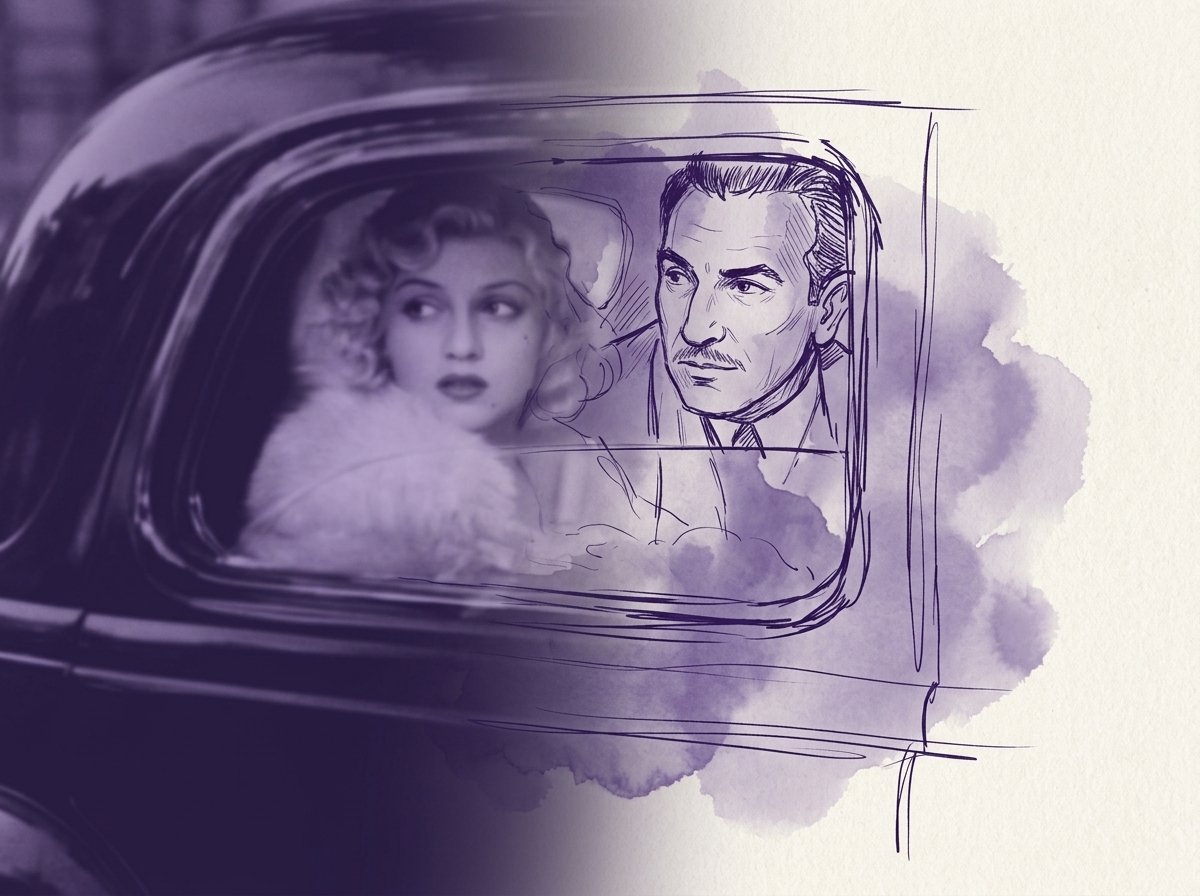


“But he was my father.”
In the film’s opening seconds, before a single word or sound, a mirror appears in a sparse, blurred room, reflecting nothing. As if someone had passed a hand across it and wiped out whatever it once held, whether deliberately or through sheer neglect; in the end, there is no difference between the two. Then Corinne’s face emerges slowly from the dark, not as a dramatic entrance but as something barely surviving its own disappearance, a face that is pale and sick and worn, as though the body itself carries a memory it has no desire to recall, as though time did not pass over it but passed through it, leaving the marks of its passage clearly on every feature. This mirror is not décor, not a visual ornament furnishing the scene. It is the film’s entire question compressed into a single shot: who are we when our image is erased? And who erased it? Is it the great sweep of history that asks no one’s permission before it passes through? The father we loved more than we loved the truth? Or ourselves, when we chose not to see, not to ask, not to know more than we found comfortable to know? And is there any real difference, in the end, between these three answers, or do they each describe the same thing from different angles?
Les Rayons et les Ombres is a French film directed by Xavier Giannoli in 2026, and it tells a true story with all the weight that phrase carries, and all the responsibility it demands toward history, the living, and the dead alike. Jean Luchaire was a left-wing journalist, a believer in European peace, carrying what seemed like a genuine humanist project of reconciliation between France and Germany, following a war that had exhausted the continent, emptied its cities, and taught Europeans that civilization is not armor but glass, and glass shatters. Within just a few years, through many small decisions that seemed at the time like nothing more than necessary practical concessions, this same man became one of the most prominent faces of collaboration with the Nazi occupation in France, until he was arrested and executed in 1946. Beside him throughout all of this was his daughter Corinne, a young actress promised stardom, who walked in his shadow because he was all the light she had, and fell with him because shadows give no warning before they disappear. But Giannoli does not see this story the way cinema has grown accustomed to seeing war narratives, from the perspective of the victims, who unquestionably deserve every voice given to them. Instead, he does something harder, more unsettling, and bolder: he walks us into the house where the betrayal was committed. He makes us live it from the inside, sit in their chairs, drink from their glasses, and see history through their eyes before our minds catch up to what our hands are doing. And this is the greatest thing art can do: not hand you answers, but make you feel the weight of the questions and carry that weight yourself.
Jean Luchaire is not constructed in the film as a villain, but as someone comprehensible, and this is the real problem the film places on the table, without offering the comfort of a ready answer. He starts from somewhere that seems reasonable: a belief in peace, a desire for stability, a conviction that war can be contained, negotiated with, or at least delayed. But with each small step he rearranges that conviction, softens it, bargains it away, not all at once, but gradually, until the line between what he believes and what he does becomes invisible, because he no longer wants to see it. He wanted to protect the newspaper he had built, the friendship of a lifetime with Otto, the name he had spent years establishing, and the comfortable life his daughter had come to live alongside him. And at every step toward the abyss, he told himself: this is the last concession. Because dialogue, once it begins, becomes arrangements; arrangements become concessions; concessions accumulate until they become a complicity from which there is no return. And at every link in that chain, everything seemed logical and justified from within. This is precisely what makes history repeat itself, not because human beings are evil by nature, but because they convince themselves each time that their moment is exceptional, that their circumstances justify what cannot be justified, that those who came before them didn’t know what they know, until they discover, too late, that they had been walking the same road as those they’d never stopped cursing.
When Hannah Arendt witnessed the Eichmann trial, she noticed something difficult to digest: that great evil does not require a person of great evil. She described what she saw as the “banality of evil,” not in the sense that evil is trivial, or that its consequences are minor, but in the sense that it does not require someone exceptional in their cruelty. It does not require a fanatical hater or a monster who delights in what it does. An ordinary person who executes without thinking, obeys without questioning, withdraws from personal responsibility in the name of collective obligation, that is enough. The idea is that the most criminal acts in history were not necessarily committed by tormented minds or exceptionally dark souls. They were committed, most often, by people who had simply switched off their capacity to ask, to verify, to stand before what they were doing and ask: is this right? Jean Luchaire is not Eichmann, he is not an executioner who kills with his own hands. But he belongs to the same species of human beings who make great things possible: through their silence, their withdrawal, their talent for finding justification for what their conscience refuses by night, while they go right on doing it by day.
Cowardice does not look like cowardice when you are living it from the inside. It looks, sometimes, like wisdom. Like pragmatism. Like concern for those you love. And this, precisely, is what makes it so deeply dangerous. Aristotle saw courage as a virtue and cowardice as a vice, but he also knew that virtues are not born in a person, they are acquired through practice, through environment, through the models set before them in their early years. Someone who grew up in the shadow of fear, of small calculations, of models of appeasement and silence in the face of discomfort, how can that person suddenly be expected, in some defining moment, to summon a courage that would break their entire life apart? This question is not a defense of cowardice but an attempt to understand how it is produced, because whoever does not understand how a vice is manufactured cannot protect themselves from it. And yet the price paid by others because of that cowardice remains a truth that cannot be erased: if courage is acquired through practice, who bears responsibility for its absence? The difference between telling people to be brave and actually training them in bravery is the difference between a funeral eulogy and a living civilization.
And the matter does not stop with the coward alone, because cowardice, when it emanates from someone who holds power and shapes the cultural space of those who look up to them, becomes a model taught through practice rather than words. When the owner of a newspaper, or a public voice, or an influential platform decides to withdraw from moral judgment and chooses instead silence, or justification, or beautification, they are not making a private decision. They are teaching, without saying a word, that silence is possible, that absence is acceptable, that compromise is ordinary. And that silent teaching becomes a culture that seeps into the social fabric until it can no longer be seen, because it has become the standard. Cowardice costs not only the person who practices it, it bequeaths a model, learned by those who come after and reproduced in contexts that may look nothing like the original on the surface but draw from the same logic in their depths.
And at the heart of all of this stands Corinne, not as a secondary character, but as a body that carries the consequence, a life that formed itself inside a shadow she did not choose and could not find her way out of. The father, in any person’s life, is more than a person: he is the first system through which you learn whether the world is safe or terrifying, the name you carry before you choose one for yourself, the social standing you walk into rooms with before you’ve proven anything on your own, the first frame through which everything that comes afterward is seen. And what most disturbs in this film, what stays with you for days after leaving the theater, is the genuine, unstaged paternal love that inhabits every scene between Jean and Corinne: visible in the way he looks at her, and in the way she believes him when he speaks and the rest of the room falls quiet. He loves her, truly. She loves him, truly. And it is this love itself, not hatred, not obvious criminal ambition, that made everything possible. Love, when it becomes the only truth governing choice, can turn into a blindness that is not necessarily cold or harsh, but a warm blindness that makes you feel safe while quietly steering you toward what you do not want to see.
The film does not indict love as though it were the soft face of evil. Rather it shows how the most noble of feelings can be put to use, not through deception, but through excess of care, through the desire to preserve what is beautiful, through the hope that things will fix themselves if you simply keep standing beside those you love. And yet there is a witness who accepts neither this hope nor this illusion: tuberculosis. The disease that inhabits both Corinne and her father at the same time, leaving their two bodies to quietly corrode. It reveals what the mind keeps avoiding, and refuses to defer the truth until after the war ends, or after recovery comes, or after any other promise of tomorrow. Both of them live only as much as the present moment allows and postpone every other question, and the body alone does not postpone. Corinne walks in her father’s shadow because that shadow enables her to live in the only way she has ever been taught to live. And when the shadow grows too heavy, she does not know how to leave it, because leaving means standing alone in a world where she has no name without him. Even when she attempts rebellion, the rebellion itself orbits him, draws its center of gravity from him, even in the moment of refusal. Because the person who spends their life resisting their father is not, in any essential way, different from the person who spends it imitating him. Both make the father the point from which they depart and to which they return. Both are trapped inside the same circle.
Neither has yet found their own free path. And in a scene that captures all of this complexity with an aching precision, Corinne says to the woman who sheltered her after people chased her through the streets and spat in her face: He was my father, he was my father, you have to understand! This sentence is not a defense of a crime or a justification of it. It is an acknowledgment that genuine love is not annulled by error or wrongdoing, however great. That when history passes judgment on a person, it cannot simultaneously pass judgment on everything that person meant to those who loved him. And this is the wound in the film that never closes: the wound of having the person who committed the crime also be the person who taught you to walk, who stood at the door waiting for you when you were late, who believed in you when no one else did. How do you hold all of this in a single sentence? How do you love and condemn at the same time?
The film does not punish her for this love, but leaves us carrying it as an open question, and it knows that anyone who searches for a clear answer, or for any resolution to this question, has not yet understood it. Corinne was not entirely ignorant of what was happening. But she knew only as much as allowed life to continue, and this is a particular and complex kind of ignorance that cannot be equated with stupidity, nor easily excused under the cover of innocence. It is the ignorance that possesses the information but chooses not to open the door it leads to, that chooses to keep the door shut because what lies behind it would change everything, and changing everything means rebuilding yourself from the foundations, and that is among the hardest things a soul can bear. Perhaps Corinne knew this about herself from the very beginning, from the moment she cried out in the 1938 film Prison sans barreaux: I am innocent, innocent, innocent! The cry of a girl performing a role in a fictional story that had nothing to do with what was coming. But Giannoli returns to this line later, when Corinne repeats it in her room, over and over, not as an actress performing a part, but as a woman trying to convince herself before she can convince anyone else. Acting and living blur into each other until no separation is possible. Was she playing a role her entire life, or was her life itself the role? At the film’s end, on the rubble of everything, Corinne sits across from Leonid Moguy, the Ukrainian Jewish director who gave her her first major role in that same 1938 film, back when the world was still wide and she was still a promising actress rather than a defendant’s daughter. He had no obligation to sit across from her after everything that had happened. But he does. They speak, and at some point she says she did not know, and he asks her, quietly, with a gentleness that doesn’t quite conceal its edge: Did you try to know? She looks toward the window and says nothing. In that silence, in that look, falls the film’s most painful moment, because neither accusation nor absolution happens there. Only a door is opened, one that had been shut for a long time. And a door, when opened in this way, cannot be closed again. Then he changes the subject, offers her the chance to work with him again, and closes the scene with something like a final article of faith: only cinema endures. What makes all of this denser still is who is sitting across from her: a man whose people were among those harmed by what her father made possible, offering her another chance. This is not forgiveness, forgiveness is simpler than this. It is a choice to go on living, with all its complications, and a belief that art can hold what history is unable to contain.
Even joy in this film is suspect. The scenes of Dionysian parties held at the very heart of the occupation, where the champagne flows and the music is loud and the bodies dance as if the world outside the palace had stopped or perhaps never existed at all, are not depicted as pleasure but as a psychological question left suspended in the air: were these people actually enjoying themselves, or was the exaggerated celebration the only method they knew for silencing something inside them that understood what was happening and wanted to stop knowing it? A person cannot feel genuinely deep pleasure unless they feel genuinely safe, and safety built on the fear of others is, in truth, an anxiety wearing elegant clothing and laughing louder than any joke warrants. Celebration at the heart of catastrophe is one face of denial, a manufactured intensification of joy to silence the interior voice that knows and that accuses, an organized noise against a silence that grows more insistent the harder you try to drown it in music. This is why, when the party ends and people walk out into the darkened street, a total silence fills them, a private emptiness that nothing fills. These celebrations also function as a mechanism of collective complicity: when you attend, and applaud, and drink alongside everyone else, you become a participant in the system regardless of everything you believe privately. And this is the intelligence of power in every era: it does not ask you to believe. It asks only that you be present.
From the parties to the newspaper, the image, the word, the same argument extends, because the instrument changes but the logic stays the same.
Jean begins with hope, not with lies, and this is what makes his fall more convincing and more painful, because hope, when severed from reality, becomes a persuasion tool that works precisely because its tone is sincere. Culture is not innocent. This is the film’s most disturbing truth, and the truth we most resist facing, because facing it demands a responsibility we would rather not carry. We want to believe that books and films and music stand outside politics, protected by their aesthetic purity, but the narrative built in the name of peace and hope can become fuel for a machine its author knows nothing about. And this is the most dangerous form that manipulation of public opinion has ever taken: not the lie that can be disproven, but the incomplete truth that appears whole. Whoever owns the image owns some portion of truth, or at least owns the narrative that will persist long after the context that produced it has been forgotten. And the visual narrative operates through mechanisms deeper than critical consciousness; aesthetic form shapes the viewer’s awareness before explicit content ever does.
Giannoli constructs his film with a precise and intentional visual beauty, filming the parties in golden, velvety light, dressing degradation in fine clothes, making the viewer relish what they see, before they realize they are relishing an image of the abyss, not an escape from it. He places the viewer in exactly the position Corinne occupied: before a genuine beauty surrounding something ugly that cannot be clearly seen from the inside. Cinema here does not condemn from above, in a superior voice, but makes you taste the sin from within before showing you its cost from without. And it raises, in doing so, a question with no comfortable answer: Are we witnessing, or are we being seduced? Does the camera reveal or entice? Can beauty itself become a form of complicity when it renders what should be refused comfortable to watch? Cinema holds a rare power to give voice back to the voiceless, to help us understand what we had refused to understand. But this power can reverse direction and work instead to rewrite memory, to beautify what deserves no beautification, to legitimize those who hold its tools. In this sense, cinema is not a neutral angel but a mirror held by whoever happens to be holding it. And the question of who holds the mirror is, at its root, a political question.
After the battles end and the cannons fall silent, a redistribution of voices takes place, announced by no one, yet operating with a quiet and affecting precision. The victims are given speech: their stories are written down and taught to generations, monuments and museums and vast archives are built for them to ensure that what was done to them is never forgotten, and their voices become part of the collective memory of nations, part of the identity on which politics and education are built. This is a legitimate and necessary right, and it must never be diminished. But on the other side, the wrongdoers and their children and their grandchildren are sentenced to something different: silence, or a voice that speaks perpetually in the only language available to it, the language of ongoing apology; a name that becomes a stigma preceding you into rooms before you enter; a silence heavier than speech, carried by those who were never consulted and who had not yet been born when what happened came to pass.
Corinne died at twenty-eight, sentenced to ten years of national degradation, barred from the art that had been her entire life. Her daughter was born in the midst of the scandal and carried the tainted name before she could understand what words meant. The second generation carries the weight of what it did not commit in forms that are more concealed and longer-lasting: in the first look that precedes any introduction, in the questions asked before you’re permitted to speak, in the constant feeling that belonging requires justifications that others, those who didn’t come from that name, are never asked to provide. Tragedy does not end with the death of the guilty. It is inherited by generations who were not consulted, who never sat at the table where the decisions were made. And the revenge the film depicts, in the scenes of women having their heads shaved, of people being chased through streets, is not justice in any deep sense of the word. It is one more layer of violence added on top of the previous layers, without erasing any of them: it satisfies a human rage that is understandable, but does not return a single dead person to life, and it burdens people who had no part in the decision and never held the option to refuse. History does not close when the guilty are punished. It stays open and returns in layers that sometimes appear far removed from their original source but carry its root within them. In this film, evil rarely arrives by clear and announced decision, and when it does arrive, it is wrapped in enough conviction and nobility to appear, on the surface, to be something else entirely. This is precisely what makes it more unsettling than any work that presents evil exposed and the villain legible, because evil wearing a familiar face, speaking the language of dreams and protection, cannot be refused with the ease we imagine when we are safely distant from it. Otto Abetz genuinely loved France, its literature, its art, its way of life, and his friendship with Jean grew from a real sharing of values, from a shared dream of a Europe that would never repeat the stupidity of wars. But Otto arrived, at some point, at a place where he could see and know, and chose to go on anyway, not necessarily out of love for evil, but out of a faith in the idea leading him there that ran deeper than his faith in what his conscience was telling him. Jean slid, and his tragedy lies in that sliding. Otto chose, in the name of something larger than himself, and this kind of choice grants its holder not the comfort of a clear conscience, but something more dangerous: certainty that he is right.
Grand ideology can absorb love and nobility and good intentions and return them as instruments, because it offers a person what they most want to hear about themselves: that they serve a cause larger than their own existence, that they are protecting something worth protecting. And when a person convinces themselves of this, their individual conscience goes on an extended leave of absence, because the collective has taken over its function. When nationalism transforms into a closed doctrine that dissolves the individual into the whole and makes the conscience operate in the name of the group rather than its own, it opens before that person a vast space for doing what they knew, in their depths, to be wrong, and they remain at peace, because responsibility is distributed among everyone and no one carries it alone. The question both men avoid remains: is this right? A simple question. But its answer would have changed everything, and that is precisely why it goes unasked.
Both men, Jean and Otto, arrived in the end at the same place by two different roads: sliding does not exempt from responsibility, and ideological choice does not bestow innocence. As for the friendship between them, that friendship which began in a sharing of dreams and values and ended in a separation never formally declared, yet realized slowly across years of diverging choices, it raises a question with no comfortable answer: do shared human values hold when they collide with the weight of political commitments and an ideology that grows until it fills everything? The film answers in a way that hurts: mostly they do not hold, because the context grows larger than anything personal, and the two men end up on banks they did not choose with a single clear decision. Rather, many small decisions accumulated until return was no longer possible, and they no longer spoke the same language when they spoke of the values that had once brought them together. And when the film reaches the courtroom scene, the prosecutor’s voice filling the chamber, the words of villains arm the hands of fools, all of these trajectories suddenly become visible in a single instant: the father who slid, the friend who chose, the daughter who carried what she did not commit, and words that once left a sincere conviction and ended as fuel for a machine that had nothing to do with the dream from which everything began.
At the film’s end, the camera returns to the same room, the same mirror. The smear that blurs the reflection is still there. But this time we know where it came from. It was not a stain on the glass, not anyone’s neglect. It was all the things he chose to be blind to, and all the questions he preferred not to raise at the moment when raising them was still possible, when a word still had a cost that could not be paid later. This film does not condemn cheaply, nor forgive at a discount. It does something harder, something more respectful of human complexity: it shows how a person becomes what they never expected to become, how a dream turns into justification, a friendship into cover, love into a comfortable prison; how children carry the weight of what they did not do, because history does not ask whom you choose to be born to or for. And it leaves us, in the end, with a question that refuses a quick answer: what would we have chosen, if we had been there, in that room, in that time, with that father and that friendship and that fear which always seems, at first, smaller than it actually is?
“Every man on earth has two faces. Good and evil. To blame everyone is to understand nothing.” Victor Hugo, Les Rayons et les Ombres, 1840.
Hugo wrote this a hundred years before the war, as though he wrote it with his eyes fixed on this very mirror. Cinema at its finest is not a court pronouncing verdicts or a pulpit delivering sermons. It is a mirror of a particular kind, one that does not content itself with reflecting what stands before it, but reflects what is inside you: what you have not yet admitted to yourself, what you know and prefer not to know. And this film is a heavy mirror, and an exhausting one, and a necessary one. It cannot be looked into in haste.