



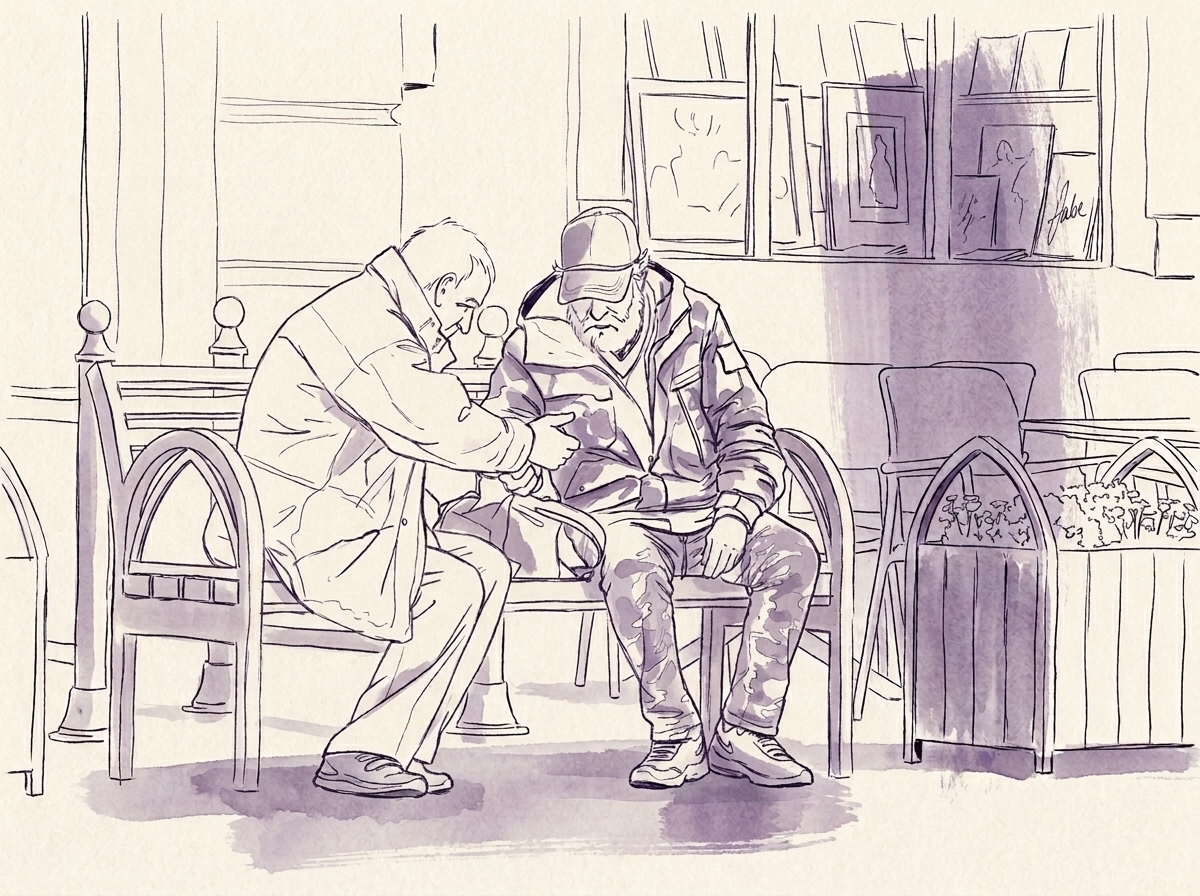



On a train, two strangers meet, and as the journey unfolds, fates shift and destinies intertwine to give us a blazing love story. At a bar table, two strangers clink glasses and trade enemies, plotting a perfect murder together. In cinema, we can believe anything when the screenplay is airtight, the actors are genuinely felt, and a conscious director holds the reins. But what of reality? In our lives we encounter millions of strangers; can events unfold the way they do in films, now that our reality has grown more complex and more absurd in the way it moves? Can our souls open up to a stranger, confiding by chance a secret of ours, a pain that wrings us, stubborn wishes? Or joke and exchange banter, agree to share a cup of coffee, listen together to a song that travels, or settle for a brief walk. Situations like these are simple and intimate, the kind that usually happen with friends; Can we imagine them happening with a stranger we meet for the first time?
Personally, I have lived coincidences of this kind, most of them in public transport. It happened that a delicious fruit like a peach was tossed to me as a gentle greeting from one traveller to another on a train. I received marriage proposals from strangers who swore to the sincerity of their intentions. A woman’s hand patted my shoulder softly when she glimpsed my tears, without uttering a single word. I got to know a girl whose name I no longer remember and decided to be late for work so I could help her find a pair of shoes. That day she borrowed me as a friend; we did not just buy the shoes, we went to a small restaurant and devoured two plates of koshari. We wandered around the city afterwards on a fresh autumn day, and I said goodbye to her at the end of the outing without our exchanging numbers.
In the famous trilogy “Before Sunrise, Before Sunset, and Before Midnight”, the two protagonists meet on a train crossing the cities of Europe; eyes meet, conversations flow, and with the rocking of the train, their feelings vibrate and draw close. Choosing the train as the opening stage of events is not arbitrary: the feeling of being a stranger liberates the one who experiences it, making them lighter, more open, more eager for everything new and unknown. The train’s departure triggers an unleashing of emotions, and stories follow one another like the cities passing before them as they travel inside their own memories.
Jesse “Ethan Hawke” tells of a day when his sister decided to teach him how to make a rainbow using a garden hose pointed toward the sun. Jesse did it, and the spectre of his deceased grandmother appeared to him within the coloured arc, smiling at him as he looked at her, until the hose fell and the rainbow vanished along with his grandmother’s ghost. His parents insisted that what he had seen was mere fantasy, for the dead do not appear to the living. He did not argue with them, but kept the story in his memory as a truth that admitted no doubt.
Céline “Julie Delpy” tells of going to a psychiatrist after her boyfriend broke up with her; he was an alcoholic and poor in bed.
She had stayed with him out of pity, until he left her, throwing her into obsession. She would bring out her thoughts with her therapist and spoke of a story she had written in which the heroine kills her lover; the therapist wanted to report it to the police and treated the story as a real desire that needed to be resisted.
Many stories of this kind were exchanged between Céline and Jesse without any fear of the other’s judgement. Memory is full of stories, and the act of selecting them is never spontaneous; it targets the other’s admiration. Here, each party wanted to be themselves, to narrate what touches their soul and occupies their mind, not what they would labour to recall in detail and describe so as to appear perfect. No competition or pressure to gain professional advantages, no social ties requiring elegance in dress or speech. They were not ashamed that their stories revealed how naive or mad a person can be, because this is, in principle, the first and the last meeting.
In another Egyptian film, “Very Hard Mission”, the director chose the bar as the meeting place of the two strangers, making drunkenness a means of liberation from constraints, and rounds of drinks the fuel for continuing to speak about the misery of their lives and their resentments, about each one’s hatred for a specific enemy who stands as an obstacle to a happier, more peaceful life. Ahmed “Farouk El Fishawi” hates his mother’s husband because he was once his friend, and Wahid “Salah Elsaadany” is at war with his wife, whose death would allow him to take hold of her money.
with drunkenness, a person loses command of themselves; the barriers they impose on their behaviour break down, emotions are freed, and anger emerges like a beast its owner failed to tame, while the lover is stripped bare, their tears flowing, and the softness of their vulnerability laid plain. With drunkenness, secrets and obscure, repressed desires are exposed.
The Egyptian film draws its idea from an American film, “Strangers on a Train”, directed by Hitchcock; there too the train was the meeting place of the two strangers. The director showed the curves of the rails and the winding, interlocking lines of the railway tracks at the start of events, as a sign of the change in trajectories and fates that the strangers’ encounter would bring, and he likewise drew on drunkenness to let the dialogue flow freely. In cinema, the passing stranger can become a lover and spouse or an accomplice in murder.
The first instalment of the trilogy embodied a reality the author himself had lived: a single encounter that happened and an appointment for another that never came. This is where cinema plays its hand: in bringing these events to the screen, the director did not wish to stop at the parting, and so created two more instalments in which the two heroes appear as a couple in the final film.
In “Very Hard Mission”, drunkenness leads one of the two to conceive, with a gleaming mix of madness and lucidity, the idea of an exchange of murders between their respective enemies; no one would think to link the crime to its perpetrator, since they have no motive and no prior knowledge of the victim. The writer wanted to exploit a recurring event like drunkenness and the emotional outpouring that follows it to create a different and compelling crime film.
Cinema here seeks to answer the question that has always bewildered the human being, the question of “What if…?”throughout their journey; a person wonders about their fate, about the paths they have avoided versus the one they took, by choice or by surrender.
“If”, of which the proverb says it opens the devil’s door, is a question cinema excels at answering by flinging doors wide open, so that we enter with it into those parallel worlds alongside our own lives.
It was with this logic that Jesse convinced Céline to get off the train and spend a night together in the streets of Vienna; he asked her to travel in time to the future and imagine herself married and bored, perhaps remembering him then as a lost chance. But spending a night with him would confirm that she had lost nothing, because he, as a husband, is “boring,” he says teasingly to persuade her.
A large part of our love for cinema stems from our capacity to identify with the heroes, to imagine ourselves in their place, and to allow ourselves to enjoy reactions that are freer and more reckless without risking the loss of what we have or the confrontation of a frightening unknown.
The same pleasure is found in literature: in Stefan Zweig’s novella “Twenty-Four Hours in the Life of a Woman”, a fleeting encounter with a stranger draws the protagonist,” Mrs C”, into an adventure that changed her view of herself and nearly led her to abandon her stable life and her children. The gambling salon was the meeting place, with a young stranger addicted to gambling. Within a few hours she was able to observe on him a variety of emotions and states, from joy to sorrow, from passion to despair. Following all those changes in the same person drew her toward him, especially since he was unable to conceal his emotions the way the habitués of that place excelled at doing for the sake of the game. She believed she knew his inner world well and followed him out of the salon to begin her adventure with him.
The choice of the gambling salon was Zweig’s means of depicting varied and intense emotional states overtaking the protagonist under the influence of drunkenness, which made him entirely lose his self-control.
More than twenty years later, the protagonist encountered another stranger, whom she appointed as a priest to receive her confession of what she had done and to lift the burden of that memory, since her Christian community, she says, does not believe in the system of ecclesiastical confession.
Zweig wanted to demonstrate how a fleeting encounter in which we are exposed to temptation can cost us our lives, and reveal to us how fragile and prone to ruin they are. It reveals our souls and their astonishing capacity to embark on adventures and sacrifice everything in a single night. It leads us to question our true identity: is it what we have known of ourselves throughout our lives, or what we discover in the company of a passing stranger?
We now turn to reality, questioning a number of writers, researchers, and freelancers about coincidences that occurred, situations with strangers, and their outcomes in everyday life.
“Bilal Abdallah”, a political researcher, recalls his encounter with a homeless woman at Ramses railway station who had made the train carriages her home. Bilal explains: “Nothing suggested she was homeless except for the fraying bag she carried containing her belongings; other than that she resembled our mothers, a simple and comfortable appearance that suggested nothing suspicious.” He continues: “I don’t know how the conversation started and flowed, but it became the longest passing exchange I have ever had with a stranger. She was new to the life of homelessness; she had spent most of her life in Jordan with her husband, and after his death she wished to live whatever remained of her life in Egypt. Back in her hometown, she could not bear living under the dominance of her brother’s wife, who had seized the family apartment; so she was forced, under the weight of many provocations, to leave the house, and ended up spending her days in train carriages without begging, which had earned her the leniency of the ticket inspectors who had grown accustomed to her presence without a ticket.” Bilal adds: “Behind this dramatic arc were dozens of stories she told me about her life with her husband, her childhood, and her life of hardship after her return. What astonished me was her firm refusal to tell me her name; she held to this with a strange insistence, as though she were clinging to the ephemeral nature of the conversation and to the identity of each of us to the other as a stranger”.
“Mohammed Mustafa”, a dates merchant, recounts that a customer asked him one day during Ramadan for a place where she could drink secretly; he took her to a storeroom belonging to his business and lit a cigarette there himself. Over a glass of water and a cigarette, she told him of her family problems, her difficulties with her late husband’s family, and the pressure from her own family. Mohammed did not ask for her name and never crossed paths with her again, but she came to his mind many times; he says he would have liked to know she was alright.
“Alaa Fouda”, an Egyptian poet and pharmacist, had the habit in her secondary school and university years of taking public transport and striking up conversations with strangers. She says: “ I would study faces carefully, and the moment I sensed kindness in one of them I would begin talking.” She would confide family and academic troubles she did not wish to voice openly to those close to her. Other times Alaa was the listener rather than the speaker, and she affirms: “I too know how to listen.”
One of those encounters took place in a ladies’ restroom at a shopping centre, where she met a girl adjusting her makeup. The girl asked her if she found her beautiful; she was with her fiancé and had recently learned that a married neighbour of his was flirting with him, which had made her doubt herself. Alaa tried to .dispel the girl’s doubts and bolster her self-confidence.
Alaa herself had, at a period in her life, doubted herself because of weight gain, having tried many times to lose it without success; she once asked a passer-by: “Do you think I’m overweight?”
Alaa explains her recourse to strangers and conversations with them rather than with those close to her by saying she does not wish to amplify her problems or draw attention to something she prefers to move beyond; informing those near to her might deepen the problem and bring it into sharper focus.
“Mohammed Mustafa”, meanwhile, does not initiate conversations with strangers, describing himself as a reserved person. Bilal Abdallah agrees with him on this, explaining that he refrains from speaking of his personal problems to those close to him, since no one else can solve them and there is therefore no point alarming them. He also finds that talking about his problems rather than ignoring them, even with strangers, increases his sorrow and his sense of helplessness.
In most of the stories, the stranger plays, in one of its guises, the role of psychiatrist or priest; the individual needs them to ease the weight of pain and bewilderment through speech, without monetary compensation, with ease and assurance, because it is the first and the last meeting that rule precisely, the rule of a single encounter, is what distinguishes reality from fiction. In reality, the passer-by insists on remaining a stranger with no name and no address, so that the story itself remains the protagonist. No one here retains any names, even if they were mentioned during the encounter, but the stories have endured in the memory of the strangers.
One also turns to the stranger because in many stories those close to us are parties to the problem or already aware of it, so that confiding in a stranger becomes easier: no objections or differing explanations to contend with while one flows freely through one’s own version of events. One sends out stories like love letters preserved in bottles cast into the open sea, with no hope that the waves will carry them ashore or that the stranger will keep them in memory.
Most encounters do not constitute a reciprocal dialogue as they do in cinema; in these situations there is always a speaker and another who listens with attention, drawing the speaker into further telling. For the desire to narrate, once it takes hold of a person, does not necessarily entice the other to speak; it is enough for the one speaking that there is someone to listen to .them with gentle and noble warmth, without judgement.
In reality too we find a diversity of places serving as meeting points for strangers, from public transport to a shopping centre restroom and through to markets. Whereas in cinema or literature the scene of the encounter is carefully prepared so that the setting contributes to the opening of dialogue and so that the audience believes in the possibility of such an intimate exchange with a stranger: a train crossing cities where the desire to pass the time propels the conversation forward, or a bar where the glass of drink is the fuel of dialogue, or a gambling salon where the stakes can change people’s destinies. Meanwhile, in reality, no one knows the secret that makes words suddenly pour from one stranger to another.
Perhaps it is the promise of happiness and calm that the stranger hopes to find by speaking with the other; several recent studies indeed recommend talking to strangers. One of them, cited in” Psychologies magazine”, is research conducted by Nicholas Epley and Juliana Schroeder of the University of Chicago in 2014, comprising nine separate experiments; they asked passengers to participate in one of three situations: engaging in conversation with a stranger on the train, sitting in isolation, or behaving as they usually do, such as looking at their phones or similar activities. It was found that the group that had conversed with a stranger was the happiest and most positive. The magazine and the researchers therefore recommend that people talk to strangers to broaden their world and look outside it from time to time, for dialogue generally brings a positive sense of happiness and satisfaction to both parties.
Poetry too, in its own way, attempts to capture the secret of words suddenly spilling between two strangers.
My tear that dampened the stranger’s hand without meaning to, My wandering gaze caught on the top button of his shirt just below the Adam’s apple, My little secret as it crept to his ear, My slip that he closed his eyes upon, My fall that his arm prevented,My blood that stained his shirt, My dream as it brushed his shoulder when I opened my eyes and it flew away, The biscuit pieces we shared to silence the hunger, His humming as it tilted my body, That tenderness which slowly opens the doors of madness.
Perhaps because the cause is too delicate, we cannot grasp it; but there remains a magic in sharing something with a stranger: a piece of fruit, a cigarette, a story, or a secret. This is what restores .our faith in humanity when we place our trust in the stranger.