





The world has its own way of refining and shaping us according to what it deems suitable for public space, and it uses our most personal feelings as a faithful guard that steers what we sense toward danger or toward the green line. Shame was one of the most effective weapons in protecting the dominant social order; it slips in like an unwelcome guest after a passing word, a lingering look, or a small spontaneous gesture we make only to suddenly discover it is “out of bounds.” And like any small child, the soul shrinks inside the body whenever it draws near that forbidden zone, putting on a new mask each time it strays a little from its truth and edges a little closer to shame.
I knew shame through the emotions that formed under critical gazes, even before that word held any clear meaning inside my small dictionary. Phrases like: “You move like a worm,” “Sit down… shame on you,” “What are you, a street girl, dancing like that?”, “Shame, don’t look at so-and-so that way,” “Stop eating,” “Weren’t you raised right? Act like a well-brought-up girl.” There was always a language surrounding my body; a language of warning and fear, telling me that when my body tilted a certain way it became a threat, that it carried a sexual connotation that opened a door to temptation, that when it craved something it turned into a source of anxiety, and that when it ate too much or too little it failed to be desirable enough or worth noticing. And as a little girl, I loved movement, and I loved even more that my body have a space of freedom through which to express itself, as if my earliest desires were tied in their essence to freedom, and to the certainty that my body was sacred and that no one but me had the right to determine what it wanted.
In the journey of discovering the different emotions my body was going through, the space never felt enough, and my room was the only place that could hold me. I would shut the bedroom door quickly, set the large headscarf aside, then prop my phone in front of me and play a Rihanna song; I would put on my cap, pull on the shorts, and gather my hair back, proud of that short style and my green shirt. I would disconnect completely from everything around me, perfectly at ease with the locked door. My room… that sacred space where I found myself far from all the fear that shackled my soul. I never understood the reason behind my intense desire to shed every constraint, and I could not bear the idea of not acting exactly as I pleased and loved. The most charged moment of the whole day was when I decided to step out looking like that in front of my mother’s friends, and then watched the disgust sweep across their faces and my mother’s anger speak faster than her tongue.
What I learned in the first years of rebellion was that escape from this reality lay first and foremost in finishing my higher education; because that way I would secure work and independence and nothing would stand in my way. Later, I tried to be more balanced than before, and I exercised a new kind of suppression on myself; I let my hair grow long, stopped dyeing it the colors I loved, and spent more time in spaces I had no desire to be in, until silence began to creep toward me and I retreated into muteness during the debates that stirred my irritation and anger, yet despite all of that, I kept closing my bedroom door until the very last day. On the deck of the felucca, the shimmer of the Nile opening onto Cairo’s people called out with a poetry that, despite its repetition, felt as though it were happening for the very first time; the rhythms of the dancing music seeped into every pore of my body, as if I had suddenly become an open musical space, the notes inseparable from me, and I barely separable from them.
Everything in that vast expanse of songs spoke to me, and to the swaying curve of my body. I danced more, the music clung closer, I danced more still, and I thought of the words that would ripen after this sweet moment, traveling to the deepest reaches of the soul, finally emerging in a comprehensible form.
How had this body, saturated with every mark of shame, transformed into this swaying note, so exquisitely sensitive to sound? How had embarrassment and fear left my skin; that skin which had fed on terror, and which now cared nothing about whether I danced well or not? You who gaze upon this vast space, do you even know what anguish I had passed through before now? “She’s a disaster”; that was what I always heard whenever the slightest part of my body moved. And as my mother had told me: there is a modest dance and another that bears no relation to morality whatsoever, there is an acceptable desire and another that is forbidden and admits no negotiation, therefore the attempt must be severed at its root.
The woman who knows her own worth does not dance, she marries young, does not consort with men, does not arouse instincts, does not invoke sin. What if I became a dancer? Would I be more outcast than I already am? What if I desired both men and women without preference? Would that be a reason for God’s anger? How did my pure body become something expressed as a crime?
And how did “the disaster” attach itself to this mass that God had blessed from above seven heavens, with everything it carries of thoughts and feelings and dreams and ambitions and challenges and a strange magic that takes shape in a singular way?
How could there be a bridge in the middle for me, blending my world with the outside world, so that this existence might at least become bearable, no longer a constant source of irritation? The world around me taught me only two colors; black and white. Neutrality is rejected, and the blending of new colors is equally unacceptable. What I mean by colors here is nothing but a metaphor for the ideas, actions, temperaments, and individual orientations tied to our vast human experiences.
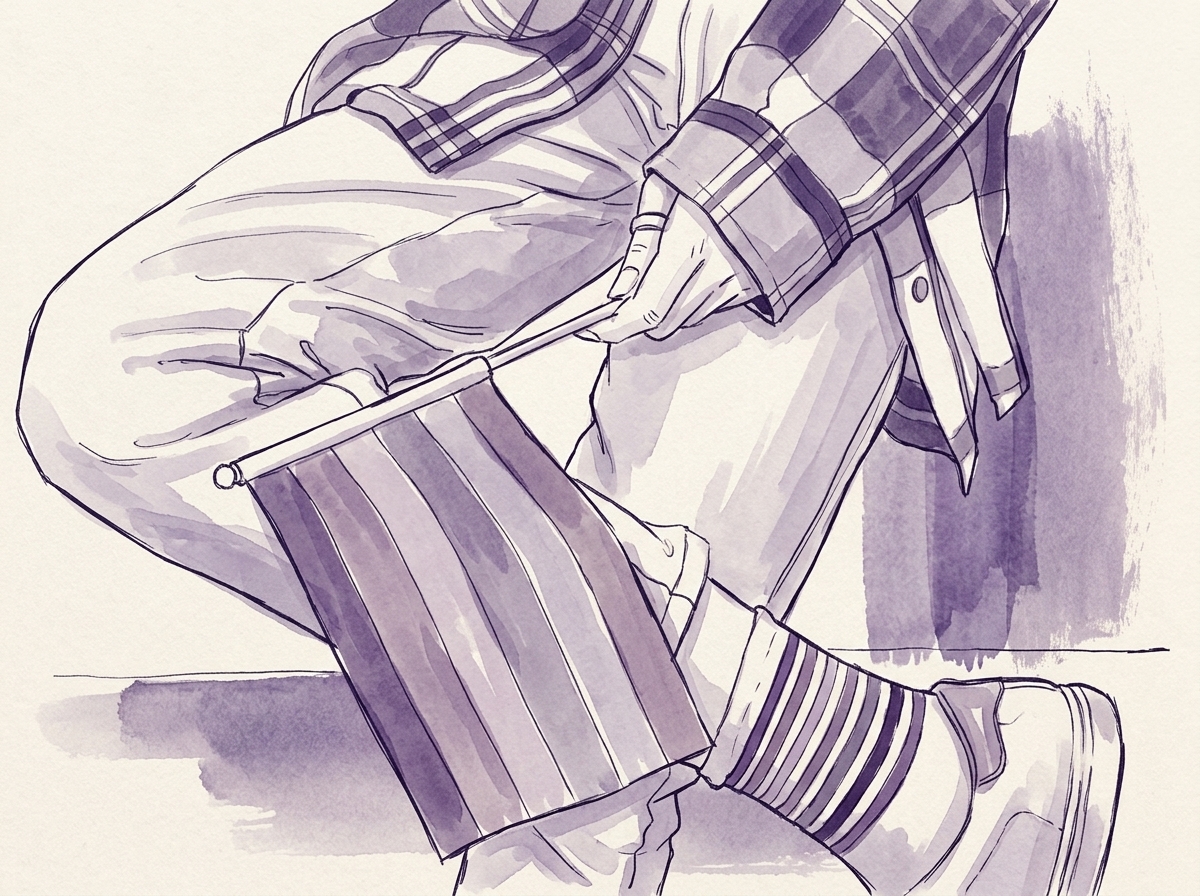
When the world is logical in a binary certainty carrying only two shades — black and white — my own neutral color comes into being in the middle, as if I were a unicorn among chickens. I found myself in a world that accepts love in a particular way, and freedom in an even more defined and abbreviated way, leaving me resembling a colorful monster bearing the colors of a spectrum whose nature I did not know. And how could I know those colors when I was color-blind, living in a society that expected me to marry a man and only a man, never a woman?
But I did not possess enough language to know what I felt, nor where it came from, nor what community I belonged to. Those first days of my colored world were intensely lonely, to the degree that I believed I was the only one afflicted with this flaw in all of Somalia. And because I had not yet known other homelands, I assumed that what was acceptable in my country was the only thing permitted to exist on the surface of the planet; the same binary view, The same two colors: black and white, as if the composition of my mind were made of this logic alone. Is a desire truly a deep desire at its root if I did not know its name? And does my acknowledgment of its existence mean it becomes visible to the world around me? A world that rejects that desire entirely, does not deny its existence, yet considers me a monster for the mere fact of feeling it, or asks me to rein it in so that I may win the divine gift that qualifies me to be among the blessed kind of humans; those who have struggled long enough to find their salvation from their base desires.
I had known, from an early age, that my existence was fragile and unimportant, and that my homosexuality had deepened my nihilistic experience to bring it to its outermost limits, which had pushed me to try to convince myself of the bisexuality of my inclinations, so that I might have at least some relative existence in a world that granted me worth only through my relationships with men. My inner desires, which had begun to surface during the middle-school years, formed for me later a burden too heavy to bear. I could not tell the difference between loving a boy or a girl; when I had developed a crush on one of the girls in the seventh grade of primary school, I wrote her a colorful letter; each line in a different color with the golden pen that left glimmers wherever it touched, I sprinkled my perfume on the paper and folded it evenly, then wrote at the end: “would you be my friend?”
I sweated with anxiety all day, and stood behind her in the long queue unable to hand her the letter. Finally, it slipped from my hands and fell to the ground, and the troublemaking boys grabbed it and pinned it to the classroom wall with chewing gum. They read every line out loud while I was dying of shame, but I was grateful not to have written my name on that letter. I was far too ashamed over a simple request for friendship, and felt exposed because someone had read those words, and I could never bring myself to tell anyone that the letter was mine, and I never expressed my anger; I felt like though I were committing some crime that I could not confess.
At first I lacked the ability to distinguish friendship from love, and I thought it was a natural feeling; and by natural I mean that I loved whoever, and that this would be acceptable and ordinary in the outside world without my being subjected to exclusion or criminalization. And though the society around me was built solely on relationships between men and women, I did not initially go deep into the possibility of what I was thinking happening, or even into the reasonableness of what I was feeling.
Those years were empty of knowledge and identity, and even of definitions. I was entirely bare of all terms, labels, research, and even books and love stories. The internet did not exist to help me search and read, and the television was not permitted in our house; so all I had were the Indian films I would watch in my room after the household had gone to sleep, under a blanket that gave me intense heat, just so the light would not seep through the crack in the door of the neighboring room where my mother slept; the first and most important censor in my life. And despite the poetry of the Indian songs in every film, I would imagine that slender girl dancing for me instead of the male lead, and as I drifted with the songs, I would imagine everyone I had ever been taken by, and especially that girl who was in the twelfth grade.
The very same girl to whom I had written the letter, and after months from the first failed attempt, I finally decided to give her another letter. I waited two years for her to reply, only to learn later that she had gotten married, which disturbed me deeply. I did not go to school for days, and I could not bring myself to go to their house because I was friends with her sister. It never once crossed my mind why I was charged with all these enormous feelings of sadness, why I had waited all this time for her to reply to my innocent letter, and why I had not been able to ask her directly: “Will you be my friend?”
In 2011, I traveled from the city of Galkayo to the Somali capital Mogadishu, after completing the institute where I had studied in place of secondary school, an institution that was like a convent of nuns in the Islamic tradition. My reward for finishing religious education was to travel and integrate further into devout society, and to enter a world that had been made for me even before I existed in it. There I heard about homosexuality for the first time, when the Somali parliament voted on the rights of homosexuals and rejected them, and a discussion unfolded before me about rights and religious beliefs regarding this act, but I did not know how to respond, only that I felt I neither rejected nor hated what I was hearing, and though the term was new, it felt deeply familiar.
Homosexuality in Somalia was considered a crime worse than murder; families might forgive a killer, but not a homosexual, and relatives or society had the right to kill anyone accused of this act or to harm and injure them publicly. And this violent thinking was not condemned but was enveloped in the blessing of society almost entirely. Arab society was no different from Somali society, but the difference here lies in the fact that Somali society entirely conceals this vast existence and denies the presence of all spectrums, which had long prevented me from imagining the very possibility of its existence. There was no kind of secret community during my upbringing, or at least not in that small city where I lived, cut off from the outside world. And with my family’s prohibition of television, I was connected to the outside world only through the novels of Naguib Mahfouz, Agatha Christie, and Radwa Ashour, and the poems of Tamim Al-Barghouti and Mahmoud Darwich.
After the internet came, I connected with many women in Saudi Arabia, Syria, the United Arab Emirates, Egypt, and even Jordan and Libya. It was fascinating to learn of their experiences one after another, as we exchanged stories, art, and suffering through secret and public forums. They were not merely long-distance relationships, but rather resembled a real family communicating in its way, helping one another to grow. And some of those friendships have persisted in my life for nearly a decade and a half.
In the beginning we tried to write novels expressing our way of loving, and we got excited waiting for the next installments with impatient longing. We tried to connect in large groups where our friendships expanded gradually over time, and it was not limited to writing alone; we exchanged phone numbers, wept together, followed the details of each other’s lives, spoke about the future, and our hearts were eased knowing the course of each woman’s life. And despite the difficulty of the experience, it was motivating and hopeful to see the Saudi girl find herself and choose to embrace her truth in a reality that prohibited her and denied her even the right to drive a car, and to see her Yemeni friend, who had perhaps been subjected to forced marriage at a young age, recognize her right to choose a life that resembled her, and to see them also help the friend who had traveled while fleeing her family in Jordan only to find herself in the Emirates. All the differences dissolved despite themselves because the experience was one, and the censorship that permitted ugliness but would not tolerate any woman who desired freedom for herself and for her body was not capable of ending our stories.
I remember the laughter of my mother’s neighbors as they described to her one of the neighbors who lived with her female friend; I was eight years old, and I did not know why they laughed, but my mother told me that the neighbor was a “lesbian” who lived with her friend, that they wore the same clothes and drank coffee together, and that instead of marrying and building a family, as my mother put it, she gave up everything for this shameful act! The laughter as a reaction was not all there was to the matter, for it was deeper than that; because what I discovered and absorbed later was not a passing moment. Ten years later, in Somalia, a painful story occurred; one of them learned that her son was gay, and she brought him back from America to Somalia to hand him herself to the Islamic militias, where he lost his life in that atrocious way.
Later I understood the depth of difficulty in the queer experience within a world where the religious character prevails, and that it is not an easy or passing experience. And it is strange and astonishing that a novel like (Banat El Basha by Noura Nagi) survived the censor’s scissors, and that a complete film was even made from it about ten women working in a women’s salon, one of whom is a lesbian. I have not yet seen the film, but while reading the novel it was remarkable to me that these stories survived, and that I witnessed other experiences far from my own, which gave me a sense of the legitimacy of my existence in this universe. Both the film and the novel possess a strange ability not to exclude this character, who, despite her reality, is ordinarily condemned by the neutrality of reality to marginalisation, as if she does not exist or is blurry and impossible to see. And it seems that cinema, literature, and poetry have never been empty of the recognition of colorful spectrums and the affirmation of their existence in a world that refuses to acknowledge ours, that tends toward stereotyping, and relies on the censor to suppress personal desires or to feign their suppression.
Ten years ago, I heard for the first time the song “Sharhazade” by the singer Thérèse Suleiman, and an unexpected wonder came over me; because I had never encountered Arabic words describing the emotional epic I felt when I thought of kissing one of them. Thérèse sang, and I swayed to the melodies, my wired earphones in my ears, my phone tucked inside the waistband of my pajama pants. She sang: “Tami aa tamma, shou ba’i… ghayrou annou el douniya tebatti’ harkataha wal dawaraan… kissas bi ayouniha teshoudni, takhtazil omri l’li faat. Chata chata chata.” The summer in my room turned to winter as I thought of the girl I was taken by, and the summer came back blazing. Me and the song, the house asleep, everyone silent, we survived the gray world, and the rainbow swept us away to another world that we knew and that expressed us honestly, pulling us from the margin if only for a moment.
All the labels that place us in the shadow watch, and keep watching, but the desire to live life with all its forbidden things is still real, tender and fresh. What the songs that escaped censorship, the books, and the freely available translated films have added to my life resembles what the writer Carol P. Christ mentioned in her book Diving Deep and Surfacing: “When a woman puts her experience into words, another woman who has been silent for fear of what others would think can find in her words validation and support. And when another woman says aloud: yes, that was my experience too, the first woman loses some of her fear.”
The desires that reached me despite the tight censorship, despite the story stitched for me and the high walls I was surrounded by, rearranged reality to resemble what I wanted. And yet shame has remained present, never vanishing but lightening, and I strive hard to break it with each new experience.
And this is what is happening now on this beautiful boat; my body sways, dances, and redraws its map inside the song. It holds the waist of that beautiful woman, draws closer, forgets the prying eyes, and goes on reveling in a space whose freedom is incomplete, but which belongs to me alone. In the middle of judgments falling one after another upon this body that has not yet reached thirty, I cover this body, I explore it, I adorn it as I wish, I summon around it all the souls, and I trace the steps of grandmothers I never knew were leaving a path that would find its way to me.