



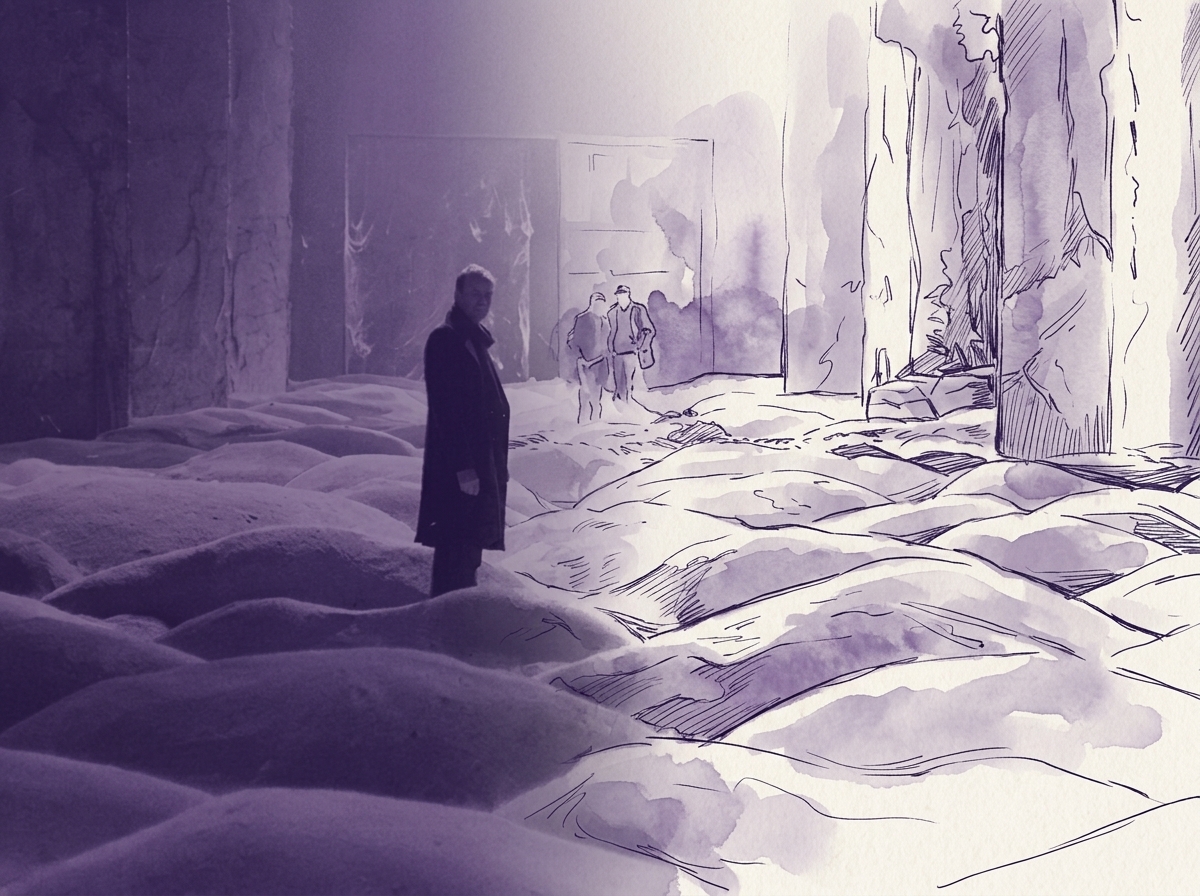



The first time I encountered a film by Tarkovsky, I was a university student studying audiovisual arts. At the time, I made no claim to having understood it. I was a rebellious young man, with little patience for spending days in libraries poring over the books and critical essays devoted to interpreting his films. Tarkovsky’s cinema was slow, while my own life moved at an entirely different pace; I had not yet acquired the inner stillness required to enter the depths of his world.
Now, having reached midlife, I decided to embark on this cinematic journey anew. Over the course of a single week, I watched all seven of Tarkovsky’s films in chronological order. It proved to be one of the most profound artistic experiences of my life. I came to feel that these films had forged a singular bond between Tarkovsky and me, as though he were a friend addressing me directly through his work.
In sharing this experience, my aim is to introduce Tarkovsky to those who may be unfamiliar with his cinema, as well as to those who have encountered only one of his films. I hope to encourage others to immerse themselves in his extraordinary cinematic universe,a body of work that continues, decades later, to inspire and shape filmmakers and viewers across the world.
The Maker of Eternal Questions
In a cinematic landscape increasingly dominated by the spectacle of manufactured action, superhuman heroes, and prefabricated narratives, the work of Russian filmmaker Andrei Tarkovsky (1932–1986) appears almost as an artifact from another world. His films are not intended for casual viewing; rather, they constitute immersive existential experiences, visual rites that bring the viewer into direct confrontation with fundamental questions: Who are we? What constitutes the essence of our humanity? How might we continue to perceive beauty and the sacred in a world perpetually poised on the brink of collapse?
Tarkovsky was not merely a filmmaker, but a poet-philosopher: an ascetic burdened by the sacred weight of existence and a sculptor who fashioned light and shadow from the raw material of time itself. His cinema speaks in a radically different language,one that is not primarily narrative, but spiritual and poetic. It is a cinema devoted to the search for traces of the divine concealed within the folds of the ordinary, the tangible, and the seemingly mundane material world.
A Different Cinematic Language: Poetry Rather Than Prose
What distinguishes Tarkovsky from many of his predecessors and contemporaries is his uncompromising rejection of cinema as merely an instrument of representation, imitation, or commercial entertainment. He regarded cinema as an autonomous art form, whose essential nature he famously described through the concept of “sculpting in time.” The idea extends far beyond cinematic technique to articulate an entire philosophical vision: each shot contains a block of lived time that the filmmaker may shape and sculpt without stripping it of its vital essence.
From this principle, Tarkovsky developed a singular poetic and visual language in which images are not merely symbols or metaphors to be intellectually deciphered by the viewer,as in Sergei Eisenstein’s theory of intellectual montage, which Tarkovsky sharply criticized,but living, autonomous presences, apprehended intuitively by the soul before they are comprehended by the intellect.
Across his films, from Ivan’s Childhood (1962) to The Sacrifice (1986), natural elements,heavy rain, blazing fire, still or flowing water, dense fog, and mud—become far more than decorative details or atmospheric effects. They emerge as tangible manifestations of the characters’ psychological and spiritual states, poetic bridges connecting the visible and material world to the invisible realms of emotion, memory, and the soul.
The quintessential Tarkovskian shot is a field of spiritual energy in which everything, even the silent and apparently inert, seems to pulse with life and mystery. As the French filmmaker Robert Bresson wrote, “To translate the invisible wind through the water it stirs”,this is precisely what Tarkovsky achieves. He renders the invisible perceptible through the traces it leaves upon the visible. For Tarkovsky, the soul is the absolute concealed within matter.
Exploring the Unknown: The Miracle as a Conscious Choice Rather Than an Exceptional Event
Tarkovsky’s spirituality extends beyond conventional religious ritual and explicit doctrinal assertion. At its core lies a profound existential faith in the “miracle”,not in the traditional theological sense of a suspension of natural law, but in the deeper sense of an epiphany: the sudden manifestation of the sacred within the familiar. For Tarkovsky, the miraculous is invisible yet omnipresent; it becomes perceptible only when we choose to look with the eye of the heart, moving beyond the constraints of logic, habit, and ordinary perception.
This idea is embodied in his persistent attention to minute movements within the seemingly static frame. His camera observes the rippling of water, the rustling of leaves, grass bending in the wind, and dust suspended in a shaft of light filtering through a broken window. Even in his quietest and most motionless compositions—as in the sequences set within the Zone in Stalker (1979),time and the natural world never cease to move, breathe, and pulse.
This is more than an aesthetic choice; it constitutes a philosophical proposition. The material world is merely a thin surface concealing beneath it a vast realm of mystery, time, and spirit. The task of art is to pierce that surface, however briefly, and allow us a fleeting glimpse into the depths beyond it.
Death and Eternity: Ordinary Objects as Mementos and Doorways to the Infinite
Tarkovsky approaches everyday objects,a stained teacup, an ordinary comb, an old mirror, a black horse,not as inert things or mere components of the cinematic frame, but as small apertures onto the infinite. They do not function as symbols in the conventional sense, since a symbol tends to direct interpretation toward a particular meaning. Rather, they operate metonymically: the fragment evokes a greater whole, and the finite gestures toward the infinite.
In Solaris (1972), the image of a teacup suspended in the air, or an object left beneath falling rain, becomes a kind of cinematic still life charged with nostalgia, memory, and grief. In Nostalghia (1983), the comb and the Bible in Domenico’s hands become material points of contact between his fractured reality and the sacred order for which he longs. In The Sacrifice (1986), mirrors, glass, and the stereo stand as silent witnesses to the protagonist’s existential crisis while simultaneously participating in the possibility of spiritual transformation.
These objects also function as memento mori, reminders of mortality that confront us with the fragility of the body and the transience of material existence. Yet, paradoxically, it is at precisely this point that they gesture toward continuity and the possibility of spiritual permanence. Tarkovsky employs the finite material object to evoke the infinite,eternity, memory, and the soul,transforming ordinary things into small material thresholds through which, for a fleeting instant, we may glimpse the mysteries of the cosmos.
Montage: Sculpting Time Rather Than Cutting It, and the Resistance to “Ready-Made Thought”
Tarkovsky’s organic and spiritual conception of cinema extends to montage itself, which, in his view, must remain faithful to time rather than seek to dominate it. He forcefully rejects the logic of “intellectual montage,” whereby a predetermined idea is constructed through the deliberate juxtaposition of images and imposed upon the viewer as an interpretive framework. In the Eisensteinian model, as Tarkovsky understood and criticized it, images risk becoming units within an intellectual syntax,letters in a conceptual sentence composed by the director and presented to the viewer for decipherment.
For Tarkovsky, such an approach threatens to become a form of artistic coercion, insofar as it limits the viewer’s freedom to experience, perceive, and arrive at meaning independently. In its place, he proposes his celebrated conception of cinema as “sculpting in time.” Each shot contains a living duration, saturated with its own emotional and temporal density. The task of montage is not simply to assemble fragments, but to bring these distinct temporal pressures into relation with sensitivity and precision, allowing them to form a living, organic structure governed by an internal rhythm of its own.
This rhythm, at its most profound, approaches the rhythms of life and human consciousness themselves. The purpose is neither to manipulate the viewer nor to prescribe an emotional response, but to establish a temporal flow within which the viewer may participate freely in the cinematic experience: to feel the weight of time and its passage, and to discover meaning through inhabiting the film rather than merely observing it.
The Individual’s Responsibility in an Age of Meaninglessness: Spirituality as an Act of Resistance
In an age shaped by globalization, digitization, and relentless consumption, an age in which individuality is increasingly threatened by homogenizing collective and populist ideologies, and in which religion may at times be reduced to empty ritual or instrumentalized through discourses of hatred, Tarkovsky’s vision acquires a striking and almost prophetic relevance. His spirituality does not constitute an escape from the world or a retreat into private interiority. Rather, it demands a profound and radical form of individual responsibility toward life and the world.
His persistent search for the “complete human being”, the individual who recovers an inner dignity, recognizes an intrinsic human worth, and struggles to transcend narcissism and selfishness—is, at its core, both an ethical and implicitly political project. His films may be understood as extended meditations on the difficulty of this journey. Andrei Rublev (1966) explores the possibility of faith and artistic creation amid cruelty and barbarism. Solaris (1972) confronts us with guilt, memory, and the ghosts that inhabit the inner self. Stalker (1979) and The Sacrifice (1986), perhaps the culminating expressions of Tarkovsky’s spiritual cinema, transform the search for a room said to grant one’s deepest desire, and the sacrifice of everything in the hope of saving the world, into meditations on the nature of faith itself.
In Tarkovsky’s universe, faith reveals itself through acts that are at once radically simple and almost impossibly difficult. One thinks of Domenico in Nostalghia (1983), whose seemingly irrational acts are sustained by an uncompromising conviction in the possibility of spiritual redemption, or of Alexander in The Sacrifice, who burns his home and embraces silence in the belief that sacrifice might avert catastrophe. Such gestures do not emerge from doctrinal certainty. They represent a faith closer to a leap into the unknown: a refusal to surrender before nothingness, and an insistence on the possibility of meaning in the face of a world that continually threatens to render meaning impossible.
It is, ultimately, a cinema of hope that refuses to die, a faith grounded not in certainty, but in endurance.
Tarkovsky and the Arab World
One of the more intriguing paradoxes surrounding Tarkovsky’s reception is that his films, despite their deep roots in Russian Orthodox Christianity, have found a profound resonance among many viewers in the Arab world. This affinity cannot be attributed solely to the visual beauty of his cinema; it may also be traced to certain spiritual and existential concerns that transcend their immediate religious and cultural origins.
Within the Orthodox Christian tradition, exile may be understood spiritually as the soul’s estrangement from its divine origin and its longing for return. In Nostalghia (1983), longing is therefore transformed from a merely geographical condition into an existential state, one that bears a striking, though not identical, affinity with the notion of ghurba in Islamic mystical thought: an estrangement from the world, from the self, and, at its most profound level, from the divine source toward which the soul yearns to return.
A similar affinity may be observed in the concept of patience. Within Orthodox Christianity, patience is not necessarily a form of passive endurance, but may signify an active trust in divine wisdom, as exemplified by the biblical figure of Job. In a comparable sense, sabr in Islamic spiritual traditions cannot be reduced to resignation or inertia; it may constitute an active ethical and spiritual discipline grounded in trust in divine wisdom and mercy.
These parallels should not be understood as evidence of theological equivalence. Rather, they reveal a shared vocabulary of spiritual experience: exile, patience, suffering, sacrifice, longing, and the search for transcendence. Tarkovsky, for all the Russianness and Orthodox spirituality embedded in his cinema, ultimately enters a broader human conversation. It is perhaps within this universal spiritual register that we may begin to understand the depth of his resonance among Arab viewers.
A Living Legacy: Why Should We Watch Tarkovsky Today?
Tarkovsky’s cinema was not addressed solely to the historical moment in which it was created. In many respects, it appears to speak with even greater urgency to the contemporary viewer. In a world increasingly saturated with materialism, visual noise, and an almost devotional faith in technology, his films remind us that the spiritual dimension of human existence cannot simply be discarded without consequence. For Tarkovsky, it is this inner dimension that offers a compass through the darkness and disorientation of modern life.
His films ask us to cease our relentless pursuit of mirages: to slow down, to contemplate, and to rediscover the everyday miracle of existence concealed within the most ordinary moments—in the corner of a darkened room, in the fleeting gaze of a stranger, in the sound of rain striking a roof, or in the silence of the natural world. They invite us to listen to what might be called the voice of silence: to a language that precedes words and to a meaning that exists before it is confined within form.
Tarkovsky offers neither ready-made answers nor consoling sermons. On the contrary, his films are demanding, difficult, and frequently unsettling. They leave us with fundamental questions that continue to reverberate through the mind and the inner life long after the screen has gone dark. In doing so, they compel the viewer to begin a spiritual journey of their own: a search for the invisible within the visible, and for the eternal within the fleeting moment.
Perhaps this is Tarkovsky’s greatest legacy and his most enduring gift to cinema: the conviction that film can be more than entertainment, that it can become an act of contemplation, a form of prayer, and a bridge toward that other world dwelling silently within us.