






What compelled me to write this essay was an urgent need to understand the kind of understanding that comes only after waking. Not waking in its physiological sense, that complex process by which the cerebral cortex stirs into activity and draws us from muted consciousness into full awareness, but another kind of awakening: slower, harsher, and perhaps destined to happen only once in a lifetime, if it happens at all.
During my years with depression, the boundaries between death, meaning, and existence gradually dissolved. Futility expanded until it filled every corner of thought, and time lost its depth, becoming a flat, endless surface. After five years spent in the company of darkness, something began to shift. Thin strands of light appeared almost shyly, and sleep slowly loosened its grip. Before me unfolded scenes from a life I realized I had never truly inhabited, as though I were watching an unremarkable film from a distant seat high above it all, suspended between sorrow and quiet surrender.
The clinical symptoms of depression are often strikingly similar. What differs is the inner landscape the language each person finds for the shadows that consume their light. Because I sensed that leaving depression behind required something gentler than resistance, I chose to meet it with conversation rather than war. I listened, questioned, and tried to understand, as though we were negotiating a parting that did not have to end in hostility. Perhaps that is why, even after it receded, I wanted the possibility of return to remain—not as a wish, but as an acknowledgment of what had once shaped me. In its absence, another longing emerged: to recover lost time, inherited grief, and the hidden psychic layers each of us carries. Looking back, I do not think I was searching for answers as much as I wanted to experience the quiet astonishment of waking after a sleep that had lasted far too long.
During therapy, I often tried to describe an undefined emptiness inside me to my therapist, Marwa. It felt like a cave at the edge of the world, still undiscovered a void that swallowed whatever came near it. She listened carefully, made notes, and then asked questions that puzzled me: Was it open or sealed? Did it have a visible floor, or did it merge into something beyond itself? At the time, I quietly dismissed these architectural details. What difference, I wondered, could the shape of the void possibly make?
et the language we use to describe what we feel becomes a map, allowing another person to trace the path an experience takes from darkness into awareness. I resisted Marwa’s questions, slipping past them whenever I could. There is, after all, something deeply human about avoiding the places that hurt us most. But the strange thing about an inner abyss is that distance does not diminish it , it enlarges it. Eventually, the only way to understand it is to stop fleeing, descend into it, measure its depth, and begin, however slowly, to fill it.
The awakening I speak of seeks more than light. For years I believed healing meant simply illuminating what had been hidden. Jung taught me otherwise. “One does not become enlightened by imagining figures of light, but by making the darkness conscious.” The darkness I had described to Marwa through images of caves, chasms, and endless voids, Jung gathered into a single word: the Shadow.
Long before then, I had been drawn to Jung’s ideas about the persona, the collective unconscious, and dreams. They fascinated me not as abstract theories but as ways of understanding the architecture of the mind. Jung did not see the self as a unified whole. Instead, he imagined it as layers in constant negotiation: the ego that organizes experience, the persona through which we present ourselves to the world and often to ourselves, and the unconscious, where everything we could not endure is quietly stored. At the threshold between them stands the Shadow.
The shadow is a moral problem that challenges the whole ego-personality, for no one can become conscious of the shadow without considerable moral effort. To become conscious of it involves recognizing the dark aspects of the personality as present and real. This act is the essential condition for any kind of self-knowledge, and it therefore, as a rule, meets with considerable resistance.
In those final words lies one of Jung’s deepest insights. Whatever we refuse to acknowledge in ourselves does not disappear. It returns indirectly, projected onto others, who become unwilling mirrors of the parts of ourselves we cannot bear to see. Jung never treated the Shadow as something to be defeated or erased. He insisted that it must first be recognized as a genuine part of the self.
That idea is what first made me love Jung’s work, and what I remain most grateful for. He gave a name to something I had spent months describing to Marwa through metaphors and fragments of language, without ever realizing that it already had one.
Jung later developed this idea through his concept of the collective unconscious, proposing the archetype of the Mother: a primordial image shared across humanity. Like every archetype, it carries opposing forces within it. One face is nurturing, generous, and life-giving; the other is exhausted, resentful, and capable of destruction. Yet culture has struggled to tolerate this contradiction. It embraced one half of the image, naming it the Good Mother, while burying the other in silence. That buried half ,the one that sometimes longs to escape motherhood altogether became something mothers learned to conceal, forcing it deeper inside themselves with whatever strength remained.
In 1976, Adrienne Rich wrote: “A worker can unionize, go out on strike; mothers are divided from each other in homes, tied to their children by compassionate bonds; our wildcat strikes have most often taken the form of physical or mental breakdown.”
A breakdown, then, may be understood as a protest for which no language yet exists. I recognize that protest intimately. My depression began with a collapse that lasted five years, and I resisted Marwa’s questions because I had no words for what was happening inside me. Rich’s “wildcat strike” was not merely an idea-it was an experience I had already lived.
Nearly fifty years after Rich wrote those words, director Bronstein gave them a striking cinematic form in If I Had Legs I’d Kick You, transforming that silent protest into an image that lingers long after the film ends.
The emotional center of the film arrives when Linda returns home with her daughter to find their apartment mysteriously flooded. As she searches for the source, she discovers a section of her bedroom ceiling rotting away, water dripping steadily through it. Then the ceiling suddenly gives way, exposing a vast black cavity above—as though it had always been there, hidden just beyond sight, waiting only for the right moment to reveal itself. The rupture feels impossible to mend. Linda spirals into overwhelming panic while her husband delays dealing with it and the neighbors carry on as if nothing unusual has happened. From that moment forward, the hole becomes an extension of Linda herself: an external wound mirroring the one within, hanging over her life, dripping relentlessly into every passing day.
And then, unexpectedly, Marwa’s architectural question returned to me on the screen. The abyss I had struggled to describe in words had become something visible: a hole in a ceiling. What I had once dismissed as an unnecessary detail in her notebook reappeared before me as an architectural truth, dark and steadily dripping.
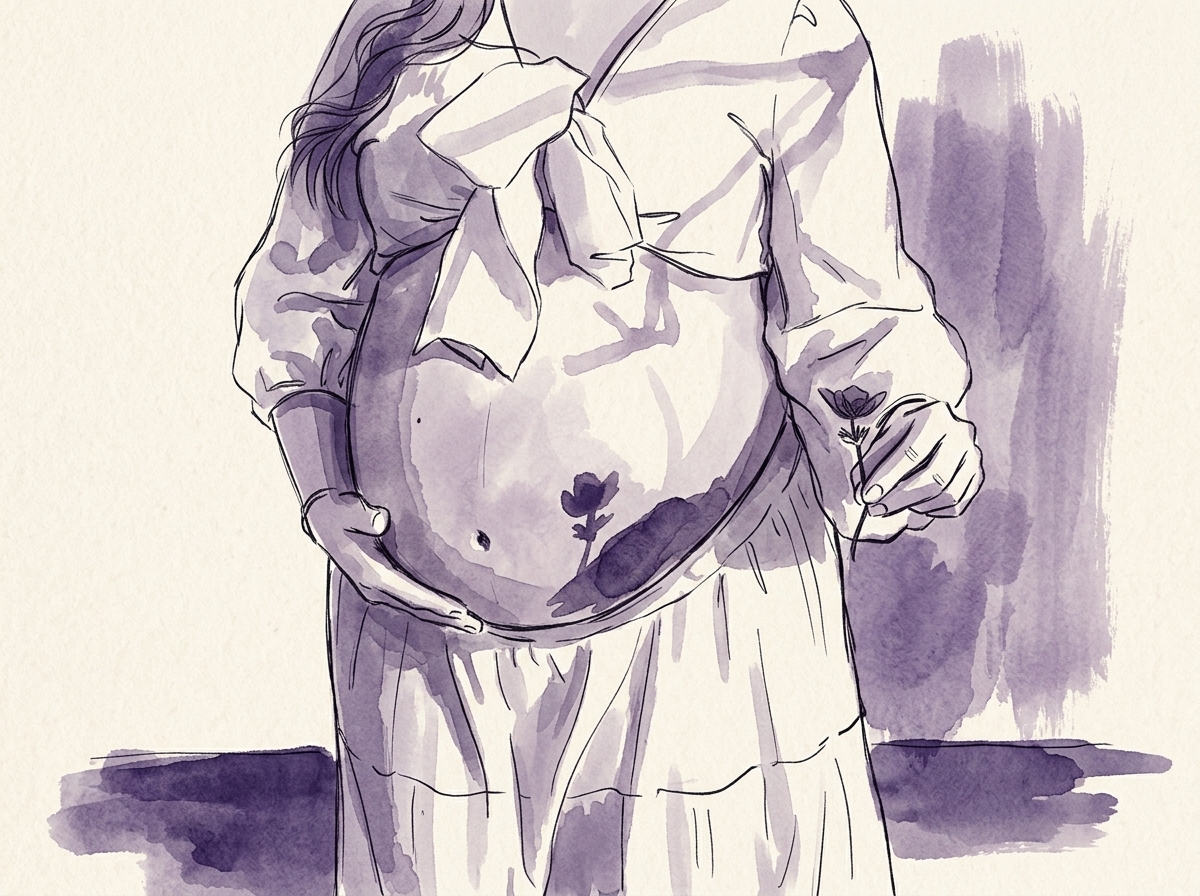
At the same time, Linda’s daughter suffers from a mysterious illness that leaves a small opening beside her navel, through which she is fed at the age of seven, echoing the way a fetus draws nourishment from its mother. As the story unfolds, we learn that Linda never consciously chose motherhood. She experiences her daughter not as the fulfillment of her life but as a weight she cannot carry, one that slowly makes her own existence unlivable. Bronstein reinforces this emotional distance by almost never revealing the child’s face. The omission is not simply a stylistic choice; it becomes a visual expression of the psychic barrier separating mother and daughter, a barrier so dense that even the camera cannot cross it.
The film is haunted by two openings. One gapes above Linda, threatening to collapse onto her; the other remains in her daughter’s body, binding mother and child through a wound that echoes the umbilical cord itself. Together they become two manifestations of the same shadow. One descends from above, the other rises from below. In both cases, motherhood appears not as a closed identity but as an opening that refuses to heal.
As a child, I was drawn to the conversations of adults, always impatient to grow beyond my years. At one family gathering, I overheard women speaking about a mother who had chosen to leave her children and begin a different life. The language they used carried a violence that remained with me for years. Whenever I later encountered women whose experience of motherhood departed from the cultural ideal, the image shaped over generations,I instinctively judged them. I saw only selfishness, perhaps the harshest form of individualism. That certainty remained intact until depression forced me to confront another possibility: that a life can become so profoundly misaligned with one’s inner reality that survival itself begins to depend on change.
Can a mother acknowledge her Shadow without being consumed by it? The film never asks the question directly, yet it quietly unfolds beneath every scene. Linda tries to contain the contradiction through projection, displacement, frantic movement, and escape, but the hole continues to widen. When a culture refuses to recognize maternal resentment as a legitimate human experience, those feelings do not disappear. They lose their language. They re-emerge as depression, physical illness, or, in more devastating cases, as violence turned against either the self or the child.
My medical studies made me understand more fully the magnitude of pregnancy and childbirth. Few human experiences transform both body and mind so profoundly. The body often requires years to recover, while the risk of psychological distress rises significantly. Yet despite these realities, mothers are expected to carry the entire burden with quiet grace. Breaking that silence requires more than compassion; it requires abandoning impossible ideals. The question should no longer be how a mother ought to feel, but how she is actually able to live.
The sociologist Sharon Hays describes this ideal as intensive mothering: an ideology that assigns mothers sole responsibility for every aspect of a child’s well-being. It demands complete emotional availability, expert-guided parenting, endless self-sacrifice, and a life organized entirely around the child, until every dietary choice, every educational decision, and every moment of attention becomes a measure of maternal love. This is precisely the standard imposed on Linda from every direction. Eventually, she comes to believe that the failure lies not in the ideal itself, but in her own inability to embody it.
Linda’s Shadow is not hers alone. It is also a shadow produced by a culture that asks the impossible of mothers, then condemns them for failing to achieve it. The hole in her ceiling stands as evidence of a system that manufactures impossible ideals, generates inevitable shadows, and then treats those shadows as personal failures. Linda alone bears the burden, but the Shadow belongs to all of us.
Throughout the film, she moves as though trapped in place. She knows something inside her has begun to unravel, yet there is nowhere to retreat. Unable to acknowledge what she feels directly, she projects her Shadow onto those around her: onto her daughter, who comes to embody her failure to become the mother she believes she should have been; onto her absent husband, whose distance becomes a vessel for her rage; onto her therapist, whom she unconsciously longs to transform into the mother she herself never had; and onto women who seem to inhabit motherhood with a grace she cannot find within herself. Meanwhile, the hole above her continues to widen. What remains unseen within us eventually finds another way to emerge.
The appearance of the hole is Linda’s moment of awakening. It is the kind of awakening I have been trying to describe all along. She is not suddenly healed, nor does she become the ideal mother. She simply begins to see. Beyond the sacred image of motherhood, another reality comes into view,one that had always existed but had never been acknowledged. For Jung, seeing is where every transformation begins.
Only in the film’s final moments does the camera reveal the child’s face. Something has shifted within Linda. Until then, the camera had been showing us only what Linda herself was unable to perceive. Now, for the first time, she is capable of truly seeing her daughter. Bronstein leaves the ending unresolved, suggesting that healing is rarely a single event. Sometimes it begins with nothing more dramatic than a hole in the ceiling through which a little light is finally allowed to enter.
The film itself becomes an act of witness. It watches Linda at the very moment the world has stopped looking at her. And in watching the film, we become witnesses as well, offering a maternal Shadow that has remained hidden for too long the simple permission to exist.
Returning to my own story, I realize that awakening did not rescue me from my Shadow. It compelled me to recognize it. After speaking about it with Marwa, I began to notice it everywhere, as though becoming conscious of it had allowed it to step fully into view. It followed me relentlessly: a quiet, persistent presence, burrowing beneath every experience, swallowing joy, memory, and even my sense of time. For a long while, I believed the abyss belonged only to me—that there was nothing in the world except myself and that darkness. Therapy slowly taught me otherwise. The Shadow is not a personal defect but part of the human condition. Trying to outrun it is as futile as trying to outrun desire itself. The harder we flee, the more completely it follows.
This is what binds Linda and me. We both woke before we were healed. My awareness of the Shadow did not flood my life with light, but it opened a space through which light could finally enter. Marwa became the person who could see me clearly, reminding me that the abyss I had struggled to describe was never a hallucination. Within Jung’s vision of the psyche, to be truly seen, by another person, by culture, and ultimately by oneself, is the first irreversible step toward wholeness.
In the end, Marwa’s question, the one I once dismissed about the shape of the abyss-turned out to be exactly the right one.