



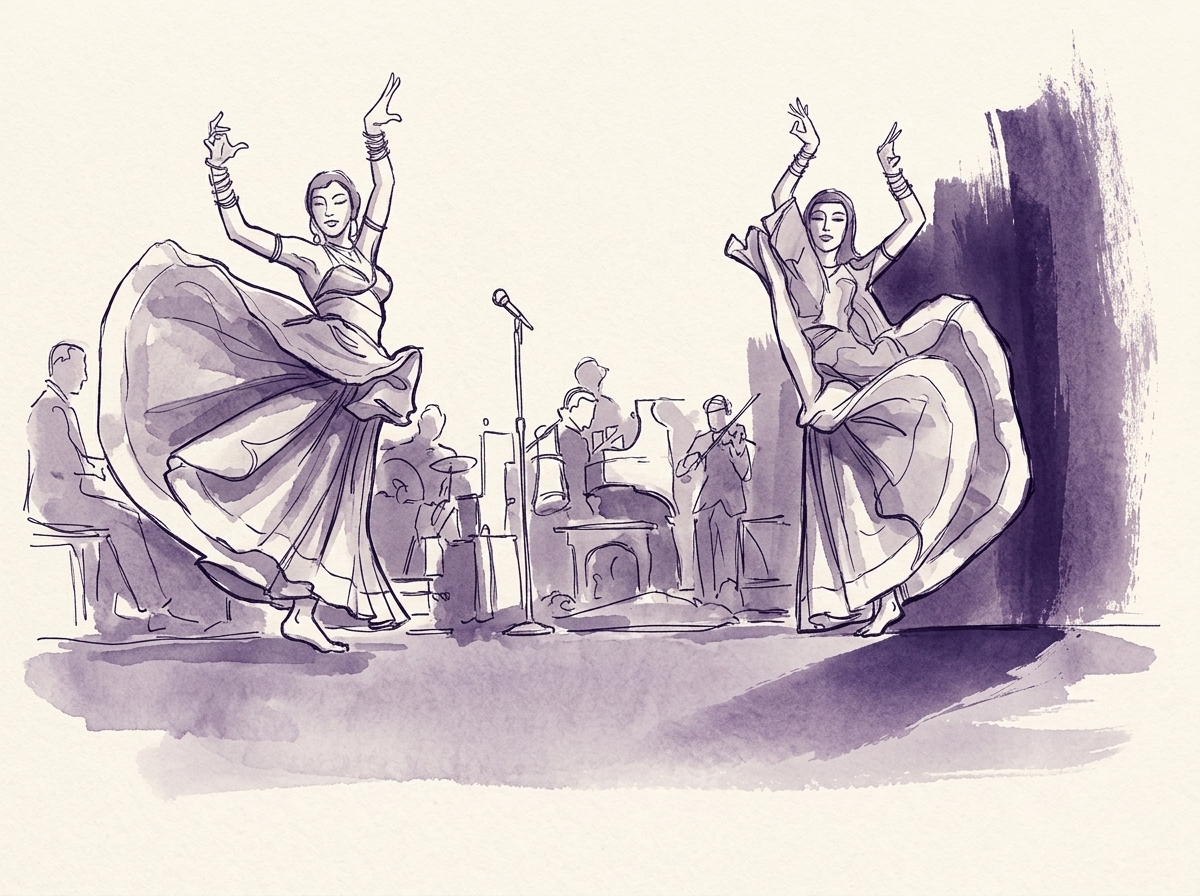



One cold Boston night, during my university years, a friend invited me to her birthday party at an Arab nightclub called Layalina. Most of those present were Arabs of the diaspora, gathered to recover, through the music, the dabke, the dancing, homelands that still inhabited them after geography had run out of room for them. Then the dancer came out with a lit candelabrum on her head, carried with an elegant steadiness: Jessica, Irish by origin, fair-skinned with a wheaten cast, an hourglass figure, commanding, filling the stage before she moved, and in love with belly dance with a passion no attentive eye could miss. She had the gestures down, every one of them, flawlessly and yet something eluded her, something like what my generation calls the X factor. Even the name I borrow for it is foreign and untranslatable. Something no YouTube lesson of the kind she had studied could teach her, and no dance teacher could impart. Her body imitated the dance and remained a stranger to it: an anxious body attempting to host a foreign spirit not of its own clay, and neither did the spirit descend into it, nor could it summon her. I had no name that night for the difference between imitating and inhabiting; the name eluded me the way the Eastern spirit eluded her body. I found it, luckily, years later, in a moment of pure serendipity, in Edward Said.
In the summer of 1950, a boy of fourteen stood among the audience at Badia’s Casino in Giza, watching Tahia Carioca dance. The first and last time he would see her on a stage before him. He was an anonymous spectator among dozens; she almost certainly never noticed him, just as Jessica never noticed me more than half a century later, and yet the boy never recovered from the sight. His name was Edward Said, and some ten years afterward he returned to Cairo intent on meeting her face to face, having followed dozens of her films in the interval; then he wrote his essay “Homage to a Belly Dancer.” Said was writing the mark that night had left on him, not a neutral piece about a dancer, and he compressed decades of admiration into a single exclamation: what a woman.
In that essay Said argued that the essence of classical belly dance, like bullfighting lies in the paucity of the dancer’s movements, in what might be called an economy of movement, not in their profusion. It is beginners and Western imitators who resort to that feverish shaking that mistakes itself for eroticism. The real dancer works by suggestion: a single gesture from the waist says what twenty consecutive movements cannot.
Then he went further. Comparing belly dance with ballet, he found them opposites rather than kin. Ballet is built entirely on defying the body’s weight: the ballerina wants to appear light as a feather, weightless, airborne, released from gravity. Tahia Carioca did the exact opposite: she planted herself deeper and deeper into the ground, as though digging into it, barely moving. Ballet flees the body. Belly dance inhabits it.
For the Western tradition, shaped by Platonism and then by Christianity, spent centuries regarding the body with suspicion: a prison for the soul, a burden to be transcended, a source of appetites to be curbed. Ballet is that aspiration set in motion: a body pretending to be an angel. Belly dance proceeds from somewhere else entirely, from a conception that sees no enmity between spirit and body, but an ongoing conversation between them. Martha Graham, the American who never knew the East, once said: “The body says what words cannot… dance is the hidden language of the soul.”
Nietzsche understood it too, from another angle. In Twilight of the Idols, deriding a German culture weighed down by abstraction, he wrote that dancing in all its forms cannot be excluded from a noble education: “to be able to dance with the feet, with concepts, with words; need I still add that one must be able to dance with the pen – that one must learn to write?” For him dance was the measure of thought itself; in the same chapter he holds that thinking is learned as dancing is learned, that it is a kind of dancing, and that an idea unacquainted with light-footedness is one whose schooling remains incomplete. And when he asked, in The Gay Science, his first question of any book, person, or piece of music -“Can it dance?” – he was making dance a measure of vitality and inner freedom, not an entertainer’s skill.
What is striking is that belly dance had been practicing, centuries before Nietzsche, the very Dionysian principle he dreamed of. In the traditions of the Middle East and North Africa, dance was not a separate art one went out to attend; it was part of the fabric of life itself: weddings, seasons, festivities, the zar rites, the dhikr circles in which the body arrives where speech cannot. It needed no stage and no ticket, because it was never separable from the life in which it occurred.
Hence the distance between the Eastern dancer and her Western counterpart, however impeccable the latter’s technique. Western enrollment in belly dance is large and growing, yet something keeps slipping away from them. The fault is not in the learning, nor is there any deficit of talent; the matter runs deeper than movements memorized and rules absorbed. It is a feeling that issues from the body’s own biography — from a childhood that danced at weddings before it knew it was dancing, from a memory accumulated in the joints before it ever reached consciousness; feelings that no one raised outside their context absorbs merely by deciding to learn them. The difference lies somewhere lessons cannot reach and imitation cannot supply.
The American anthropologist Edward T. Hall helps explain why. In Beyond Culture (1976) he proposed the notion of “hidden culture”: those deep strata of behavior and perception that govern us without our awareness. How we sense the distance between ourselves and others, how we handle time, how our bodies move when we speak or fall silent. Everything a human being produces, Hall argued, from tools to languages to arts, is an “extension” of biological and psychological capacities, and these extensions carry the imprint of a culture inseparable from them. Art is not a luxury a people adds to its life; art is that life itself, restated. To understand a people, its arts must be read as texts opening onto its collective consciousness.
By this logic belly dance becomes one of the densest of cultural extensions. It carries within it an entire structure of feeling for time, place, and the body. A structure sedimented over centuries and not to be abridged into any curriculum, however exact; its passage into the body is the yield of a lifetime, not of a weekly hour with a teacher or in front of a screen. This does not mean that a non-Eastern dancer cannot dance; it means she may execute the movement without carrying with it the cultural charge that gives it meaning. The difference is not technique. The difference is what lights the movement from within.
What holds for dance holds for all rooted arts. In 1973 the American poet Maya Angelou was asked whether white critics have the right to judge Black art. Her answer moved past the question of right to the question of capacity: the white critic, she said, “will hear, he will understand, hopefully, the gist,” but he will not catch the counter-rhythms that Harlem children stamp out with their feet in a game of hopscotch. The rhythms on which she built her poem “Harlem Hopscotch.” Hopscotch is the same wherever it is played: a hop, a hop, a hop; but beneath it in Harlem runs a counter-rhythm audible only to those raised on it. The outsider, Angelou says, will see the social implications in the rhymes, “but he will not hear.” Between understanding and hearing lies the whole distance, the same distance at which Jessica stood in Layalina: she understood everything, and she did not hear. What Said said of dance and Angelou of poetry is one law of rooted arts: every culture has its inside talk, whose gist can be grasped from without, and whose rhythm is audible only from within.
But what draws Western women in particular to this art feminists above all, who hardly see themselves as instruments of male pleasure at a time when belly dance is bound in the popular mind to titillation and seduction?
The German writer Dietlinde Karkutli offers, in her book The Belly Dance Book (1983), an answer from inside the experience. She sees the German women’s turn to belly dance as arriving at a particular moment: a moment sated with cold rationality, with the boredom and spiritual vacancy bred by an excessive worship of logic. The body had wearied of its role as “a prop for the dominant intellect,” in her phrase, and wanted its voice back. Some of these women came to the dance after a period in which they had won their freedom and their legal equality, but did not know what to do with an inner pain that logic alone could not treat. And when they began to practice it, they noticed something they had not expected: a balance between mind and body, as if something severed had begun to knit. It is as though the Germany Nietzsche mocked for its heaviness had come back a century later looking for its lightness in the dance of the East.
Why this dance in particular; why did ballet or modern dance not do the same work? Karkutli observes that modern European dance is to a great extent a “dance of legs”: the movement comes from the extremities, not from the body’s center. It may be lovely and lithe, but it does not express what stirs in the depths. Ballet is worse in this respect: rigid systems imposed on the body from outside. Belly dance, by contrast, issues from the center. The belly, the pelvis, the torso, from the region many cultures regard as the seat of vital energy and buried feeling. And it is, besides, improvised: no memorized template, no choreography set in advance. The body speaks for itself.
Strange convergences emerge here between Said and Karkutli, neither of whom, in all likelihood, read the other: an art that plants itself in the ground against an art that flees it; movement from the center against movement from the extremities; improvisation against template; suggestion against declaration. All of it runs in one direction: Belly dance differs from its Western counterpart not in style, but in the philosophy underneath it.
Western women felt, Karkutli says, that this dance was “theirs,” a way of reviving their femininity, not in the shallow sense that reduces femininity to allure, but in a deeper one: the recovery of a severed relation with the body itself. As though belly dance offered them what their own culture could not: a way of dwelling in the body in peace rather than escaping it.
The paradox is that this attraction undermines itself. The “therapeutic” value Western women discovered in belly dance derives precisely from those deep cultural strata they were never given the chance to inhabit; they take the fruit without possessing the root. And here Said’s observation returns with its full weight: you cannot wrench Tahia Carioca out of a Cairo nightclub or a village wedding. She is entirely local, untranslatable, resistant to investment outside her context. Every culture has its closed districts, and Tahia was one of them.
Certain expressive forms resist globalization by their very nature, not because they are “backward,” but because what gives them their value is so rooted in its context that uprooting it empties it of meaning. This is no sanctification of the borders between cultures, nor a refusal of exchange; it means only that certain arts resemble those words the dictionaries call untranslatable: not impossible to understand, but understanding them takes more than knowledge. It takes dwelling.
I understand now what I saw in Layalina. It was no deficit of talent in Jessica, nor of passion or effort; she performed the movement perfectly, and what she lacked was what lights the movement from within. That “X factor” I had no name for that night has a name now: to inhabit the dance rather than imitate it. The diaspora crowd applauded her generously, and in their eyes was that longing which knows that the dance before it is an imitation, and that the original had stayed behind, in the country they had left and that had never left them.
When an Egyptian dancer stands and delivers, with a single movement of her waist, what twenty movements could not say, she is not practicing an art; she is practicing an entire culture, saying with her body what no book of anthropology will ever say: authenticity is not what is learned. Authenticity is what is lived.