



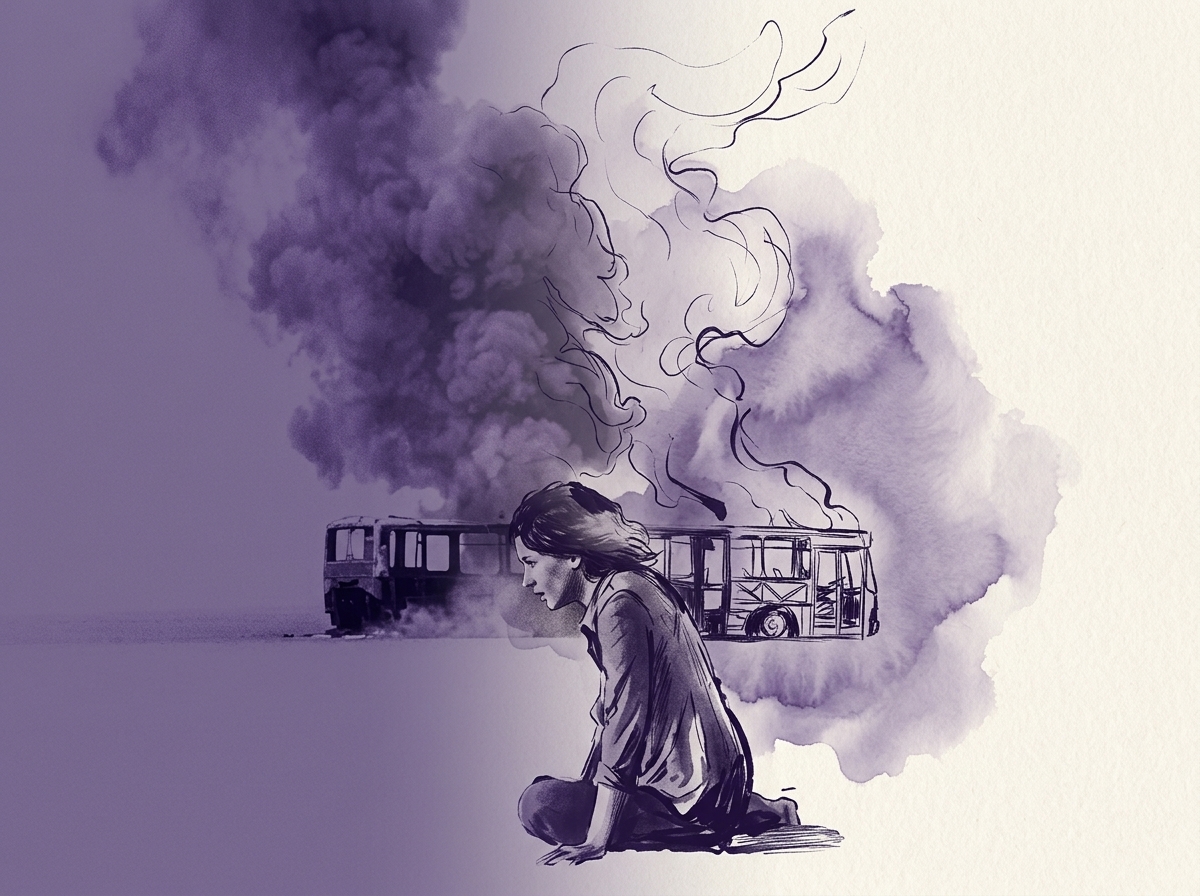



Released in 2010, Incendies remains one of the most compelling cinematic explorations of the devastating legacy of civil war in the Middle East, particularly the Lebanese Civil War, a conflict that fractured a nation, dismantled its social fabric, and left generations trapped within cycles of violence, grief, and sectarian vengeance. Through a masterful fusion of realism and visual symbolism, Lebanese-Canadian director Denis Villeneuve crafts a film of remarkable emotional and philosophical depth, revealing not only the brutality of war but also its enduring psychological and moral consequences.
Adapted from the acclaimed stage play by Lebanese-Canadian playwright Wajdi Mouawad, Incendies is far more than a faithful screen translation. Villeneuve reimagines the work through a distinctly cinematic language, transforming an intimate family drama into a meditation on memory, identity, and historical trauma that resonates far beyond its Lebanese setting. The film’s emotional power enabled it to transcend cultural and geographical boundaries, earning widespread international acclaim and demonstrating cinema’s unique ability to translate a local tragedy into a universal human experience.
Its critical success reflected this broad resonance. Incendies received more than thirty international awards, was named by The New York Times as one of the ten best films of 2010, earned an Academy Award nomination for Best Foreign Language Film in 2011, and won eight Genie Awards in Canada. These achievements firmly established the film as one of the defining cinematic works of its time, celebrated not only for its artistic excellence but also for its profound engagement with questions of history, memory, and human resilience.
At its core, Incendies is not simply a story about uncovering a family’s hidden past. It is an exploration of how personal histories become inseparable from the collective memory of a nation scarred by war. The film suggests that memory is not merely an archive of suffering but an ethical responsibility, a refusal to surrender the past to silence or oblivion. In doing so, it poses enduring questions about guilt, inheritance, identity, and the possibility of confronting history without becoming imprisoned by it. Ultimately, Incendies presents remembrance itself as an act of resistance, affirming that preserving memory is often the first step toward breaking the cycle of violence.
A Journey in Search of the Past and the Truth
Incendies begins with the death of Nawal Marwan, a Lebanese woman whose final will sets in motion the film’s central mystery. Before her death, she leaves her twin children, Jeanne and Simon, an extraordinary request: they must return to Lebanon to find the father they believed was dead and the brother whose existence had been concealed from them. What initially appears to be a deeply personal family mission gradually unfolds into a journey through the hidden history of a nation devastated by war.
As Jeanne and Simon retrace their mother’s footsteps, each discovery reveals another layer of a past shaped by the violence of the Lebanese Civil War. Their family history proves inseparable from the country’s fractured political and sectarian landscape, where private suffering and collective trauma become impossible to disentangle. The search therefore evolves beyond the recovery of lost relatives; it becomes an excavation of memory itself, compelling the siblings to confront not only the truth about their family but also the historical forces that shaped their identities.
Yet Incendies is not simply concerned with exposing long-buried secrets. It is equally interested in the enduring afterlife of violence. The film explores how unresolved historical trauma continues to inhabit the lives of those who never directly experienced it, demonstrating that war leaves behind more than physical destruction. It creates inherited wounds that pass silently from one generation to the next, shaping identities long after the conflict has ended.
In doing so, the film poses difficult and enduring questions. How do the wounds of one generation become the inheritance of another? In what ways does collective suffering shape individual identity? Rather than offering definitive answers, Incendies invites the audience to confront these questions alongside its protagonists, transforming the search for truth into an emotional and ethical journey through the complex relationship between memory, identity, and history.
The Will as a Narrative Device: Storytelling and the Burden of Memory
Within Incendies, Nawal’s will functions as far more than a legal document or the catalyst for the plot. It serves as one of the film’s most powerful narrative symbols, transforming a personal testament into an instrument through which suppressed history is recovered. In societies marked by war and displacement, where official records are often destroyed and individual stories deliberately erased, the written word becomes an act of preservation against oblivion.
The will gradually shifts from a series of instructions into a key that unlocks a deliberately concealed past. Each step Jeanne and Simon take in fulfilling their mother’s final wishes uncovers another fragment of truth, exposing histories that others have sought to silence. Their journey becomes an act of remembering that challenges the forces of erasure, allowing memory to emerge not as passive recollection but as an active confrontation with the past.
On a deeper level, the film reflects on the enduring power of narrative itself. Written words outlive those who compose them, surviving attempts at suppression and continuing to speak across generations. In Incendies, storytelling becomes an ethical responsibility rather than a simple recounting of events. It insists that history cannot simply be buried, because what remains unspoken continues to shape the present.
The testament also carries a broader political significance. It quietly condemns the violence, whether political, sectarian, or institutional, that seeks to erase individual lives from collective memory. At the same time, it warns that societies unable to acknowledge their past remain vulnerable to repeating it. The inheritance Nawal leaves her children is therefore not material but moral: the burden of confronting a painful history that cannot be escaped, denied, or forgotten. In Incendies, memory itself becomes the true legacy, and bearing that legacy is the first step toward understanding both oneself and the world that produced such suffering.
Motherhood and Politics: The Body as a Site of Resistance
At the emotional and philosophical center of Incendies stands the figure of the mother, where the intimate and the political become inseparable. Motherhood is not portrayed as a private experience confined to the domestic sphere, but as a form of resistance forged in the midst of violence. Through Nawal Marwan, Denis Villeneuve presents a woman whose maternal identity is continually shaped and tested by the brutal realities of war. She is more than a mother searching for her lost child; she embodies the suffering, resilience, and moral endurance of a society fractured by conflict.
Nawal’s body becomes one of the film’s most powerful symbols. It is not merely the victim of violence but the very terrain upon which political conflict is inscribed. Imprisoned, tortured, and repeatedly subjected to acts intended to strip her of dignity, her body bears the visible scars of war. Yet it also becomes a testament to survival. Rather than surrendering to the forces that seek to silence her, she transforms suffering into an act of witness. In this sense, the body carries two histories simultaneously: one of trauma and another of extraordinary perseverance.
The film therefore reimagines motherhood beyond its conventional associations with care and protection. Nawal is compelled to fight on several fronts at once. She struggles to preserve memory against erasure, to defend identity against fragmentation, and to protect human dignity in a world determined to destroy it. Motherhood becomes an ethical and political act, demonstrating that nurturing life may itself become a profound form of resistance when confronted with systematic violence.
By placing maternal experience within the historical realities of civil war, Incendies challenges idealized representations of motherhood. It portrays the mother not as a passive symbol of sacrifice but as an active participant in history one whose personal suffering becomes inseparable from the fate of an entire nation.
Individual and Collective Memory: Where Pain Becomes Identity
One of the film’s most profound achievements lies in its exploration of the intricate relationship between individual and collective memory. Rather than treating them as separate realms, Incendies reveals how personal histories and national history continually shape one another. Through Nawal’s life and the journey undertaken by Jeanne and Simon, private suffering gradually unfolds into a broader narrative of collective trauma, illustrating how the experience of one family can reflect the wounds of an entire society.
Within the film, memory is never a passive recollection of the past. It is a living, evolving space in which personal experiences intersect with historical events. Individual tragedies acquire collective meaning, while national catastrophes leave permanent traces on individual lives. Identity, therefore, emerges not as a fixed condition but as something continually reconstructed through remembrance, loss, and survival.
Incendies also confronts the moral consequences of forgetting. It suggests that forgetting is rarely an innocent act; when societies refuse to acknowledge their deepest wounds, they risk perpetuating the very cycles of violence that produced them. Silence does not erase trauma. Instead, it allows unresolved pain to endure beneath the surface, where it continues to shape future generations in unseen but enduring ways.
For this reason, the film presents remembrance as both an ethical responsibility and a political necessity. To remember is not merely to preserve the past but to resist its repetition. By confronting history rather than suppressing it, individuals and communities create the possibility of reconciliation without surrendering the truth. In Incendies, memory ultimately becomes an act of justice, a refusal to allow suffering to disappear into silence, and an affirmation that acknowledging pain is the first condition for breaking the inheritance of violence.
individual memories preserve the intimate details of personal experience, yet they never exist in isolation. They inevitably converge with collective memory, which carries the broader narratives of belonging, history, and cultural identity. It is within this intersection that Incendies locates its deepest psychological and social tensions. The characters are compelled to confront a past that is both deeply personal and profoundly historical, while attempting to forge a future burdened by inherited wounds.
Villeneuve visualizes this relationship through a narrative that moves fluidly between past and present. Nawal’s personal story unfolds alongside the events of the Lebanese Civil War, revealing how individual lives are inextricably woven into the history of the societies that shape them. The film refuses to treat history as a distant backdrop. Instead, it demonstrates that historical violence penetrates the inner lives of individuals, leaving emotional and moral traces that continue to define them long after the conflict has ended.
Ultimately, Incendies presents memory not simply as a repository of suffering but as a source of ethical possibility. Remembering becomes the necessary condition for reconciliation, while forgetting risks perpetuating the very violence it seeks to escape. The film echoes the enduring insight that societies unwilling to confront their past remain vulnerable to repeating it. Memory, therefore, is not merely an inheritance to be endured but a responsibility to be acknowledged with honesty and courage.
When Silence Becomes Language: The Horror Within Stillness
Cinema does not always communicate suffering through explicit violence or heightened emotion. Some of its most devastating truths emerge through silence. In Incendies, silence is neither an absence of sound nor a pause between lines of dialogue. It functions as a language of its owndense, expressive, and emotionally charged, capable of conveying terror, grief, and trauma with an intensity that spoken words could scarcely sustain.
Denis Villeneuve understands that certain human experiences exceed the limits of language. War, bereavement, sexual violence, and sectarian hatred often produce a state in which speech itself becomes inadequate, unable to encompass the magnitude of suffering without diminishing it. Rather than forcing these experiences into dialogue, Villeneuve allows silence to occupy the screen, acknowledging that some truths are communicated more powerfully through absence than through explanation.
Within this cinematic language, moments of stillness become psychologically charged spaces where fear, guilt, shame, grief, and anticipation accumulate beneath the surface. Silence offers no comfort; instead, it intensifies emotional tension, drawing both the characters and the audience into an unspoken confrontation with trauma. Long, unbroken takes, motionless faces, lingering gazes, and carefully composed shadows all contribute to what may be described as a poetics of silence, in which stillness acquires a narrative force equal to, and often greater than, dialogue itself.
The result is a cinema that trusts the expressive power of restraint. Rather than instructing the audience how to feel, Incendies creates space for contemplation, allowing silence to become an active participant in the narrative. In doing so, the film reminds us that the deepest wounds are not always those that are spoken aloud, but those that remain suspended between words, waiting to be recognized.
The film further suggests that silence is not merely an individual response to trauma but a collective condition imposed by war itself. Societies emerging from conflict often struggle to construct a coherent account of what they have endured. Just as memory becomes fragmented, so too does language, leaving silence as the only possible means of coexisting with experiences too painful to articulate. Through Nawal Marwan, Incendies gives this condition a deeply human form. Her prolonged silence is neither resignation nor defeat; it is a deliberate moral choice, an attempt to preserve the integrity of truth and to protect suffering from being diminished by inadequate words.
This silence, however, does not remain confined to the characters. It extends outward, placing an ethical responsibility upon the audience. Villeneuve refuses to provide emotional certainty or neatly resolved meanings. Instead, viewers are invited to inhabit the spaces left unspoken, drawing upon their own moral imagination to complete what language cannot express. In this way, the audience ceases to function as passive observers and becomes active participants, sharing the burden of memory and confronting the horrors concealed beneath the film’s stillness.
Silence in Incendies, therefore, should not be understood simply as an aesthetic device. It represents the point at which language reaches its limits. Faced with experiences whose magnitude exceeds verbal expression, words inevitably falter. Rather than forcing language to explain what cannot truly be explained, the film allows silence to bear witness. In doing so, it transforms absence into testimony, suggesting that the deepest truths are sometimes communicated most faithfully through what remains unsaid.
A Testament Against Forgetting
As the twins’ journey draws to a close and Nawal’s final testament is finally fulfilled, one truth becomes unmistakable: the past is never truly past. It continues to inhabit the lives of those who inherit it, shaping identities, relationships, and the moral landscape of the present. Incendies insists that suffering should never become a justification for silence or denial. Instead, it calls for the difficult but necessary work of confronting history in all its complexity.
In an era increasingly marked by attempts to erase, simplify, or manipulate historical memory, the film stands as a powerful affirmation of remembrance. It argues that truth demands courage, particularly when that truth is painful, and that genuine peace cannot emerge from forgetting but only from an honest reckoning with the past. Reconciliation, the film suggests, is not the absence of conflict but the willingness to face history without illusion.
By the time the narrative reaches its conclusion, Incendies has moved beyond the story of one family to pose questions of universal significance. Can a society build a peaceful future without first confronting the violence that shaped it? Can individuals truly heal while refusing to acknowledge the wounds they carry? These questions remain deliberately unresolved, inviting reflection rather than certainty.
More than fifteen years after its release, Incendies continues to resonate with remarkable urgency in a world still scarred by war, displacement, and political violence. Its enduring relevance lies in its refusal to separate personal suffering from historical responsibility. The film reminds us that the scars of history cannot be erased through denial or silence. They can only be transformed through remembrance, understanding, reconciliation, and the courage to face the truth, however difficult that truth may be.