Author: Amir Al-Omari
Original text in Arabic
Translation revision and editing: Salma El-Sharkawy
Fellini Satyricon (1969) is Fellini’s most ambitious film and also his most difficult and formally complex. It is an intensely singular experience, not only within European and Italian cinema in general but also within Fellini’s own body of work in particular.The film departs from conventional narrative structure and from the idea of a central character around whom events revolve, as in 8½ and La Dolce Vita.
Here, Fellini ventures boldly into working with an unfinished text from a distant past from the age of Emperor Nero—namely, the text written by Petronius. Yet it ultimately appears as if it belongs to Fellini himself. He plays with it, manipulates it, intervenes in its narrative, and reshapes many situations and scenes to present his own vision of the “ancient world,” in Alberto Moravia’s terms—or of ancient Rome: what it was, how it decayed, and how it collapsed once human beings no longer hesitated to devour one another, not metaphorically but literally and materially, as the film shows.
Fellini invents and imagines a multitude of scenes, presenting a vast spectacle that, as usual, incorporates elements of circus performance though here human beings have taken the place of animals. He offers a terrifying image of the end of a civilization through a return to “Rome” not merely Rome as a place, but Rome as a mentality, a culture, an identity, a way of life and governance, patterns of human interaction, and systems of social stratification.* All of this unfolds in the form of a dream a “conscious dream,” or a “cultural dream”carefully composed and arranged in Fellini’s mind before being projected onto film.
Before Fellini made his film, another film titled Satyricon, directed by Gian Luigi Polidoro, had been produced around the same time. For this reason, Fellini titled his film Fellini Satyricon to distinguish it from the other film released in the same year, 1969, which has since fallen into oblivion. It is correct to say that Fellini adapted his film from Petronius’s Satyricon, which dates back to the first century AD. However, it would be incorrect to claim that Fellini intended to create a “historical film.” The historical dimension of Satyricon is merely an external covering, or an artistic device. The film is not historical in any real sense, and its connection to the original text by Petronius is weak.
This is due, first, to the fact that Petronius’s work survives only in scattered fragments and incomplete sections. Perhaps this very fragmentation, this absence of continuity and hierarchy, attracted Fellini and led him to follow its logic, since it frees him from structured narrative and aligns with his own conception of history as consisting of discontinuous, fragmented, disjointed, and incomplete pieces. Secondly, this loose narrative framework allows Fellini, as indeed happens, to depart from the text, to invent, create, add, and ultimately present his own image of ancient Rome.
Fellini says in an interview with the writer Alberto Moravia, published in the book Fellini’s Satyricon, whose full text appears in the appendices of that volume:
“I tried to eliminate what is generally called history. I attempted to rid myself of the idea that the ancient world had any real existence. That is why the overall atmosphere of the film is not historical, but closer to the world of dreams. Perhaps the ancient world never existed at all, but there is no doubt that we have dreamed it. Satyricon possesses a mysterious transparency the clarity of dreams and their obscure symbols.
My effort in this film focused on carrying out two parallel, completely contradictory operations at the same time. Everything in the film is my invention: the faces, the gestures, the postures, the objects. To achieve this, I had to trust my abilities and my imagination, tinged with a certain emotional charge. Yet I was also compelled to render the result of this imaginative process in a completely objective way, and to distance myself entirely from it, so that I could look at it again as a coherent entity, yet one that cannot be fully grasped.
This is precisely what happens in dreams. They contain things that belong entirely to us, through which we express ourselves. Yet in the light of day, the only relationship we can perceive between ourselves and dreams is a mental, conceptual one. This is why dreams appear to our waking selves as distant, remote, strange, and resistant to full understanding.”
Fellini himself may be the one who best articulated his film in words, while many critics have viewed the film as reflecting, even if symbolically, the mood of political unrest and anxiety that marked Italy in the 1960s, when the film was being conceived. Others, and here I do not mean journalistic reviewers but major intellectual figures such as the Italian writer and filmmaker Gianfranco Angelucci, who holds a doctorate in art history, have linked the film to what had been ingrained in Fellini’s memory of fascist Italian society, and to how he often expressed his satire and critique of it in his films. Fellini may therefore have perceived a similarity between modern fascism and the mentality of ancient Roman society. Petronius’s narrative portrays “decadence,” or the state preceding collapse, the erosion of values and morals, and the disintegration and corruption that came to dominate the elite aristocratic class rather than the world of slaves. (Hava Aldoubi, Federico Fellini: Drawing in Film, Drawing on Film, University of Toronto Press, 2013).
There is no doubt that the idea of decline and collapse invites comparisons between Fellini Satyricon and fascism, which sought to revive the glory of ancient Rome, exalted its symbols and monuments, practiced repression, domination, and persecution, and waged wars in the name of Roman grandeur and pride. Yet it seems more plausible that the film primarily seeks to express the brutality of the ancient world and its lack of spiritual values through that long, abstract, extended, fragmented, obscure, non-fluid, and discontinuous dream. Through visual imagery, Fellini draws upon multiple artistic styles. As he explains in his interview with Moravia, he was inspired by Byzantine, Greek, and modern art, as well as pop art and the psychedelic aesthetics of the 1960s, that is, art associated with hallucination and drug culture. He also employs the grotesque, artistic forms that combine ambiguity, shock, and disturbing, repulsive imagery, along with large fresco paintings.
This “abstract” expression did not lead Fellini, of course, toward constructing a tightly organized narrative. This may explain why some critics rejected the film, as the famous American critic Pauline Kael did. She regarded it as merely a “modern imitation” of Cecil B. DeMille’s The Sign of the Cross (1932), but less entertaining due to its lack of characters, with Fellini himself effectively becoming the protagonist. However, Kael made a fleeting but highly significant remark when she stated, while downplaying her earlier observations, that the film is “a fascinating presentation of a dubious proposition: that the absence of God is equivalent to the absence of law.” (from the article Fellini’s Mondo Trasho, The New Yorker, March 7, 1970). In truth, Pauline Kael did not appreciate Fellini’s films, nor those of European modernist filmmakers in general.
Fellini, the son of Catholic culture and at the same time a rebel against it, never abandoned his foundations connected to religion, or more precisely, to the concept of divinity, and thus to belief in God and in the values derived from the Bible. The scenes of decay and downfall in Satyricon are linked to the idea of sin and the absence of faith. Fellini sees that the absence of what we might call the “essence” of the soul in modern Roman society closely resembles many aspects of what prevailed in ancient Rome before the emergence of Christianity.
He renders, through successive scenes, the spread of cruelty, brutality, deviance, rape, the degradation of art, and the violent abuse of women, along with collective sexual practices. These are accompanied by images of animal slaughter, the disembowelment of a pig from which dozens of chickens and pieces of sausage emerge, loud and repeated belching presented as a sign of artistic creativity, the expulsion of gas on stage, the enslavement and oppression of human beings, and the killing of the sacred idol, the albino hermaphrodite, a creature of extreme pallor, who dies of thirst in the desert after the two companions, Encolpius and Ascyltos, are forced to steal it at night and carry it across the open desert under the burning sun. All these shocking images are meant by Fellini to make us feel that decay, both material and spiritual. Art has collapsed, the deity has been killed, what remains?
Yet Fellini’s interest does not lie in the manifestations of power, influence, or the ancient prestige of imperial Rome, but rather in depicting the lives of the lower classes, the marginal figures, those whom history books have never mentioned. He imagines them, summons them into his vision, and brings them back to life through his own distinct dream.
The British scholar Leanne Glass writes in a remarkable study, more precisely a comparative analysis between Satyricon and the film 300 (2007) by the American director Zack Snyder, published under the title 300 and Fellini Satyricon: Film Theory in the Tertiary Classroom:
Fellini rejects conventional cinematic representation and the stereotypical imagery of ancient
Rome characterized by spectacular scenery, lavish palaces with marble columns, temples adorned with golden ornamentation, and luxurious furnishings. In most traditional films, characters appear in aristocratic costumes, with a focus on emperors, their courts, members of the Senate, generals, armies, battles, and grand triumphal processions. These familiar images usually stem from the subject of the film itself, which is always centered on major historical figures and events that appeal to a wide audience, as in 300, which presents an inspiring or didactic narrative, or in The Robe (1953) by Henry Koster.
By contrast, Fellini begins his film Satyricon in a Rome that does not appear in Petronius’s text, focusing instead on Subura, the densely populated popular district inhabited by the lower classes. This means that the typical grandeur of Rome, as commonly depicted in cinema, is replaced by narrow streets, crumbling buildings, exposed staircases, and missing walls, all captured through tight camera angles. This reduces Rome’s familiar opulence to a minimum and redefines the urban landscape, bringing it back to the scale of ordinary human experience. Fellini does not depict Rome in daylight, but at night. As a result, the focus shifts toward strange characters and events, such as the furtive movement of an imperial bust through the streets, or a theatrical scene that retains elements of the comedy associated with the works of the ancient Roman playwright Plautus, who lived between 254 and 184 BC.
Encolpius, played by the English actor Martin Potter, appears in most of the film’s scenes. But he is not the Greek Ulysses who sails away, disappears for a long time, and ultimately returns victorious to his homeland. Rather, he is a defeated hero who loses his lover Giton at the very beginning, taken from him by his friend Ascyltos. He is then invited by the poet Eumolpus, whom he meets in a museum, to the house of the coarse and vulgar wealthy man Trimalchio, who steals poetry and chews it while eating with grotesque greed, humiliates his wife in public, despises everyone, and then orders the poet to be tortured. He later stages his own death, pretending to die as he lies in a tomb built to his exact measurements, in order to tell his companions and guests a Greek story that mocks death.
It is the story of a woman whose wealthy husband died in the desert. A thief killed him, hanged his body, and suspended it next to the corpse of the rich man laid out on a table, appointing a guard to watch over them. The guard seduces the grieving widow, who had decided to take her own life after her husband’s death, and she sleeps with him. Meanwhile, the thieves return and steal the body from the gallows. The guard finds himself in a difficult predicament: what is he to do now, and how can he justify himself to those in authority who entrusted him with the task? The woman suggests hanging her husband’s body in place of the stolen one, repeating that a living lover is better than a hanged husband. This story is shown within the film itself, but it is recounted by Trimalchio in the context of denouncing the fear of death, after God has died, or the soul has vanished, and those in power no longer fear punishment in the afterlife.
The film contains another story related to death and the contempt for it. When a wealthy man dies, his will is opened and it is discovered that he has stipulated that his relatives must eat his body as a condition for inheriting his fortune. After hesitation, confusion, and unease, they eventually resolve to do so, cutting up the corpse and chewing its flesh. The scramble for wealth has thus replaced respect for the dead and reverence before death.
Regarding the Greek sources used by Fellini in the film, Vincent Tomasso, a scholar specializing in ancient Greek history, writes in a study titled Fellini’s Reception of Greek Sources in Satyricon (2018):
During Encolpius’s visit to an exhibition of Roman and Greek art, we see a painting from the famous Greek Tomb of the Diver and a red-figure vase. The poet Eumolpus laments contemporary Romans, saying that they do not care about “those mad Greeks” such as Phidias or Apelles, who placed virtue above money. These observations position Greek culture as a counterpoint to the Roman characters in the film. During Trimalchio’s banquet, three actors perform a passage from Homer. However, while other poetic excerpts, such as those Trimalchio has taken from Lucretius, are spoken in Italian, the Homeric passage remains in Greek. In Fellini’s own notes on the screenplay, he writes that these lines are “incomprehensible yet harmonious,” that is, they possess purely aesthetic value, but will not be understood by either Italian or modern Greek audiences.
Tomasso takes this as evidence that Greek culture in Fellini’s Satyricon functions as a form of the “Other” in general. He adds that this explains how both ancient Roman and Greek cultures are used differently to distance the modern audience. Moreover, the Italian reception of Fellini Satyricon allows us to understand the unique character of Italy’s historical relationship with ancient Greece, distinct from other national traditions.
Encolpius passes through many events and witnesses the collapse of Rome. He survives an earthquake and undertakes a long journey that leads him from pleasure to pain, from the house of the vulgar rich man to that of a noble aristocrat who gives all his wealth to his slaves before committing suicide with his wife after realizing that the old order is collapsing. Fellini states that this noble aristocrat is in fact Petronius himself. Encolpius then discovers sexuality with a beautiful African woman who remains alone in the aristocrat’s house. He is later captured with his friend Ascyltos and enslaved at the bottom of a Roman ship on which the emperor is traveling. He is forced into a confrontation with an old, ugly, one-eyed slave trader who subdues him and marries him. But the guards turn against the emperor, kill the man, and Encolpius survives. He is then left in a labyrinth where he must face the mythical creature of the Minotaur, a being from Greek mythology with the head of an animal and the body of a man. He soon realizes that he is being toyed with, that the Minotaur is in fact a strong young man who spares him because of his eloquence. Yet he discovers that he has lost his sexual potency when he is asked to sleep with a lustful woman as a reward for his rhetorical skill, a reward that consists of desireless sex observed by others.
In this scene, Encolpius begs the Minotaur for mercy, saying, “I am not Theseus, nor am I your equal,” in reference to Theseus, king of Athens and rival of Heracles. After revealing his face, he claims that everything was merely a joke in honor of the god of laughter and joy, which leads the audience to burst into laughter. Encolpius is then humiliated in public when he is forced to have intercourse with a woman playing Ariadne, the Cretan princess of Greek mythology, but he fails to perform in front of everyone, and they mock him.
J. P. Sullivan says, in a chapter entitled “The Social Climate of Petronius: Satyricon and Fellini Satyricon” in the book Classical Culture and Myth in the Cinema (Oxford University Press, 2001), that Fellini invented this scene after drawing on several ancient sources, and that it is not mentioned in Petronius’s text, which confirms his interest in using ancient Greece as a means of estrangement.
The young Encolpius seeks healing from the sorceress Oenothea, whose story becomes the second story we witness within the film, after the story of “the living lover and the corpse of the hanged husband.”
Oenothea was a beautiful, seductive young woman whose beauty an old, wealthy, and exceedingly ugly magician wished to possess. She mocked him, and in his anger he caused fire to burn forever between her thighs. This woman is served by a very ugly old woman who gives Encolpius a drink and then asks him to sleep with her, after which his sexual power returns to him.
The scene in which Encolpius goes to the house of the sorceress Oenothea reflects Fellini’s method of embodying the dream in this film, which is perhaps the most visually driven of all his films, and perhaps also the most “stylistic,” in the sense that style overwhelms the represented material. Encolpius enters Oenothea’s dwelling through an opening in the rock. An ugly old woman in her service hands him a cup of drink while muttering incomprehensible words in a strange language. He turns to face the camera and drinks. He looks right and left. The woman points him toward an opening in the rocky wall. The camera gradually advances through the opening. We see a blazing fire, and behind it Oenothea in her beautiful form. The camera approaches, then we cut in reverse shot to Encolpius moving toward her. The background of the image is always rocky, marked with carvings and drawings of creatures with frightening eyes. Oenothea smiles, dark-skinned, with large blue eyes.
The camera moves toward her face through the mass of fire. Encolpius closes his eyes, smiling with happiness, then opens them to see Oenothea’s face transformed into that of a terrifying monster. He recoils for a moment, then smiles, for beauty has returned to Oenothea’s face as the camera pulls back from her. He sits beside the rocky wall in a drugged state. He looks outward to his friend Ascyltos, who is being attacked with a knife by the man who had steered their boat, and the two are fighting. Ascyltos calls on his friend to save him from slaughter. But Encolpius is completely drugged. A huge bird, like a peacock, passes before him. Fellini is well known for his strong interest in strangely shaped, beautiful animals and birds, and in most of his films he sometimes shows them without any real symbolic meaning or apparent reason, simply for their aesthetic presence and as part of the mysterious natural world before which the human being stands powerless to explain its beauty and splendor.
Encolpius then finds before him a huge naked Black woman. He tells her that he is guilty, that he has killed a man and violated a temple when he stole the sacred being. The enormous woman stretches herself on the ground and smiles at him so that he may sleep with her. The camera recedes. Directly behind the woman is a mound of fire, and behind it we see Oenothea’s terrifying face. Encolpius cries out, “I must succeed,” then lowers himself to embrace the
woman, and as the camera retreats from behind her head, the mass of flames overwhelms the shot. In the background Ascyltos calls to him to leave with him. He emerges into the open space near the lake across which they had come together by boat. There is a stone form shaped like a phallus lying stretched out on the ground. In the very next shot we see the stone form erect. He has recovered his sexual power through the blessing of the god Mercury, as he tells his friend Ascyltos while preparing to sail away, for the new Caesar is “very cruel to wretches.”
The characters move against backgrounds of wall, rock, or desert, or else in open spaces, isolated from their surroundings. Place is abstracted: an altar for animal sacrifice, a museum of sculpture, a temple in which a man’s arm is amputated, a brothel, banquets overflowing with food, especially sacrificial meats, for abundance of food was a sign of power and wealth in that age.
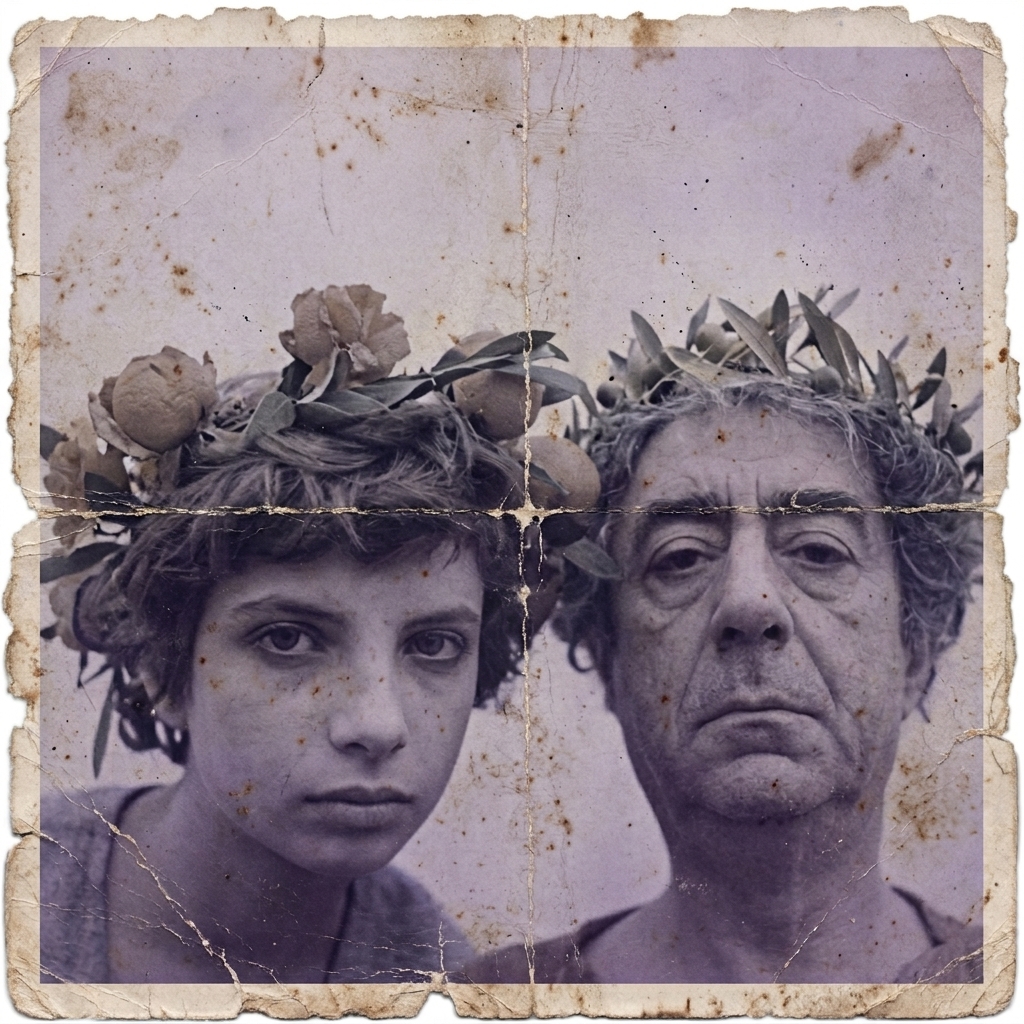
In his film, Fellini uses expressions in multiple languages: Italian, Latin, German, and Greek, and phrases and chants in Arabic also recur in some crowd scenes. He brings together human beings of different races and colors, films the largest fish ever shown in a motion picture with some twelve people hauling it out of the sea in a surreal scene, and shows many people wearing masks and enormous hoods on their heads, dwarfs, fat prostitutes, ships that appear in bizarre forms like huge toothed monsters, and naked groups of people shouting noisily and submitting in humiliation and meekness to the wealthy masters who dominate them. He has Encolpius and Ascyltos, under threat from a foolish highwayman, steal the sacred being, the hermaphrodite, who possesses the power to heal the sick, in order to demand a ransom for it. But when they walk with it in the desert under the sun’s rays, its throat dries up and it dies, as though they had destroyed the one who possessed the power of salvation.
Fellini Satyricon is a world without coherence, heterogeneous, composite, made up of images and associations that surge out of the world of dreams and appear as though they were revealing themselves to us upon the surface of the waters of a clear lake. It is Fellini’s own extended dream, about his ancient world, about Roman identity, about hell, in the material rather than the moral sense, hell “without purgatory and without paradise,” in Moravia’s phrase.
And no doubt the idea of non-homogeneity and the absence of harmony among the various segments seduced Fellini and led him to place his film within the context he chose for it, that is, without plot, without a clearly defined beginning, middle, climax, and end. The ending is truncated. In the final scene, Encolpius halts in his long monologue near the lake after realizing that his companion Ascyltos has disappeared. He calls him several times, but to no avail, then discovers that he is a corpse stretched out on the ground. He mourns him in poems of loss and weeps for him, then walks away sadly through the desert under thick black clouds. With gradual disappearance and reappearance, we then see him near a strange ship, telling us of his anticipated journey with a group of young men to Africa. Then he says that he visited many lands and met a Greek youth who told him… but he does not complete the sentence. The image freezes on him, then changes into a fresco painted on a massive rocky slab. And as the camera withdraws to the sound of whistling wind, all the characters of the film appear on separate ruined stone fragments. The “ancient world” has collapsed, and nothing remains of it but stones. Is that not what remains of ancient Rome?
Fellini says: “The humanists used the ancient inheritance in order to justify themselves and to express what was within them. They projected onto it their preconceived ideas about ‘the ancient.’ I, however, project nothing onto it. I have no preconceived ideas, but I see the ancient heritage as I see anything else, and I find it obscure, indeed profoundly obscure. It is a lost, vanished world. It has departed from us and we hardly know anything about it. We have no real connection to it, especially we Italians, who always pride ourselves on descending directly from it. It is a world utterly alien to us.”
On one of the rare moments in the history of Fellini’s cinema, we see him turn back to the remotest past, not through nostalgia, or longing for Rimini, his small hometown which he left in 1938 to discover the great “city,” or the “eternal city,” Rome, nor Out of a desire to look back in anger at what fascist Italy was in the 1930s, but toward pre-Christian Rome, pagan Rome in its fall and decay. Yet he did not wish to make a historical film, and he once described his I, Fellini as “a science fiction film, except that the journey takes place in the past instead of the future,” as the American critic Roger Ebert noted in his article in the Chicago Sun-Times on January 1, 1970. Although Ebert expressed reservations about what directors usually say about their films, he believed that Fellini was right in this description.
Fellini also says in I, Fellini: “When you choose a subject like Satyricon for your film, it is as though you are writing speculative science fiction stories. Instead of casting light on the future, the film casts light on the past. Distant time is no less strange than the unknown future.”
Fellini always insisted on the idea that he films characters without merging with them, taking care to maintain a distance separating him from them, and indeed from the film as a whole, a distance that allows him to contemplate without emotional surrender. That is why Fellini turns to many non-professional actors. He uses their faces after reshaping them to suit his own imagination, dresses them in strange clothes, and paints their faces with makeup that places them far from any notion of “the illusion of reality.” In Satyricon, he reaches the summit in his use of this estranging mode. He wants us to look at beings who seem as though they belong to another planet, yet are close to him, to his world, and to his city as well. In his next film, Roma, he will show us how the city lives above another city, above ancient Rome, and how it is inseparable from it. It simply needs to be discovered, and the ongoing relationship with it discovered as well, even if only on the level of imagination and fantasy, something that has increasingly tempted Fellini since he departed from neorealist cinema after Nights of Cabiria.
Fellini recounts to the American writer Charlotte Chandler, whose real name is Lyn Erhard, the story of his life and his relationship with cinema and the arts in I, Fellini, and says: “Petronius wrote about the people of his time in a language that we can understand now. And I wanted to recover the pieces of mosaic that had fallen and been lost. What was lost was precisely what pleased me, because it gave me the chance to fill it with my imagination and actually enabled me to become part of the story, to travel to that time and live in it. It was like contemplating life on the planet Mars in collaboration with one of its inhabitants, and thus Satyricon satisfied my desire to make a science fiction film.”

Writer, journalist, and Egyptian film critic

Egyptian Writer and Translator