



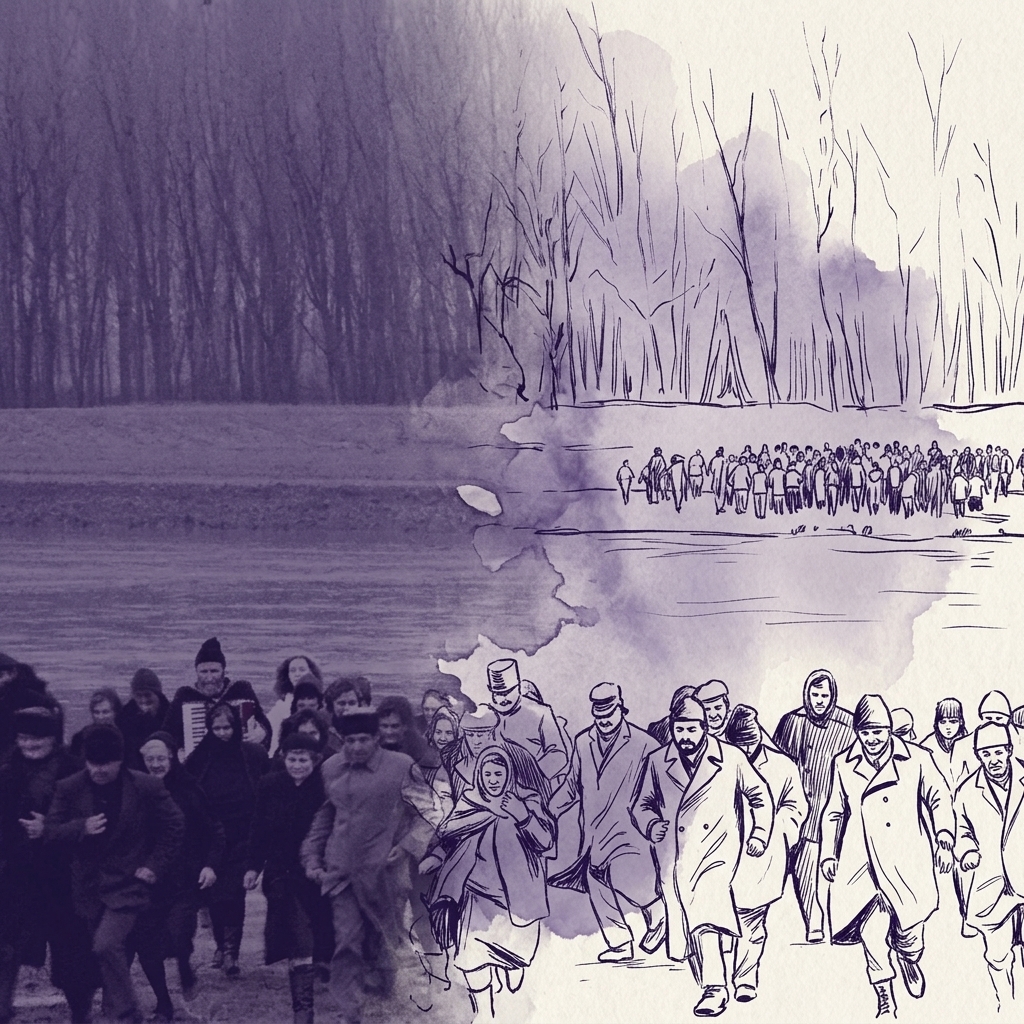



There are characters in literature and cinema who do not die in the traditional sense, yet fade gradually from the world, as though slowly and silently losing their human essence. We witness no clear moment of death, no funeral, no final farewell, and yet we sense that these characters are no longer present in the same way. Their presence dims, their voices soften, and their relationship to the world erodes little by little, while life goes on around them without concern, as if nothing had happened at all. This “fading instead of dying” has become one of the most profound themes in modern art, for it is not merely about the perishing of the body, but about the contemporary human being’s fear of losing all trace of meaning within a world that is fast, cold, and overcrowded. The tragedy here does not lie in the ending itself, but in the gradual transformation into an invisible creature, slowly forgotten within cities, memories, relationships, or even within itself. What makes this kind of character so painful is that it remains alive on the surface while gradually disconnecting from life: no longer capable of connection, belonging, or sustaining any genuine bond with others. These are characters who do not fall all at once, but erode silently within time, as though the modern world were erasing human existence piece by piece.
In modern literature, particularly in the work of Franz Kafka and Samuel Beckett, the human being no longer faces death as a clear and tragic end. On the contrary, he confronts a form that is both more obscure and more merciless: the gradual dissolution from the world. The characters of Kafka and Beckett do not collapse all at once; they erode slowly within time, isolation, and meaninglessness, until they become marginal beings who have nearly lost their human imprint entirely. They are alive in the physical sense, yet their existence undergoes a silent and continuous erasure, as though the world were withdrawing its recognition of them, degree by degree.
In The Metamorphosis, the tragedy of Gregor Samsa does not lie in his physical transformation into an insect, but in the collapse of his human standing in the eyes of others. The true metamorphosis takes place in the way his family sees him; the family that once depended on him begins, gradually and imperceptibly, to erase his emotional and moral existence, until he is nothing more than a burden to be shut behind a closed door. The room in which he lives turns by degrees into a space of forgetting, and his voice loses its ability to reach other human beings. Kafka is writing here about the fragility of human recognition, about a man who remains alive while the world ceases to see him as human.
This dissolution takes a more abstract and more desolate form in Waiting for Godot. Beckett’s characters live through a slow exhaustion within a waiting that leads nowhere. Vladimir and Estragon are trapped in an empty time, repeating the same words and movements in a closed loop, as if time had lost both its direction and its meaning. Waiting here becomes an existential condition that consumes the human being in silence. The theatre critic Martin Esslin saw in the “theatre of the absurd” a world in which characters have lost their relationship to meaning and certainty. This is why Beckett’s figures do not appear as beings moving toward any clear fate, but as human ghosts eroding slowly within the void, the repetition, and the long silence of the modern world.
It was from this precise literary inheritance that modern cinema emerged to give dissolution a visual and acoustic form. While literature had expressed disappearance through language, cinema began to embody it through image, space, and time.
In the cinema of Michelangelo Antonioni, disappearance becomes part of the visual language itself, not merely a passing event within the narrative. In Michelangelo Antonioni’s L’Avventura
(1960), “Anna” disappears during a sea excursion, but Antonioni does not turn her disappearance into a detective mystery; instead he makes it a mirror of the coldness and fragility of modern human relationships. Rather than becoming a lasting wound, Anna’s trace begins to fade gradually from the memories of the other characters, as if the world possessed a frightening capacity to swallow people and forget them with ease. This is where the tragedy resides: in the indifference that follows. Death grants a human being a final recognition of his existence, whereas dissolution strips him even of the right to be remembered. Antonioni’s characters therefore always seem suspended within an emotional and spiritual void, incapable of holding onto another person or preserving their trace, for modern relationships themselves have become fluid and erasable.
This existential dissolution reaches a different poetic peak in Andrei Tarkovsky’s Nostalghia (1983). If Antonioni films the disappearance of the human being within the coldness of modernity and the failure of human relationships, Tarkovsky films it within memory and exile, where nostalgia itself becomes a slow form of dissolution. The film’s protagonist lives in Italy, far from his homeland, yet he does not seem fully present in the place he inhabits. He moves like someone who lives more inside memory than inside reality. Nostalgia here is an existential condition that gradually engulfs the human being and severs him from the world around him. The character therefore seems perpetually suspended between two times: a present to which he cannot belong, and a past that can no longer be recovered.
The fog, the still waters, the ruins, the abandoned houses, and the distant sounds are the direct extension of the character’s inner state. In Tarkovsky, the place itself seems to erode slowly, and time moves with tremendous weight, until the viewer feels that the characters are living inside a long dream or a dying memory. This is why the long silent takes appear to grant the void a greater presence than the human being himself. Disappearance comes about through a gradual detachment from reality. The protagonist does not lose his body, but loses his capacity to live fully within the present. He is there, immersed in an inner world of memories, longing, and solitude, as though exile removes a person not only from his homeland but from himself as well. This dissolution can be observed in Ingmar Bergman’s Persona (1966). Here it appears as the gradual collapse of identity itself. The story begins with a stage actress named Elisabeth Vogler who suddenly stops speaking, for no apparent reason. But she falls silent because she has lost faith in language itself, as though words were no longer capable of expressing truth or offering the human being any stable meaning. This silence gradually transforms into a form of withdrawal from the world. Elisabeth does not disappear physically, but retreats from life, from communication, from her former self. With the arrival of the nurse Alma, the boundaries between the two figures begin to dissolve; their faces, voices, and confessions become so intertwined that the distinction between the two women grows uncertain and unstable. Bergman is no longer concerned with presenting two separate characters, but reveals a fractured self eroding from within, as if identity itself has lost its coherence. The silence in the film thus appears as a progressive collapse of the relationship between a human being and herself, between the true face and the mask that the world imposes.
In Theo Angelopoulos’s The Suspended Step of the Stork (1991), disappearance and dissolution appear as a choice that is at once existential and political. The character rumoured to have been a prominent politician does not simply vanish from the world; he withdraws from history itself, as though he has lost all faith in the language, power, and identity he once embodied. The character does not die, but ceases to belong to any clear place. The political figure in the film lives on the border itself, as if he had chosen to remain in a zone that belongs fully to neither side. This is what makes the border directly linked to the idea of dissolution: a person there loses both stability and a clear sense of identity, and his existence becomes provisional and suspended. In Angelopoulos’s cinema, borders are not merely a geographical line separating two states, but a suspended space between presence and absence, between memory and forgetting, between the human being and his former image.
The characters alwayss inhabit a state of incomplete passage; they never arrive, and they never truly return. This is why his long takes seem like time slowly wearing itself away, rather than a conventional unfolding of events. Disappearance here is a form of silent protest against a world that has lost its moral and political meaning. The character does not confront power directly, but through a complete withdrawal from the scene, as if to say that the modern world no longer deserves one’s participation. Dissolution in Angelopoulos’s work is therefore more cruel than death, for it leaves the human being suspended on the borders of existence, present as a ghost, and absent as a truth.
Thus the idea of dissolution travelled from literature to cinema; from the Kafkaesque and Beckettian language that reveals the human being as he is slowly erased from social and human recognition, to the cinematic image that shows him dissolving within place, time, memory, or silence. Modern art has become preoccupied with death conceived as this gradual disappearance in which the human being loses his trace and his relationship to the world. The tragedy no longer resides in death itself, but in the human being becoming invisible, fading in silence within a world that is no longer capable of seeing him or hearing his voice.