





The bench in front of our building was tempting to sit on, a concrete bench with a pot of basil at its center, its soft scent drifting into the surrounding air. And even though my feet ached from standing there every morning while waiting for the school bus, I refused to sit on it, so as not to dirty my school uniform or wrinkle it.
I used to watch our neighbor, Umm Abdullah, the mother of the mosque’s imam, a grandmother from the south who lived in the next building, come out in the morning to pick basil, and I wondered why, until I noticed the sprigs of basil tucked behind her ear when I saw her in the evening at the neighborhood mosque, where I attended the evening Qur’an memorization classes.
After that, I stopped wondering and simply watched her henna-stained fingers as they selected the basil. Noticing my watchful eyes on her, she would greet me, then pick it with remarkable skill, never damaging the shrub.
It was she who once asked me, in a raised voice, why I didn’t return her greeting, so I answered.
I used to think: Saudi women dye the whole of their palms with henna, red. And grandmothers put basil behind their ears, and they don’t like songs, because they’re forbidden.
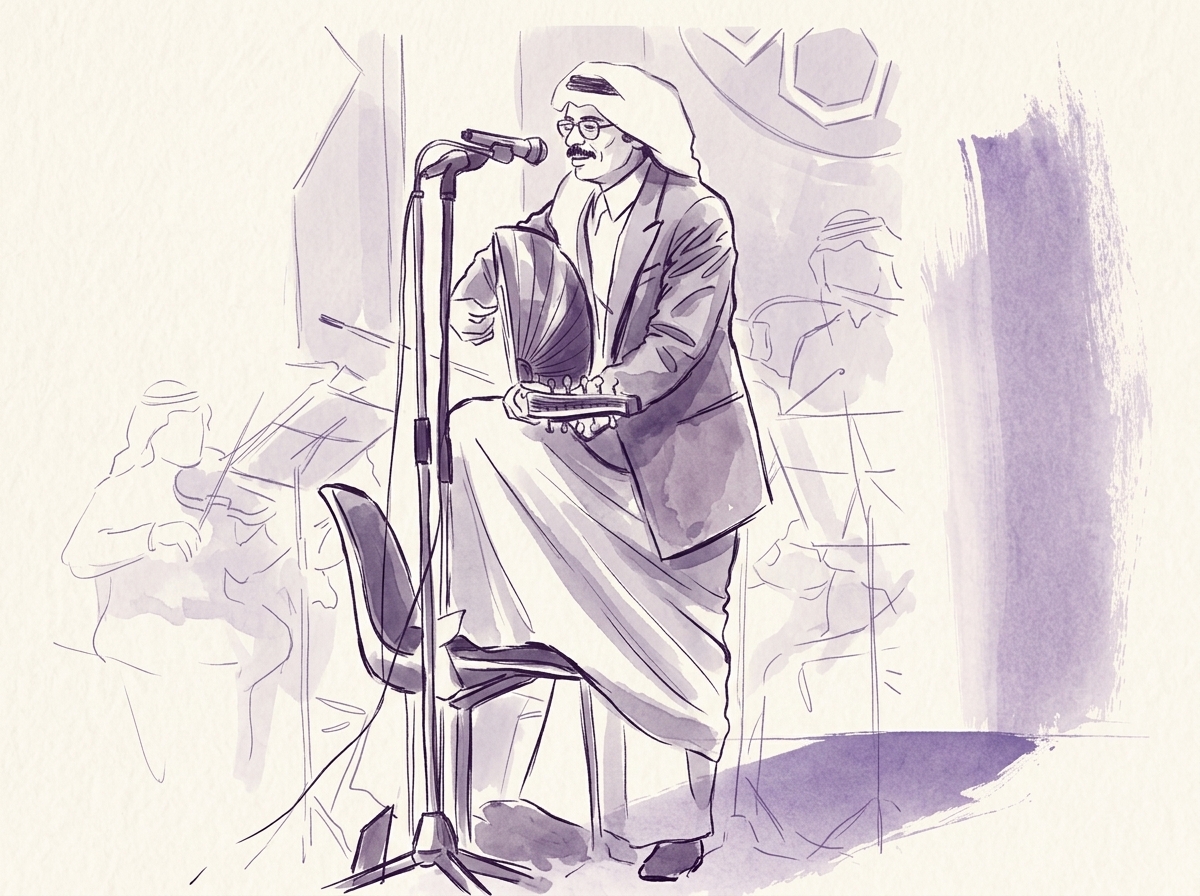
I remembered the day before, when Umm Abdullah and the women at the neighborhood mosque had talked about the death of some singer, on a stage. They sought God’s protection from the evil of what he had done and from that terrible death; one of them broke into tears, praying that God grant her a good end, another covered her face, wailing, out of fear of God. I stared at Umm Abdullah’s basil and thought: how wretched this man is. I decided afterward never to do anything I would be afraid of dying while doing.
My heart trembled as I remembered the scene while waiting for the bus, and I felt fear and loneliness. I was alone on the quiet street; Umm Abdullah had gone back to her building with her basil, and no one was left but me. A divine court appeared before me, convened for the singer by the people of our neighborhood, led by Umm Abdullah at the far end of the street, in which God tried the wretched singer, rebuked him, and shouted at him, but I stopped before the scene of him being thrown into the fire because I couldn’t bear to finish it. I closed my eyes and remembered I was wearing my new shoes for the first time, black boots. I looked at them proudly, felt reassured, and took a few steps in front of the building’s reflective glass gate to see how I looked in my new boots.
The trial scene tried to creep into the background of my reflection in the glass, but the bus arrived before it could.
The bus finally came, its sliding door opened, and I grabbed my bag and rushed toward it as the scent of basil gradually faded away. I climbed aboard and sat in my usual seat.
Uncle Khamis, the bus driver, remarked in his Jeddah accent: “Why don’t you say hello, Alaa?”
“I do say hello,” I answered.
The girls responded in calm, drowsy voices. Then Uncle Khamis drove the bus on to Shaden’s house, my classmate, the only one who talked to me on the bus, and who sang. She used to sing a lot, and every time the bus supervisor would scold her: “Don’t sing songs, it’s forbidden.”
I thought again: Saudi women dye the whole of their palms with henna, red. And grandmothers put basil behind their ears, and they don’t like songs, because they’re forbidden, some say “wash,” some say “eesh.”
Shaden arrived with her two older sisters, and unusually, they were sad that day, they who normally filled the bus with life from the first minute they got on, but that day they seemed switched off.
Shaden sat beside me, and didn’t start talking as she usually did, so I asked her how she was. She looked down and said she was sad because her father had left the day before for Abha. I thought they simply missed their father, so I asked her if he would be gone long. She told me he’d be back the next day, but that he was sad, and they were sad because of their father’s sadness, so I assumed the deceased must be someone close to the family.
“Dad went to Talal Maddah’s condolences.”
I asked her who this man was.
“Talal Maddah, the singer… how do you not know him?!”
Many questions came to my mind then: why would anyone go to the condolences of someone they don’t know personally, why would Shaden’s father, my close friend’s father, go to the condolences of a man who did something forbidden, and the more serious question, was this the same singer for whom a terrible trial had just been held in our street?
I swallowed hard… I asked her carefully: is this the singer who died on stage?
Shaden cried, and told me: yes… he was devoted to art until his last moment. Her voice broke as she said it.
I asked her: what do you mean by devoted?
She said: my father says a devoted person dies while doing something they love.
Her last words fell like a heavy stone into the still pool of my consciousness.
“He dies while doing something he loves”
The phrase kept turning in my mind the whole way, pulled between the Hijazi and southern accents of our neighborhood, and tugged by the “wash and eesh” rules that stirred through my childhood.
How could death, which Umm Abdullah had painted for me the day before as the ultimate punishment, be, in Shaden’s father’s eyes, proof of devotion?
When we arrived at school and got off the bus, I felt a new weight had been added to my new boots.
All that day, I wasn’t fully focused in class. I sat beside a subdued Shaden, watching the absence of her usual joy, and the wooden benches seemed harder and more rigid than ever. During calligraphy class, tracing letters with childlike concentration, I studied the white inside of my palm; it wasn’t dyed with red henna like the palms of Umm Abdullah’s granddaughters, my own grandmother didn’t put basil behind her ear, I wasn’t like Shaden, my father didn’t talk about art, I didn’t know the difference between “wash” and “eesh,” I didn’t know what had become of the trial at the end of our street, and in that moment I felt a double exile: the exile of the child who doesn’t resemble the details of the place around her, and the exile of the idea that had split inside my head into two halves that never met.
I looked out the classroom’s small window at the sky, and wondered: is God right now shouting at the singer, or rewarding him for his devotion?
The school day ended, and the mood on the bus home carried the same monotony as the morning. The singing was completely absent this time, and the supervisor scolded no one; a heavy silence hung over the bus, like the silence of houses whose fathers had left for Abha. When I got off at the turn of our street, Jeddah’s humidity had turned into a suffocating heat. I looked at the concrete bench; the basil pot looked colorless to me under the vertical sun, as if it had turned into an archive.
I climbed the stairs of our building slowly, went into the apartment, took off my shoes, and looked at them; they no longer gave me that complete morning pride, the questions had ruined it.
That night, I fell asleep wondering about the secret of that man who made the streets, the memorization circles of our neighborhood mosque, and our school bus all change their moods simply because he had stepped off a stage.
Talal Maddah’s name remained in my mind tied to a memory carrying within it a discordant mix of feelings, thoughts, and judgments, and the worlds within that memory were sharply divided: the world of the neighborhood’s trial, the world of Shaden and her father, and my own world, inside my head, where I processed all these inputs.
The singer Talal Maddah’s death formed a deep emotional and intellectual turning point in my character; my heart loved the songs Shaden used to hum and savored the devotion her father had described, while in my mind sat Umm Abdullah, seeking God’s protection from the evil of what he had done.
And between the two, I kept wondering: doesn’t God command us to be devoted? So why would Talal Maddah be put on trial?
From that time until my adolescence, the memory remained nothing more than an intellectual and emotional conflict, until the day I dared to ask Shaden to lend me a Talal Maddah cassette.
She told me: I’ll ask Dad’s permission and get back to you.
I told her: I promise I’ll take care of it.
The next day, Shaden told me: Dad didn’t agree, because it’s forbidden at school. I felt crushed.
I felt her hand slip something to me under the table: it was the cassette.
She told me: I stole it… if you get caught, that’s not my problem.
I felt a vague dread, I was holding Talal Maddah’s voice, the voice of the earth. I counted the hours until I could go home, smuggled my little Walkman into my Qur’an-memorization bag, fixed the earphones in my ears, and listened… at last… to Talal Maddah’s songs… in a bold act of possessing the forbidden.
That evening, I slipped through the mosque’s long corridor to the bathrooms. Behind me, the voices of my classmates in the memorization circle droned in a monotonous collective rhythm, reciting verses and searching for serenity, while I walked in the exact opposite direction, carrying my greatest secret in my small bag.
I went into the last bathroom at the end of the corridor. It was the darkest and least used. I pushed the heavy wooden door and turned the old iron latch. The latch made a sharp, sudden creak that froze the blood in my veins for a few seconds, before settling into place, declaring my complete isolation from the world.
The air inside the narrow bathroom was cold and damp, thick with the sharp smell of cleaning products mixed with stagnant water on the tiled floor. I looked at my reflection in the small mirror fixed to the door; my eyes were wide with pure childish terror. I felt around for the cassette at the bottom of my bag, and with trembling fingers, took out the small player. I placed the cassette inside with great care, pressing the lid down slowly so it wouldn’t make the familiar click that would give me away. I wound the black earphone cord, ran it under my headscarf, then lifted it behind my ears so it would disappear entirely under my abaya. I put my finger on the play button.
I wasn’t just going to listen with my senses, because my whole body had become an alert radar. My eyes were fixed on the bottom of the door, watching the small gap between the wood and the floor, on guard for any sign of the supervisor or another student arriving. And my ears split into two contradictory worlds: an inner world waiting for the sound, and an outer world catching the faintest noises in the corridor, the snap of fingers, the rustle of abayas, the echo of recitation coming from the main circle.
I pressed the button, and the first magnetic hiss ran through.
Then Talal’s voice broke out.
It was calm, clear; his voice washed over me as if it were a halo of light breaking into the darkness of a cell.
Suddenly a vague fear swept over me: I imagined the door being torn open, the cassette confiscated, Umm Abdullah leading the terrible trial from the mosque corridor into the heart of the street, everyone shouting in my face. An overwhelming urge to cry took hold of me, but my fear was bigger than my tears. I reached my hand very slowly under my headscarf and pressed the stop button. The sound cut off suddenly, and the bathroom’s suffocating silence closed around me again.
That night, sleep found no way to my eyelids. As soon as the house had fully settled, the lights had gone out, and the family had sunk into deep sleep, my room turned into a secret laboratory of joy. I played the cassette over and over, flipping it between sides A and B, with an insatiable hunger. I placed the player under my pillow, and Talal’s clear voice flowed warm and pure, as if it were washing away every fear lodged in my nerves. The music drove out all the fears of the divine trial, and my whole mind became fixed on one urgent thought: “I want more. I want Shaden to buy me lots of cassettes… every single one of Talal Maddah’s cassettes.”
The thrilling idea soon collided with the solid wall of our reality; songs in our house weren’t just a passing mistake, they were flatly forbidden, and discovering a single cassette bearing a singer’s name meant a certain family catastrophe that would wipe out all of my small margins of safety. The obstacle was enormous, and the strict surveillance at home demanded a different approach.
After days of thinking and silently contemplating the stacks of cassette cases piled on our home library’s shelves, wishing for some magical way to turn them into song cassettes, I hit upon a brilliant idea. I looked at the religious lecture and recorded seminar tapes that filled the house. I wondered: “What if these tapes stayed exactly as they looked on the outside, while carrying Talal Maddah’s songs on the inside?”
The plan involved recording the songs over the original lecture tapes, so that the case and outer cover would look, to any inspecting eye, like an ordinary religious lecture, while the songs stretched across the reels underneath.
I began gathering the neglected lecture tapes around our house, and carried them very carefully in my school bag to Shaden’s. Shaden, who had now become my partner in this passion for art, welcomed the idea with the recklessness of teenagers trying something for the first time.
At her house, away from watching eyes, we ran an artistic piracy operation carried out by two teenage girls skilled at solving problems. Shaden would run two tape recorders at once, pressing play and record at the same instant, so the sound of sermons and speeches would transform into art, slowly and retroactively, like traveling back through time, moving forward.
What was oddly touching about those pirated tapes was that the copying process was crude and rudimentary, yet satisfying all the same. When I went home and put the earphones in to listen in private, behind Talal’s clear voice I could hear other sounds and interruptions the recording had picked up; sometimes I clearly heard the sound of doors closing in Shaden’s house, or distant murmurs of their daily family conversations.
When I told Shaden about the security gaps in our pirated tape, she laughed and swore to me she put the two recorders deep inside her wardrobe, shutting the wooden doors tightly to block out any outside light or sound.
We would trade those tapes under the tables, our faces giving nothing away, while our hearts danced with joy at our small victory over the strict systems around us. I would go home, place the supposed lecture tape in front of everyone in the recorder, fix the earphones in place, and smile with overwhelming delight as I watched my family reassured by the dignified outer label, while in my ears Talal was singing, along with the distant sounds of doors from Shaden’s house. That trick was my own carved-out space of freedom, my first noble act of resistance in defense of a beauty I had chosen for myself. And despite the thrill of victory, my chest often tightened with fear, and every time I held those falsified tapes, a suffocating sense of guilt crept over me, and Umm Abdullah’s stern gaze and the bus supervisor’s warnings would appear in my imagination.
I would ask myself, confused: am I disobedient? Am I leading myself to that trial? What if I died while listening to songs?… But the moment I fixed the earphones in place and Talal Maddah’s clear voice rang out, all those terrifying doubts would dissolve. His joyful voice held a strange power to cleanse my soul of fear, filling the corners of my room with a peace that dispelled the charge of sin, and convincing me that this pure beauty was too great to be a wrongdoing.
Art was, for me, the only bridge across the distances of diaspora; in Talal Maddah’s voice, my early sense of being a stranger in Saudi Arabia dissolved completely. I never once felt, toward this art, that it belonged to others; I felt I was a genuine part of those Talal sang for.
Art is an exceptional state, one that makes the long weight of reality lighter, so the moment a song ended and I returned to the ground of reality, all the thoughts would wake back up inside me, returning me to my confinement as a watched being; a watching creature who understood with cold clarity that it had no full right of belonging here: not historically, not geographically, not even ethnically. Reality always shrank me down, and pulled me back, against my will, to the small square of that child standing at the turn, watching the basil pot with love, drawn in by its heady scent and vivid colors, yet standing there helpless, without the courage to pick it, not knowing how to place it behind her ear.
Our exile was never just a distance measured in kilometers between two geographically close shores; for me, it was a far deeper existential matter. I lived torn between two continents; I never fully belonged to those I lived among in Jeddah, nor to those waiting for me in Sudan. I was a stranger in both cases, unlike either of them, with no guide to teach me how to blend in or be a genuine part of either. In Saudi Arabia, I was the Sudanese girl watching the basil, and in Sudan, I was an “Arabian-certified” girl who spoke a different dialect and carried different traits.
But once again, beneath the weight of this cultural wandering, I found my own way toward belonging, unconsciously; and I realized I could use the same trick to restore my Sudanese identity. It dawned on me that I could copy Sudanese songs onto religious lecture tapes too.
I remember clearly that the first tape I pirated, again with Shaden’s help, was the album “Amrak Ya Helou” by the duo Al-Tawmat man and Amani. I had obtained the tape during one of my sentimental adventures on one of our brief visits to Sudan, and once again, in Shaden’s closet, we built for me a hybrid homeland, secret, needing no one’s permission.
Around this time(in August), the twenty-sixth anniversary of that legendary departure of Talal Maddah passes, on the stage of the Al-Muftaha Theater in Abha. Twenty-six years have gone by, during which places have changed, the old street trial has collapsed in my mind, and the features of the child I once was have transformed. The old warnings have faded, the narrow bathroom door in the memorization house has opened onto Jeddah’s open sky, and the scent of faithful basil now fills the air.
“I wrote your name upon my voice
I wrote it on the wall of time
On the color of the calm sky
On the valley
On my death and my birth”