



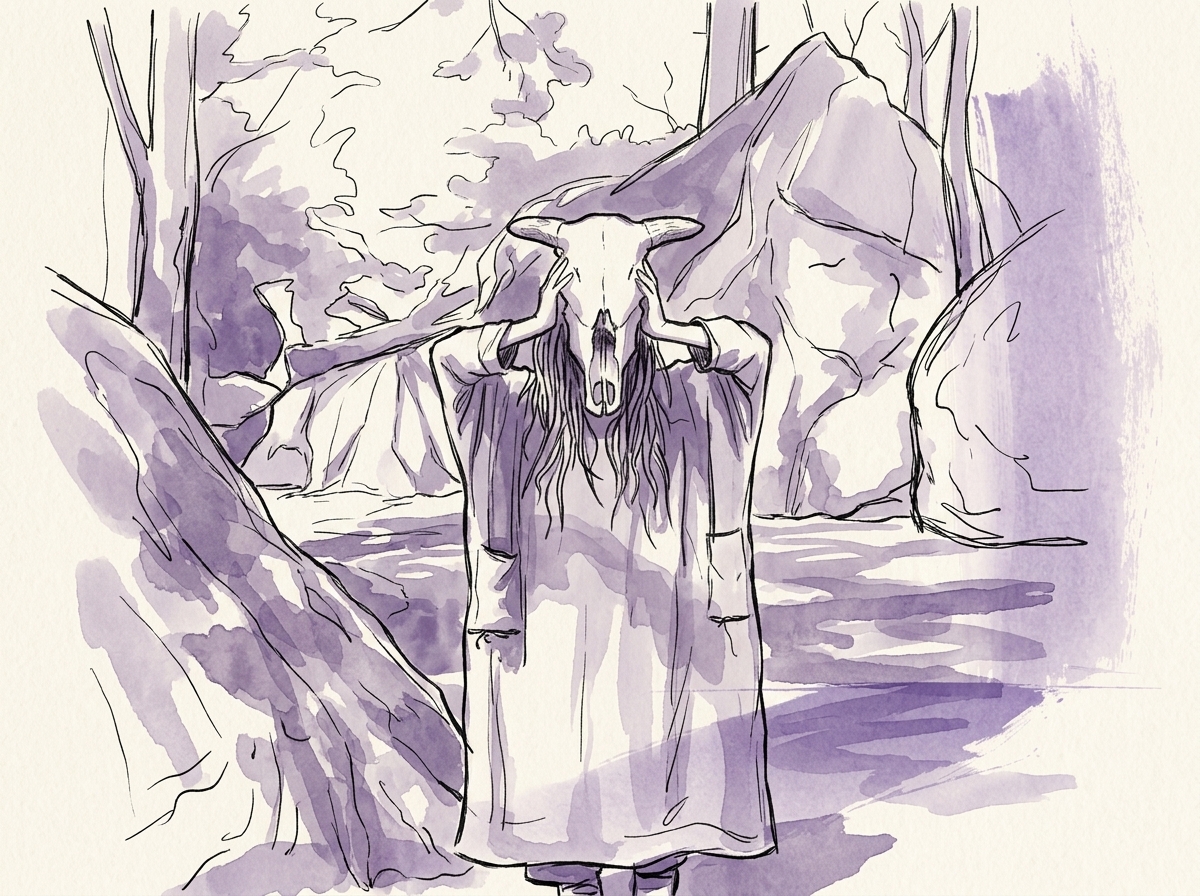


Ever since humans began grouping themselves together, it has seemed that they can know themselves only through their opposite. That opposite was not always an outside enemy or some unknown natural force; very often it was someone from within the group itself, bearing the same features, speaking the same language, living under the same roof or sat beside the same fire, yet remaining, for reasons difficult to name precisely, outside the true radius of belonging. Over the centuries, this opposite took on ever-renewing, self-replicating forms: the stranger who speaks with the wrong accent, the minority who prays at an unfamiliar hour, the dissenter who raises a question at the wrong moment, the one who differs in voice, in rhythm, or in the way they look at things. Societies discovered very early on that preserving their inner unity takes more than mutual agreement alone; they also require someone excluded from that agreement, someone made to carry what others refuse to, someone who becomes a living repository for everything the collective fears to see in its own mirror. This need for an inner opposite is far older than any social institution or written law. Its roots reach into a deep evolutionary structure tied to how the earliest human groups formed and survived in environments that punished individuality and rewarded dissolving into the mass. A person who resembled those around them was safer within a herd that demanded unity to hunt, defend itself, or migrate, whereas a person of deviance represented unsettling possibilities: perhaps weakness, illness, or tendencies which could scatter the group and waste its energy. What began as a strict, necessary survival mechanism turned, over time, into an entrenched psychic inheritance that operates automatically, without conscious decision, even in contexts threatened by no real danger at all, so that difference itself now triggers that same ancient defensive response: wariness, active exclusion, and the wish to restore things to a familiar, reassuring order.
Social neuroscience contributes an important part of this story by showing that the human brain processes social exclusion in the very same regions that process physical pain, a discovery of great significance. It suggests that the experience of rejection is not merely an emotional metaphor or a poetic exaggeration for describing hurt, but real pain in the fullest physiological sense of the word, pain that leaves its mark on the nervous system and alters how the brain processes information afterward. A person who has suffered repeated rejection begins to receive every new social situation through a layer of pre-emptive negative expectation, grows more sensitive to signals of refusal, and reads potential threat into ambiguous situations even when none exists. This is what produces the painful contradiction lived by many who experience early rejection: they want belonging and fear it at the same time, drawing near and then pulling back, offering what they can offer, then reading any spontaneous distance from the other as proof of what they already expected. In this way, the old wound turns into a predictive mechanism that reproduces itself in every new relationship.
‘The black sheep of the flock’ compresses this idea into a single visual, and it goes a step further. This phrase acts not only to point out surface level differences, but draws a line around an entire social role that carries with it expectations, penalties, and unspoken procedures. Whoever assumes this role usually knows it before the group ever names it explicitly. They know it from the silence when they enter a room, from the way eyes shift when they speak, from that strange sense of always needing to justify their presence or offer additional proof of their worth in situations they enter. It is a feeling unknown to whoever sits at the centre of belonging, because their existence needs no justification, their worth is assumed in advance, and confidence in their belonging is a source of energy rather than a cause of anxiety. This disparity in starting point, between someone who feels their belonging is defaulted and someone who feels it as a privilege they must continually prove, produces entirely different life paths even when outward circumstances look similar. What makes the black sheep’s experience so intricate is that it forms within an ongoing, mutual relationship with the very group that produces it. The rejected person does not remain static in the face of rejection, but responds to it and adapts in various ways that shape their personality, their way of thinking, and their relationship to themselves, in ways that later become hard to untangle. Some absorb the spoiled identity, as Erving Goffman described it in his analysis of social stigma, coming to believe the definition the group gave them and beginning to see themselves through it, as though it were the only possible truth about them. Others reject that definition and develop a rebellious self that takes pride in difference and turns it into a parallel identity. Some even adopt both approaches at certain junctures of their day and of their life. They may believe their imposed identity in moments of fragility, reject it in moments of strength, living in this exhausting oscillation between two inner voices that never stop disagreeing.
Despite spurning them, the group is somewhat dependent on the black sheep’s presence as a negative mirror showing it what it does not want to be. It defines its identity, in large measure, by comparison with the one it has excluded, and renews its inner cohesion each time its members engage in commentary on that difference or in standing together against what it represents. This process operates with even greater intensity within the family dynamic. Being the first and most deeply formative of all groups, it takes only a family history of organized silence around some particular matter, an addiction, a betrayal, a failure, an unaddressed shame, for that history to be reproduced in a single child. They become both the keeper of the secret and the bearer of the shame at once; a child punished in subtle ways when they break the agreed silence or threaten the image the family wants to preserve of itself. René Girard built an entire theory on this observation when he argued, in Violence and the Sacred, that what groups do to their victims is not an occasional aberration but an indispensable structural mechanism. Groups generate within themselves tensions and accumulated violence that threaten them with internal collapse. The spontaneous outlet they resort to is redirecting that violence toward a single target, a scape goat, who alone bears the full weight of accumulated collective anxiety, before being put to death, expelled, or marginalized. Thus, the group can regain its temporary balance and its recovered sense of purity. What matters most for Girard is that the choice of victim does not follow the logic of real guilt. The victim is chosen because they are suitable for selection, different enough to appear external to the group’s symbolic consensus, but not so different that condemning them becomes politically or socially costly. They fall precisely within the zone that lets the group condemn them without paying any price for it.
Yet, Girard describes the moment of collective selection without describing what happens afterward to the selected subject, what unfolds as they gradually begin to believe what has been said about them, and to see themselves through the very eyes that rejected them. It is this gap that Erving Goffman places Stigma. Through a precise analysis describing how a single trait in an individual, their voice, their origin, their manner of speaking or of solving problems, even their silence, turns into a total, sweeping classification that entirely redefines their personality in the eyes of those around them, making everything they do readable only through this prior label. They cease, from that point on, to be an individual with a history, complexity, and inner contradictions worth getting to know, and instead are reduced to ‘the odd one out,’ ‘the misfit,’ ‘the difficult one,’ or ‘the eccentric’. Every subsequent detail of their life is read in light of this pre-existing judgment, a judgment that precedes any real encounter and makes genuine encounter impossible from the offset, since the other person arrives already carrying a verdict. The cruelest thing Goffman’s account reveals is that the stigmatized person gradually absorbs this distorted identity without ever deciding to do so consciously, and begins seeing themselves through it as though it were the only possible truth about them. And so, the prison becomes doubled and airtight in a way, requiring no warden. The prisoner becomes their own guard, the prison of the group that classifies them, and the prison of the self that internalised this classification and went on living within it, reproducing it in every new situation. A child who grows up inside this role learns, very early on, that something in them disturbs those around them, and that this disturbance seems like a fixed truth about them rather than a passing incident. In early childhood, they lack the cognitive tools to objectively question the source of this disturbance or the family dynamics that produce it. They interpret what happens to them in the only way available: that the problem stems from them, and that the solution lies in their changing, in becoming less than what they truly are. This conviction, taking root in years when critical thinking has not yet reached sufficient maturity, remains embedded in the psychic structure as a silent inheritance shaping every decision, every relationship, every ambition to come. And even once the person grows up and becomes intellectually capable of seeing what happened to them, rational understanding of the mechanism does not automatically erase the emotional trace left by long years of absorbing it.
The deep paradox of the black sheep’s experience is that the very traits which make them unsettling to the group are, very often, the same traits that give them special value from another angle. The heightened sensitivity that makes a child cry easily, making them ‘the problem’ in a family that glorifies toughness, is the very same sensitivity that might later make them an artist, a therapist, or someone able to see what others miss. Likewise, the tendency to question and challenge, which disturbs the group is gets labeled rebellion, arrogance, or difficulty adjusting, is exactly what sometimes drives discoveries and ideas that never arise from quiet conformity. The points of difference that the homogeneous group punishes is, at the same time, precisely what any group keen to evolve and respond to changing environments actually needs. This contradiction between what the group punishes in the present and what it may need in the future is part of the tragedy; often the black sheep does not recognize the value of what they carry until after they have spent long years trying to rid themselves of it.
On this matter, literature accomplishes insight no theoretical framework alone can achieve. It grants us access to the inner structure of a character at the very moment of their rejection, allowing us to see where exclusion begins and how it seeps into the way a person looks at a door even before opening it. When Gregor Samsa dies in The Metamorphosis, and the family feels that strange lightness filling the apartment, leading them to talk of going out for a walk in the sun and moving to a smaller flat, Kafka is not offering an exceptional scene but presenting the distilled truth of a situation that had existed all along. Gregor was treated as a burden even before his physical transformation, playing the role of the silent provider allowed to exist only as long as he produced and asked for nothing. And once his production stopped, the presumptions that had always hung over his head landed. What a chord in those that have lived similar experience is that Gregor himself comes, in a gradual silence, to accept that he has become a burden, and that his death will bring relief to those he loves. This acceptance is the most painful part of all, because it shows just how deeply the mechanism of rejection can burrow when it operates, over years, within the most intimate of spaces. Meursault, in The Stranger, lives a different experience in form, but one springing from the same source. He refuses to perform the emotions society expects of him, simply because he does not possess them in the required shape. This quiet refusal becomes, in society’s eyes, more dangerous than any overt rebellion, because this kind can be classified and dealt with. Whereas, someone who refrains from the normative framework of emotional expectations without ever declaring it unsettles the group in a way that finds no ready name. This drives society to reach for the harshest tool it has, deeming them ‘a soulless being.’ Such a label says more about the group that chose it than about the person to whom it is applied. The prosecutor, moreover, entirely reconstructs Meursault’s character through others’ testimonies of him rather than through anything he says about himself, until Meursault becomes the least credible party when it comes to defining who he is. The verdict is delivered before the trial even ends, because it had already been delivered implicitly before it began. The old colonel in Márquez carries another kind of rejection, the rejection of memory itself. The colonel who waits, for fifteen years, for a letter that never arrives, carries alone the weight of an unfulfilled collective promise, and his very presence reminds the village of the dreams it abandoned, of the promises it deliberately chose to forget. In this, he becomes a silent rebuke to everyone who chose forgetting as a strategy of survival. The rooster he refuses to sell despite real hunger is the last tangible remnant of a world that still promised meaning. Those who retain the memory and refuse to let go of it become a moral burden on a society that wishes to forget and move on.
Turning to Arabic literature, we find individual rejection intertwined with collective rejection, so that the single outcast becomes the bearer of crises far larger than themselves: the crisis of identity in the postcolonial era, the crisis of gender and body in patriarchal societies, the crisis of a collective memory no one wants to carry. Mustafa Sa’eed, in Tayeb Salih’s work, recognizes his own rejection and turns it into a strategy of attack. He understands the colonial expectations the West projects onto him, anticipates them, and wields them as a weapon, becoming what the West wants to see in him, but from the position of an agent, not a victim. Yet, even as he instrumentalises the stigma, the identity built around him remains what determines his movement and his final fate, as though escaping the mechanism of rejection by using it only reproduces the same confinement in a more twisted form. The Sudanese village the narrator returns to, meanwhile, has no fitting category for Mustafa, and so leaves him suspended in mid-air without explicit judgment, and this very suspension is itself a form of exclusion, all the harder to object to because it carries no name. Firdaus, in Nawal El Saadawi’s work, offers a different path. She tells her story hours before her execution, and what she tells is nothing but the cumulative effect of a rejection that began early and built up patiently, a rejection that decided, from the start, what she had the right to feel, what she could do with her body, where her silence was acceptable and where her speech was. When she says that what she did was the only free act of her entire life, she is diagnosing what some who are rejected and confined for too long eventually arrive at. The one act in which they feel they truly own themselves becomes precisely the act that will condemn them, because every other act was constrained by expectations they never chose. And in Kanafani’s Men in the Sun, this mechanism reaches its most systematic form. Abu Qais, Assad, and Marwan die inside a tanker because no one heard their knocking on its walls. Kanafani presents them with all their human detail before letting them die, so that we understand that what died were not numbers but real people carrying hopes and fears. The silence which killed them was a conscious choice, repeated at every stop along their journey: the choice not to be asked, the choice not to be seen, the careful organization of an absence that leaves no trace to demand accountability.
All these forms of rejection that literature has drawn extend as well into everyday life, in more ambiguous shapes less easy to trace. The migrant’s experience, for instance, adds a geographic and linguistic dimension that condenses the entire mechanism into a single body carrying two histories. The migrant embodies in their accent, in their laughter at something no one around them finds funny, an entire history that goes unseen and unheard in the new society, a society that expects them to start from zero, as though they had been born the moment they arrived. The new society carries a ready-made image of what an acceptable migrant should be, an image combining gratitude, compliance, and a sufficient speed of assimilation. Any migrant who departs from that image finds themselves facing a question posed in various phrasings and from multiple directions: why haven’t you integrated yet? Embedded within that question is the prior judgment that failure to integrate is a personal failing, not a natural response to a complicated situation. What makes the migrant’s experience distinct within the context of rejection is what Homi Bhabha called the ‘third space,’ that zone belonging neither fully here nor fully there, producing, instead of double belonging, a double absence. The society of origin sees the migrant as having changed and no longer belonging properly, while the new society sees them as not yet having become what they ought to. Between these two judgments, the migrant spends a long time in an exhausting negotiation with their own self-image, trying to decide which parts of themselves to keep, which to adjust, which to hide, and in which context. This ongoing negotiation consumes enormous energy despite it slipping under the radar for anyone who has not lived through it. For them, it can be easy to overlook the energy spent managing multiple identities, watching for reactions, and constantly translating, not only between languages but between ways of being. One’s mother tongue, the one in which they firat learned to think, dream, love, carries the most intimate details of the inner self. Whereas, the new language, whose grammar, and perhaps even style, one may master, often remains the language of the outside. This distance is neither ignorance nor refusal, but something far harder to name, because true belonging requires a shared memory beginning in childhood, something an adult migrant can never manufacture no matter how much effort they make. And a person who grew up different in their original society before emigrating carries with them two layers of experience with rejection, not one; they already knew the feeling of not belonging before leaving, and upon arrival find the same patterns repeating themselves in different forms. What unites, then, the black sheep of the family, the outcast in society, and the migrant in a new country is one thing, the sense that existence itself requires constant justification. They feel that just their presence in a room is not a given but something that must be earned each time and proven anew. This feeling leaves its mark on how a person walks, speaks, occupies space, on how they shrink their presence upon entering a room, on how they apologise before asking questions, and on the recurring need to confirm that their presence is welcome before doing anything at all.
The group does not need to demonstrate over hatred of those they reject. It is substantial that they refuse to ever see them fully, that they keep them at the periphery of their vision, of their community, where they can be summoned when the group requires them for confirmation of its own self-image. This selective overlooking is what makes soft rejection more lethal than open hostility, because open hostility identifies an opponent and gives them a position from which to defend themselves. Whereas, selective overlooking leaves the subject in a permanent haze, unable to tell whether what they feel is real or exaggerated, whether what is happening to them is a deliberate pattern or just a string of unfortunate coincidences. It is here that Gayatri Chakravorty Spivak, the Indian scholar regarded as one of postcolonial theory’s leading thinkers, poses her famous question: “Can the subaltern speak?” The question that has nothing to do with the physical ability to produce sound, but touches on something far more unsettling. Can someone who has been marginalised and rejected produce a discourse that is heard, recognized, and taken seriously within a system that excluded them in the first place and set the terms of their silence? Or does that system itself determine what counts as legitimate speech worth listening to, and what counts as mere emotional noise or personal grievance that never rises to the level of real discourse? This question remains open and disturbing across all the contexts we have surveyed. Anyone writing today about the experience of rejection from the inside faces a difficult paradox: the language they write in, and the platforms they publish through, all belong to a system with its own standards for what counts as legitimate analysis and what counts as mere personal complaint. And often the most resonant literature on the phenomenon of rejection has come from people who were, at the very same time, writing about themselves, about years spent wondering why they resembled no one around them, before discovering that this very question was the most honest one they could ask.
There remains, then, at the closing of this whole analysis, a question left hanging, one no theory can answer entirely. What becomes of the so called ‘black sheep’ who after a lifetime in the role came to understand what had happened to them, to understand that the flaw was never theirs, and that the role assigned to them served the group’s need, not their own truth? This realisation tends to arrive late, after years shaped by a definition they never chose, and it is a realization that does not resemble victory, because it reveals, at the same time, the price paid in its absence: every relationship built on the assumption of personal defect, every decision made from within a distorted identity, every voice muted or hidden so as not to disturb those around them more than they already were. The trouble is that this epiphany does not give back the years, nor erase what has taken root. Yet, it does something more intricate still, it lets the person see, slowly, that what they took for their nature was only ever an adaptation, and that what they took for their flaws were, very often, the most honest parts of themselves, the parts that refused to conform to what they were asked to become.
Someone who lives for many years in the position of the black sheep develops an extremely complicated relationship with belonging itself. They want it and fear it at the same time, in a way they cannot always explain to themselves or to those around them. They want it because the need to belong is a primary need that never disappears no matter how much rejection a person endures. And they fear it because every past experience of belonging ended in the same painful discovery, that acceptance was conditional, and that condition is withdrawn the moment they stop performing the required role. This is why many ‘black sheep’ tend to create a protective distance ahead of rejection itself, a buffer zone, to be the first to withdraw before being pushed out, to interpret any passing silence as the beginning of the usual exclusion, to make trust difficult for themselves even when it is possible and safe. This constant state of readiness, which may appear from the outside as coldness, pride, or indifference, is nothing but a protective system built by years of harsh learning.
The black sheep’s relationship with anger is a particular and exhausting one, because anger from the position of the rejected always carries a double danger: ordinary anger already unsettles the group and calls up defensive reactions, but the rejected person’s anger reconfirms the very label placed on them. It is repurposed as proof that they are ‘difficult,’ ‘aggressive,’ or ‘unable to fit in.’ They find themselves facing an unfair choice, express what they feel and hand the group an added pretext, or swallow what they feel and keep performing the expected role. Many choose to swallow it, for a very long time. They become masters at hiding pain behind excessive competence, or behind humor that turns everything painful into a joke that can be passed around. Yet, this concealment costs more than it appears to, because it requires constant energy to manage the gap between what is felt inside and what is shown outside, energy that is always drawn from somewhere else.
Perhaps the strangest phenomenon in the psychology of the black sheep is that, at times, they defend the very group that excludes them, justify its behavior, find it excuses, and postpone acknowledging what is happening to them far longer than they should. This defense does not come from foolishness or weakness, but from a deep psychic need to believe that the group they belong to, or wish to belong to, is a fair one, that what is happening to them is the exception rather than the rule, and that things will improve if they themselves improve. This conviction gives them the strength to carry on, but at the same time keeps them in place far longer than they should stay, and hinders their ability to see the pattern repeating itself. Breaking out of this pattern, when it happens, is rarely a conscious, deliberate decision, but rather a moment of accumulation, a moment when the gap between what is said and what is lived grows too wide for any reassuring story to bridge. And perhaps this is what society truly fears most in the black sheep: not their difference in the present, but the possibility that one day they will understand that their difference was never a problem needing a solution, and that the years spent trying to fix themselves wasted energy that could have been re-routed for the common good.
But when the black sheep reaches this moment, the moment of ceasing to want to belong to a group that never wanted them as they were, something unexpected usually happens. They do not turn into someone cold, withdrawn, or bitter, as the group likes to imagine, but instead begin to discover that all the energy once spent managing the gap between what they felt and what they showed, justifying the group’s actions, making themselves small so there is room for those who believe themselves the standard, all that energy suddenly becomes available for something else. This liberation from the wish to belong is not a clean victory nor a neatly arranged happy ending, but something more like a space that slowly opens up, a space in which the person can, for the first time inquire who they really are outside the definition the group gave them. More importantly, they can hear answer without measuring it against a standard they were forced to internalise.
Throughout all of history, it has been the black sheep who changed what is most essential in how humanity thinks about itself. Only those placed outside of consensus can see that consensus for what it is, notice what everyone else is supposed to ignore, and ask the question everyone else is supposed to consider improper. Simone de Beauvoir, in writing The Second Sex, was writing from within a society that did not want to hear what she had to say; Frida Kahlo, in painting her broken, atypical body, insisted on a visual language no one of her time knew how to receive; Copernicus, in announcing that the Earth revolves around the sun, was dismantling an entire collective certainty in the face of ridicule from those who considered themselves the sole guardians of knowledge and science; Averroes, in holding to his interpretations against juristic consensus, paid a steep personal price for an idea that bore fruit only centuries after his death. All of them were, in their time, black sheep within the flock surrounding them, paying whatever price comes with existing on the cusp of consensus. What has reached us of their ideas did not reach us because their groups eventually welcomed them, but rather, out of spite that they never did. Mostly, the importance of their work and their views did not reach us until after they had spent their entire lives in that margin the world refused to recognise, move or dismantle. Societies that produce no black sheep, or that crush anyone who appears as different before they can even speak, are societies that secure their present stability at the cost of their capacity to change when change becomes necessary. And when that moment comes, they discover they possess neither the language, nor the tools, nor the support of the people they have rejected that could have helped them build the very thing they need. They find themselves calling out for a voice to lead them forward, and find only the echo of what they have always been saying.