



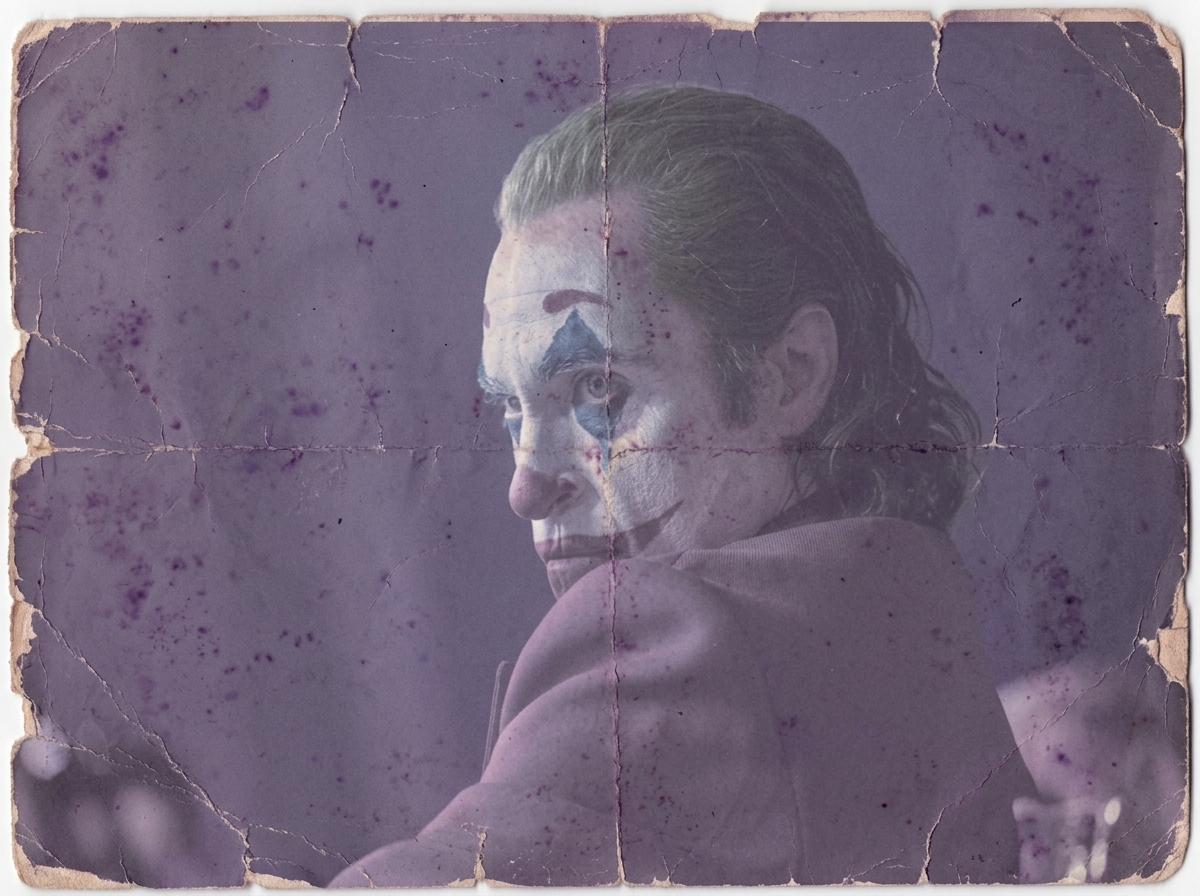



Todd Phillips might answer you, if you asked him this question of mine: “Yes, I’ve heard that one, I might answer it someday.” That is always his reply whenever one of these theories is put to him, And I imagine he feels a certain satisfaction at having made a film that went beyond the usual imagery of comic book movies, leaving behind it many questions, some of them admittedly far fetched, which fans of the film have been passing around the world in search of an answer.
Filmmakers are usually shaped by their intellectual heritage, which includes their religious background, since for a long time this has been common ground between them and their audience. They have therefore used religious references and symbols to convey their ideas, at times even projecting the stories of religious figures onto the heroes of their works. It is enough for the name “Judas” to be mentioned for betrayal to be expected automatically of the dramatic character linked to it; one waits for repentance whenever “Mary Magdalene” is invoked; or a character’s traits take on majesty, righteousness, generosity, holiness and redemption if some dramatic thread connects them to one of the most important figures in human history, “Jesus Christ.” That is exactly what happened when I watched “Joker.”
The Road to Galilee / Gotham:
A people’s need for a savior arises from a predicament that people is living through. As when its members carry on living while garbage piles up around them, not necessarily only the waste of their own consumption, But also the residue of a social and economic injustice weighing on them, which has settled inside their souls until darkness accumulates there the way black garbage bags with their foul smell pile up in the streets. Both kinds of garbage, the psychological and the physical, need a savior who will carry the people’s refuse away from them, bearing the pain and the weight of the task so that the people may live a good life.
“The situation truly is dangerous, this crisis is hurting nearly every resident of the city, regardless of who they are or where they live,” says the radio announcer in the very first seconds of the soundtrack of the film Joker, since the sanitation workers have gone on strike, as if to declare that there are “no saviors,” exactly as it was in Galilee during Christ’s childhood, before his baptism at the hands of John the Baptist, in the days of Herod the Great and then his sons after him, an age in which every child in a city could be put to death simply because a ruler felt angry: “Then Herod, when he saw that he had been mocked by the wise men, was exceedingly angry, and he sent forth and put to death all the male children who were in Bethlehem and in all its districts, from two years old and under, according to the time which he had determined from the wise men.” Or a ruler could order all the nation’s notables killed at the moment of his own death, so that the people’s grief for these notables would outweigh their joy at the death of a mad ruler. In a place, then, where one can be killed by sheer chance, one is ready, just as readily, to kill by chance, to oppress or to strike, for one needs some outlet through which to release the pressure bearing down on oneself, and there is no better outlet than to exert that very same pressure on whoever is weaker, so that a cycle begins, the strong wronging the weaker, the rich wronging the poorer, the one who holds power wronging the one who holds none. The environment in Galilee and its surroundings was ideal, in this sense, for the appearance of “Christ,” just as the environment in Gotham was ideal for the appearance of “Joker.” I therefore do not think it entirely a coincidence that the last line of dialogue before the film’s title card is: “Beat him up and take his stuff, he’s weak, he won’t do anything,” a line that hands us over to a wide shot in which “Arthur Fleck” writhes in pain amid garbage bags, just before our eyes are blocked out, the word “Joker” filling the screen completely.
Between Birth and Baptism:
No one knows for certain exactly when the incarnate Christ became aware of his theological identity, namely his being the second person of the Holy Trinity; yet up until his baptism he was called “Thr carpenter’s son,” in reference to “Joseph the carpenter”: “Now when Jesus began his ministry he was about thirty years of age, being the son, as was supposed, of Joseph, the son of Heli.” Likewise “Arthur Fleck,” who lived roughly the same span of years, knows nothing of his own identity except that the woman who cares for him is his mother. And just as Mary raised Christ believing he had come for those who “have no wine,” Arthur’s mother told her son that he had been “put here to spread joy in this cold, dark world” and that he must always smile. Which is to say that each of them had, in his own way, to walk a certain path on which he would bear violence and injury for the sake of the people, whatever the outcome might be, a path that “Jesus” began with a baptism in flowing water, after confessing the sin of the whole nation so that God might turn back from wrath toward them and protect them from themselves and from the devil, while “Arthur’s” baptism was a “gun” in his hand, so that he might stop making peace with his own weakness before others, protect himself from them, and place himself between the hammer of injustice and the anvil of the devil, producing, after many blows, a false Christ in pursuit of a false salvation.
What is certain is that, at some moment in each man’s life, the mother will tell the child the truth of his lineage, that he is the son of one who holds “authority and power,” or the only person capable of setting right what has gone wrong; but the impact of this revelation will differ according to the nature of each mother.
Light, Darkness, and Deliverance from the Evil One:
“And lead us not into temptation, but deliver us from the evil one,” millions of people ask this of God every day in the Lord’s Prayer, a prayer Jesus Christ taught when his disciples asked him how they should pray. And perhaps the mention of “temptation” and “the evil one” by Christ in this prayer is simply an acknowledgment, on his part, of how hard both are for the children of man; for Christ himself underwent three temptations from the devil on the mountain after his baptism, and overcame them all. He was first tempted through hunger, having fasted forty days and grown intensely hungry, so that the devil said to him, “If you are the Son of God, command that these stones become bread,” To which Christ replied that man does not live by bread alone, that is, that man can live by the word of God, meaning that he can live for the sake of goodness and truth. He was then tempted regarding his identity, and whether God truly loved him, when he was asked to throw himself down from the top of a mountain, with the promise that, if he truly were the Son of God, the angels would save him and keep him from being dashed on the stones; Christ answered that one must not “put the Lord your God to the test,” for God’s love is not something to be tested. Finally, he was tempted with glory, when the devil took him up a high mountain and promised to give him the kingdom of all the inhabited world if he would bow down to him; “Jesus” refused, and the devil left him for a time, but “Joker’s” devil never did.
A magnificent expressive dance, performed by “Joaquin Phoenix,” embodies the moment a person begins to merge with evil, his exhilaration as he feels power coursing through his limbs for the first time, “I own everything now,” is what his stance expresses as he stands with arms outstretched before the mirror. Joker failed the devil’s third test, and so the devil gave him what he had promised: power and glory. Arthur’s body occupies the middle third of the frame as he struts along, and he goes so far as to kiss the young woman he is drawn to, a bold act he would never have dared before. The subway lighting flickering between light and darkness, the very subway that witnessed Arthur’s first crime, and the blaze of the iconic scene that drove the crowds protesting social injustice to raise placards reading “We are all clowns,” that wavering between light and good, darkness and evil, is exactly what was happening inside Arthur before the crime. This is the stage of ripening.
Before we reach the third temptation, the devil had already tested “Arthur” twice, as though slowly, patiently kindling a fire beneath him. He first tested him through hunger, when Arthur was fired from his first job and had his pay docked without knowing why; in a town like Gotham, whoever does not work will starve; and yet he laughed, “it’s not something to laugh at,” but that is what he does, as the card he carries explains, whenever he is overwhelmed. He was then tested in his love for those around him and for the thing he loves most. He found everyone disowning him, waiting for the smallest mistake so as to punish him all the more harshly, even inventing lies to add to his torment, believing he would never lift a finger and could never do anything to fend off the harm done to him. The first sign of his maturing came when “Arthur” learned of his friend “Randall’s” betrayal and his false claim regarding the gun, which cost Arthur the job he loved: he did not laugh; the usual fit that overtakes him whenever he cannot push back against injustice did not seize him either; instead he struck his head hard against the glass of the train car, a sign of anger. Even his clothing betrayed part of this transformation, for he was wearing some pieces of his former work uniform along with pieces of the “Joker” costume soon to become iconic, the clown wig on his head, the “Joker” makeup on his face, clutching his shabby clown case, until the three young men began to harass him, peeling this fragile clown away, layer by layer: they tore off his wig, threw his clown props aside, began kicking him; light, dark, light, dark, until everything went completely dark, and the gunpowder of the revolver flared. That bullet took the victim by surprise, took us by surprise, and even took “Arthur” himself by surprise, finally announcing his surrender to the devil and his transformation into “Joker.”
So Life Goes:
As though his life refused to let him turn back from the path he had taken, Arthur’s life began to unravel from the subway killing onward. Papers fell into his hands that his mother had been writing to “Thomas Wayne,” the city’s anticipated mayor and one of Gotham’s most famous wealthy men; his mother had told him the truth of his lineage to this influential “Wayne,” as I mentioned. Mary believed what she told her child, since a voice from heaven had told him, “You are my beloved Son; in you I am well pleased.” “Arthur,” for his part, was led by his own feet to the mansion of his supposed father to make sure it was true, a deeply symbolic meeting brought him face to face with “Bruce Wayne,” who stood inside a candlelit gazebo, lending him an almost luminous glow, as though he were a radiant being moving freely through the grounds of the mansion he owns, while “Arthur” moves furtively through the darkness outside. By the garden, Arthur stood before its iron gate like a prisoner, trying to beg a bit of “laughter” from Wayne’s true son, who will later become a genuine savior and will end organized crime in Gotham with his own hands. “Arthur,” meanwhile, was shattered by everything at once: his mother is not his mother, he is not “Bruce Wayne’s” son, and on top of that he is a “joke” and not “funny,” as he had wished to be; he has been living inside a lie, a farcical charade with no truth to it beyond the fact that he killed three young men and became a symbol of chaos. The truth pulled him downward with tremendous speed, matching the speed at which he descends the stairs carrying “Penny Fleck’s” case file. The truths poured down on his head like rain, and we find him coming home soaked, life having washed “Arthur” completely away.
Unlike what “Jesus Christ” did with “Judas Iscariot,” who betrayed him and sold him for thirty pieces of silver even as Jesus treated him with the utmost gentleness and tenderness, saying to him, “Friend, my companion, my confidant,” “Joker” wanted to avenge “Arthur” for his friend “Randall’s” betrayal by thanking him, thanking him for everything: “Thank you, Randall, thank you so much,” since, without meaning to, Randall had been the cause of everything that happened, before finishing him off with several stabs of the scissors and crushing his skull. Jesus’s disciples ate the bread as a symbol of his body, which he distributed among those present, and when he declared the wine a symbol of his blood, he explained: “For this is my blood of the new covenant, which is poured out for many for the forgiveness of sins.” Joker, however, will have no one eat his flesh or drink his blood; they have already eaten enough in the past, and now it is his turn to drink from their blood, in atonement for their sins against him.
I Am:
Nearly every shot that brings “Arthur” together with a staircase is a shot of ascent: the weak, exhausted “Arthur” climbs a long staircase that seems to stretch to the horizon, except in his final scene with a staircase, where he descends, of his own will, dancing, dressed up and happy about what awaits him. He runs, taunting the police officers trying to stop him, and lures them to the very site of his first crime, the subway station, since that is where everything began. The two officers tried to frighten “Joker” with their gun and were the first to open fire; but in a literal enactment of what Christ said to the soldiers at the moment of his arrest, “All who take the sword will perish by the sword,” the two officers died, or were on the verge of dying, as a direct result of their own act, having provoked the fury of the crowd protesting in clown masks; “Joker,” for his part, left them to their fate and went off dancing to meet his own, setting the Joker mask atop the very garbage from which he had emerged.
When my interest in Christian mythology first began, I was struck by the recurrence of four Latin letters above every icon of the crucified Christ, “INRI,” and I later learned that these were the initials of the phrase “IESUS NAZARENUS REX IUDAEORUM,” meaning “Jesus of Nazareth, King of the Jews.” I wondered why it was written there, until I learned that it was the answer to a question put to Christ during his trial, when he was asked, “Are you the King of the Jews?,” a question repeated four times, and the principal charge brought against him among several others: that he was corrupting the nation, forbidding the payment of tribute to Caesar, and claiming to be King of the Jews.
Although Christ knew, from the very first moment of his arrest, what was to come, for he had to be crucified, to die, and to rise from among the dead so that God’s plan for humanity’s salvation might be fulfilled, he nonetheless went through a religious trial and then a political one, across several stages, among them his appearance before Herod the son. During this trial he was mocked and ridiculed, and after the trial’s conclusion, even though “Pilate” had acknowledged that he was not guilty, he was dressed in a crown of thorns and a purple robe, and they called him “King of the Jews” as he was led to the cross. Christ, of course, had asked none of this of them, but they did it to humiliate him. It was in the likeness of this very purple robe that “Arthur” designed, all by himself and for himself, a ridiculous costume in which to appear on television before all the people of Gotham, and he himself asked to be called “Joker,” the very name that “Murray” had given him in mockery and derision. In other words, while Christ endured mockery in order to atone for the sins of the people of the earth, “Joker” demanded mockery in order to take revenge on the people of Gotham, and to make his death worth more than his life by taking it in front of everyone, as he had planned, thereby delivering himself from his own torments.
The phrase “I am” is an expression referring to God in the Jewish religion, and Christ has many sayings that begin with it: that he is the bread of life, the light of the world, the door of the sheep, the good shepherd, the resurrection and the life, the way, the truth, and the life, the true vine, all of them noble attributes, and it was also with the words “I am he” that he faced the soldiers who came to arrest him. That admission would bring upon him the punishment of the cross afterward, yet it was the truth that people needed to know for their salvation to be accomplished through God’s will. In the same way, another truth pushed “Joker” to confess that he was the one who had killed the three young men, and why not, since if he had been found dead on the roadside, people would have walked right over him and ignored him. By confessing, he places them before themselves, before their own coarseness, for they are no longer civilized; everyone shouts in everyone else’s face, and no one puts himself in another’s place; this is simply their own goods returned to them. So “Joker’s” “I am” is the exact reverse of Christ’s: I am what you get when you mix an autistic patient into a society that wrongs him, oppresses him, and treats him like scum; I am the product of all your deeds; I am what you deserve. He had intended to kill himself after saying those words, but he decided that “Murray” and those like him deserved death more than he did, as though the bullet that pierced “Murray’s” skull had really been meant for the head of that whole unjust society.
The Punchline, the Joke’s Final Line:
I am not attempting here to determine whether “Joker” was right or wrong in what he did, or whether what unfolded on screen truly happened at all, or whether it is nothing more than delusions afflicting a disturbed mind. What is certain is that his resurrection, walking free among those who now regard him as a symbol after his arrest, resembled the rising of someone lifted up out of a grave: through all his actions, “Joker” achieved for himself a kind of salvation from his hardships and secured for himself the worth he had been seeking. All that remains in my mind, now that I have finished writing this article, is my certainty that we will never again have a Christ willing to seek our redemption from our sins and bear them on our behalf; but I hope that we will not, because of our own sins toward anyone, or toward ourselves, produce another “Joker” who then seeks his own deliverance from us.