
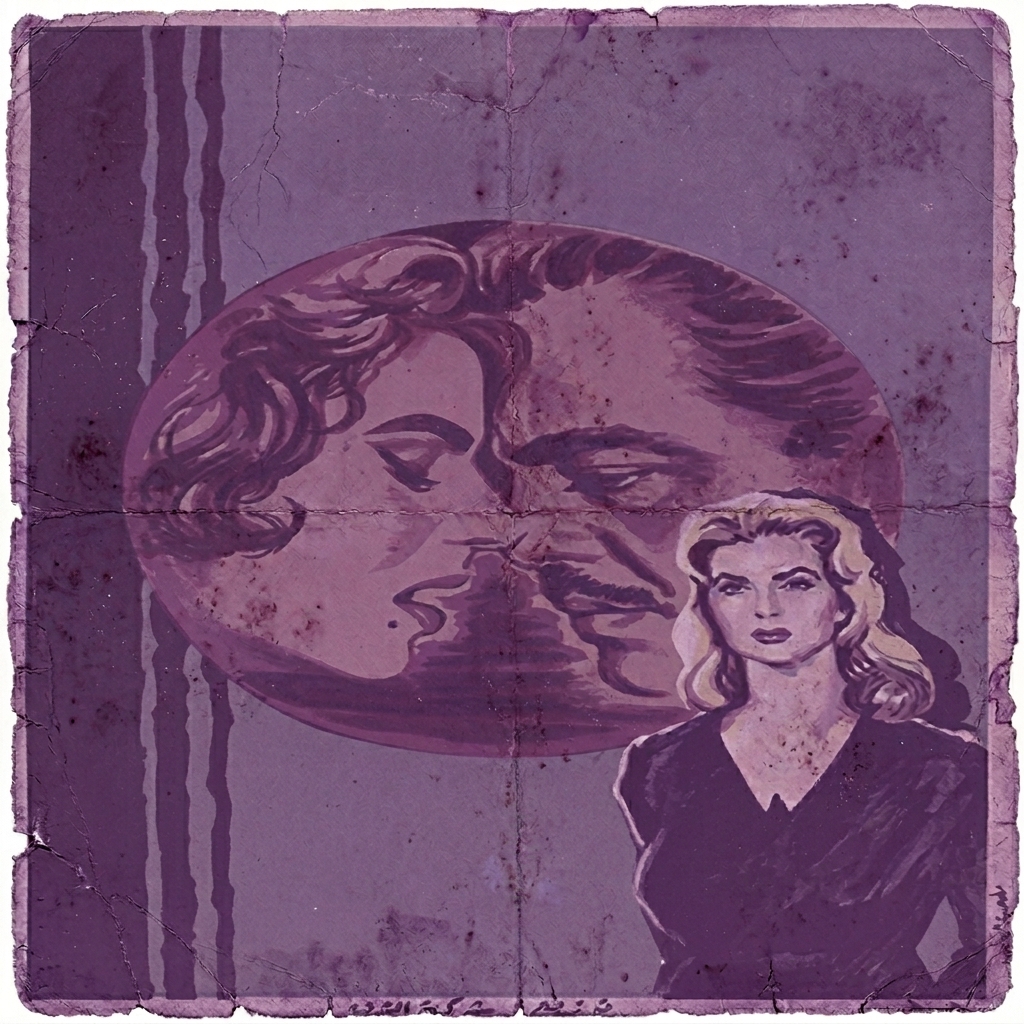
Author: Ramy Abdel Razek
Original text in Arabic
Translation revision and editing: Salma El-Sharkawy
In 1961, Road of Tears, a film based on the life story of Anwar Wagdi, was released, becoming one of the earliest Egyptian films to break the silence surrounding the private lives of cinema stars. It was followed by a succession of films drawn from the personal lives of artists, and with each new release, the debate intensified over the nature of cinema’s exploitation of the stories generated by the lives of those who work within it. Were these films acts of documentation, or were they merely an application of the Egyptian proverb that says Juha has the greatest claim to the meat of his own ox?
For many years before any film of this kind was produced, numerous parties, both directly involved and entirely uninvolved, had grown accustomed to immersing themselves in accusations, debates, anxieties, and claims about the extent of the truth being presented, the degree of freedom permitted in the treatment of such material, and the preemptive defamation deployed as a safeguard against whatever questions or rumors a film might provoke about its protagonists. With closer scrutiny, one discovers that the very same problems continued to flare up whenever something appeared on the horizon suggesting that a particular film had been inspired by the life of an artist, or contained a direct or indirect borrowing from it. This is the issue we will address through an attempt to revisit some of those films that appeared throughout the history of Egyptian cinema and were either adapted from, or invented out of, the private lives of artists.
Road of Tears (1961)
Story & Production: Kamal El-Shenawy and Partners
Starring: Kamal El-Shenawy, Sabah, Layla Fawzy
Screenplay: El-Sayed Badir
Direction: Helmy Halim
In May 1955, the body of the artist Anwar Wagdi arrived from Stockholm, where it was received at the airport by his third wife, Leila Fawzy, amid devastating grief over his early death at the age of fifty-one. About four years later, the actor Kamal El Shenawy, who had been a friend of Anwar Wagdi, decided to produce and star in a film about the life of this struggling artist who had risen from nothing to become one of the brightest stars of Egyptian cinema.
Kamal El Shenawy began collecting stories and details from the people who had lived alongside Anwar Wagdi, and the preparation process took more than three years. But he soon began receiving warning after warning from Wagdi’s heirs, demanding that he abandon the project or face intervention to stop the film’s release if it were ever made. The number of warnings eventually reached eleven. Even Anwar Wagdi’s own mother called Kamal by telephone, weeping and begging him to let her son’s memory fade into oblivion. But El Shenawy old her that he wanted to produce the film in order to preserve Wagdi’s memory, after feeling that it was on the verge of being extinguished from the memory of cinema, just as had happened to many before him.
The opinions recorded In the press at the time were sharply divided. Some claimed that El Shenawy did not truly wish to immortalize Anwar Wagdi’s memory so much as expose many of his personal flaws, especially regarding the relationship between marriage and work in his life with Leila Mourad. Others saw in what El Shenawy was doing an act of loyalty to the memory of a friend and companion on the path of art.
Production arrangements had already begun to move forward, but before filming started, El Shenawy called a meeting attended by everyone involved in the film and agreed with them to change the names of the characters so that they would remain at a distance from any direct infringement upon Anwar Wagdi’s life. El Shenawy had offered Leila Mourad the chance to play herself, and the film’s director, Helmy Halim, even mediated in the matter, but Leila refused vehemently. The name of the singer Sabah then came forward, yet she too expressed her apprehension about portraying Leila Mourad. She would never have agreed had it not been for the intervention of Mahmoud El Shafei, the distributor of the film and at the same time the husband of Anwar Wagdi’s sister, who convinced her that if the film had directly and negatively targeted Anwar Wagdi’s life, his brother in law would never have agreed to distribute it.
After that, Kamal contacted Leila Fawzy, who would burst into tears whenever anyone spoke to her about the film. She had shut herself behind the gates of grief ever since Anwar’s body had returned to her in a wooden coffin. But in the end, after a period of withdrawal from public life, she agreed to play her real self.
The central line the film takes from Anwar Wagdi’s life is that of artistic ascent, from his beginnings as a young actor in a theatrical troupe, working for modest pay and in love with his beautiful colleague Leila, who later marries the wealthy older singer Aziz Othman. Wagdi then throws himself into work with fierce determination, marries Leila Mourad, and shares dazzling successes with her, before being struck by a grave kidney illness that leads Leila Mourad to ask for a divorce. He then returns to his first love, Leila Fawzy, marries her, and dies while still her husband.
The film, however, while adhering to the same ascending narrative line, with the young actor
Ashraf Hamdy standing in for Anwar Wagdi, his love for his colleague Leila, her marriage to Abdel Aziz Adnan standing in for Aziz Othman, his later marriage to Samia Fouad standing in for Leila Mourad, and then his illness and her divorce from him, nevertheless alters the original ending. Its makers chose to have him die without marrying his first love, exactly as did not happen in reality. He also dies in Egypt rather than abroad, and returns not as a body transported home from another country, but dies on Egyptian soil.
In this way, the film broke through the barrier that had long been erected around drawing on the private lives of artists in Egypt, turning those lives into material for a work of art no matter how greatly its details might diverge from actual events. It was a step that would later be repeated in more than one cinematic experiment.
The Last Kiss (1967)
Production: Abbas Helmy
Starring: Magda, Rushdy Abaza, Ihab Nafe’
Based on a story by: Ibrahim El-Wardany
Screenplay & Dialogue: Mohamed Abu Youssef
Direction: Mahmoud Zulfikar
When Faten Hamama stood before Omar Sharif in the final scene of Struggle in the Valley and kissed him—her first on-screen kiss—it caused an uproar. Hamama had always refused to be kissed directly in any film, no matter how essential the moment might be to the drama. Yet this time, and for the first time, she yielded to Youssef Chahine’s insistence. What followed was a love story between Hamama and Sharif that quickly became the talk of the artistic community and the wider public, captivated by this radiant star and the rising actor. Years later, they were married.
Screenwriter Ibrahim El Wardani approached producer Abbas Helmy with the story of The Final Kiss. As preparations for the film began, rumors spread rapidly, soon solidifying into a widely held belief that the film was inspired by the story of Faten Hamama, Omar Sharif, and director Ezz El Din Zulfikar, who had been married to Hamama for years before their separation and her subsequent marriage to Sharif.
El Wardani denied that the film was based on this specific incident, insisting instead that it drew on multiple stories from within the artistic community. He cited the cases of Hussein Fawzi and Naima Akef, as well as that of Mahmoud Zulfikar himself and Mariam Fakhr El Din. After all, how often does a celebrated director discover an actress, turn her into a star, marry her, only for conflicts to arise that lead her to seek a divorce and marry someone else?
Mahmoud Zulfikar himself denied that the film reflected the life of his late brother Ezz El Din, despite a near consensus that he had deliberately shaped Rushdy Abaza, the film’s leading man, into a clear echo of him—in personality, in mannerisms, and even in his distinctive appearance. As for Magda El Sabbahi, the film’s heroine and the one most affected by these comparisons, she refused to acknowledge that she was portraying her foremost rival at the time, Faten Hamama, even though the film’s own poster carried a promotional line that outwardly appeared to summarize the plot, yet inwardly functioned as a sharp provocation: “The kiss that destroyed the life of a great director.”
A careful viewing of the film reveals that it is constructed around two central incidents: Youssef
Chahine’s discovery of Omar Sharif as a rising actor opposite the established star Faten
Hamama, and Hamama’s later divorce from Ezz El Din Zulfikar followed by her marriage to
Sharif, who himself had broken off his engagement during the filming of Our Best Days. These two events were fused within the screenplay, which the press at the time described as the strangest film in the history of Egyptian cinema.
At that time, Hamama had followed Sharif abroad in the mid-1960s, after his star began to rise as one of the new faces of Hollywood. She neither commented on the film nor made any public statement about it. The narrative of the film closely mirrors this reality, with one key alteration: the merging of events so that the same director who had been married to the famous actress is also the one who discovers the rising young actor. As he becomes increasingly absorbed in his work and artistic creation, a love story emerges between the young actor and the star, culminating in the director’s awareness and his surrender to fate, leaving his first wife—the actress—for his second wife: the camera. The film ends with an image of him standing beside it, as though it were his entire glory and his whole life.
Barefoot on a Bridge of Gold (1977)
Production: United Films Company — Mokhles El-Shafi’y
Starring: Hussein Fahmy, Mervat Amin, Adel Adham
Based on a story by: Ibrahim El-Wardany
Screenplay: Abdel-Hay Adeeb
Dialogue: Raouf Helmy
Direction: Atef Salem
The Cat Consumed by Fire
Once again, the name of Ibrahim El Wardani emerges, this time attached to one of the most famous stories in Egypt’s artistic milieu: the story of Camellia, also known as Lillian Cohen, the enchanting actress who appeared in several films in the 1940s and whose life ended tragically when the plane she was traveling on to Switzerland exploded in 1950, before she had even reached the age of twenty-one.
Among the stories that circulated about her life was the claim that Camellia was not Jewish, but rather the result of a relationship between her mother and an Italian merchant, and that her mother had attributed her to a Jewish man. It was also said that she had met King Farouk only once. Yet none of these accounts can be confirmed with certainty. If one considers the nature of King Farouk’s appetites, alongside Camellia’s striking beauty, and the rivalry between Farouk and the actor and director Ahmed Salem at that time in their pursuit of beautiful women, one hesitates before dismissing the story linking Camellia to Farouk and Ahmed Salem altogether.
Ibrahim El Wardani had written a novel inspired by this story titled Barefoot on a Bridge of Gold, adding to it a great deal from his own imagination. It was originally intended for Abbas Helmy, who had previously produced The Final Kiss, but producer Mokhles El Shafei became enthusiastic about bringing it to the screen. The resulting film retained many features of the original novel, while attempting to incorporate as many parallels as possible with the story of Camellia, Farouk, and Ahmed Salem. This begins with the heroine’s name itself, Camellia, and extends to the recurring line “Ya Otta,” repeated by Adel Adham throughout the film in his role as Aziz, one of the centers of power in the 1960s and 1970s, clearly evoking Farouk with his absolute authority. Finally, there is Ahmed Sameh, who is none other than a reflection of Ahmed Salem—the handsome young director who once starred in The Unknown Past opposite Leila Mourad, for those who may not recall him—embodying the dream of dozens of young women like Camellia, all seeking either fame or love.
Naturally, this adaptation did not provoke widespread objection at the time of its release in 1977, since all the real figures involved had long since passed away. The film thus became a form of quasi-political expression about centers of power and their absolute influence during the 1960s, framed within a romantic melodrama infused with one of the classics of world literature, The Lady of the Camellias by Alexandre Dumas.
The Death of Samira (1985)
Production: United Films Company — Mokhles El-Shafi’y
Starring: Kamal El-Shenawy, Raghda, Youssef Shaaban
Screenplay & Dialogue: Nabil Ghallam
Direction: Mohamed El-Bashir
A Corrupt Reality… and an Even More Corrupt Cinema
December 1984 was a particularly intense month for both artistic and criminal journalism alike. The case of the death of the Moroccan woman Samira Melyan, which took place in the apartment of the renowned composer Baligh Hamdi, dominated headlines and investigations. The vast majority of film producers began circling the story, eager to turn it into a cinematic work, as everyone could sense the potent combination of mystery, drugs, sex, and crime embedded in this tragic incident, a combination that was especially marketable in the mid-1980s.
At the time, the real case had not yet been resolved in court or by the police. It revolved around the death of Samira Melyan in Baligh Hamdi’s apartment. A wealthy Saudi man, rumored to have been involved with her, was accused, and Baligh Hamdi himself faced accusations of facilitating illicit activities. The case also involved several Egyptian and Arab figures, including an Algerian poet said to have been connected to the Saudi millionaire, a former police general, and a legal advisor. It was widely suggested that these entanglements led some witnesses to withhold the truth at critical moments, allowing the Saudi figure to leave Egypt. Only then did a serious problem emerge for producer Mokhles El Shafei, who seemed to have developed a strong inclination toward producing films based on real incidents following Barefoot on a Bridge of Gold.
In the 1980s, Egyptian cinema relied heavily on Gulf and Saudi markets for video distribution, markets that could cover production costs and generate substantial profits. The involvement of Arab figures in this incident meant that these markets would not welcome the film, and might even refuse to screen it altogether. This forced the filmmakers to resort to a familiar strategy: transforming all the characters involved in the incident into Egyptian figures within the screenplay, turning it into a purely Egyptian story. This decision sparked growing criticism, with some voices calling for the film to be suppressed altogether on the grounds that it would damage Egypt’s reputation abroad.
When the script was offered to Madiha Kamel for the role of Samira, she refused, arguing that it distorted the image of the Egyptian artist, especially after all the characters had been localized. Raghda, however, agreed to take on the role. The character of the Algerian poet was replaced by that of a young Egyptian singer, played by Elham Shahin, whose mother pushes her to exploit her beauty in order to achieve fame through a relationship with Fahmy, portrayed by Youssef Shaaban, a well-known composer who, driven by financial need, organizes musical soirées for Abdel Rahman, played by Kamal El Shenawy, a millionaire relentlessly pursuing his desires.
There, the composer Fahmy meets Samira, the millionaire’s secretary and lover, who collapses upon discovering his marriage to the young singer. She descends into drug addiction, and her story ultimately ends in murder at the hands of the millionaire in the composer’s apartment. The millionaire then flees abroad, leaving the composer entangled in a murder case.
The film, through its flattening of characters and their one-dimensional portrayal, attempts to absolve the composer without convincing justification. It also seeks to transform the incident into a didactic moral lesson, even concluding with a Qur’anic verse to reinforce its ethical message, while carefully avoiding any deeper analysis or commentary on what the case reveals about corruption in Arab society. As critic Kamal Ramzi wrote in Al Mawed magazine following the film’s release, “The Death of Samira ultimately shows us how a burning case dies, killed by a screen that reflects fear and hesitation.”
From Tears to Biographies
With the decline of Egyptian cinema in the 1990s and the emergence of a new generation of filmmakers no longer interested in producing films based on the lives of those within the profession, such cinematic experiments largely came to a halt. This continued until the release of Planet of the East in 1999, written by Ibrahim El Mougy, directed by Mohamed Fadel, and starring Ferdous Abdel Hamid. Its appearance coincided with a wave of biographical television series that swept through Egyptian drama, particularly following the landmark success of Umm Kulthum, written by Mahfouz Abdel Rahman and directed by Enas Mohamed Ali in the same year.
Television drama effectively inherited from cinema the role of narrating the lives and stories of artists throughout the first decade of the new millennium. Cinema itself, however, produced only one notable film based on the life of Abdel Halim Hafez, Halim (2005), also written by Mahfouz Abdel Rahman and directed by Sherif Arafa.
Meanwhile, the film The First Time You Love, My Heart (2003), starring Gala Fahmy and directed by the late Alaa Karim, passed almost unnoticed, despite claims at the time that it was inspired by the well-known incident involving Yousra and Abu Al Rous, in which a police officer was accused of detaining the actress Yousra in her home.
The same director, Alaa Karim, was also unable to complete his project based on the case of the young actress Habiba, who was accused of murdering and robbing her Qatari husband, and was sentenced in 1998 to fifteen years in prison. It was later said that she had confessed under torture, before the real perpetrators were eventually arrested.
Writer and Egyptian film critic
Egyptian Writer and Translator