
On Ghosting and Care in an Age of Digital Cruelty
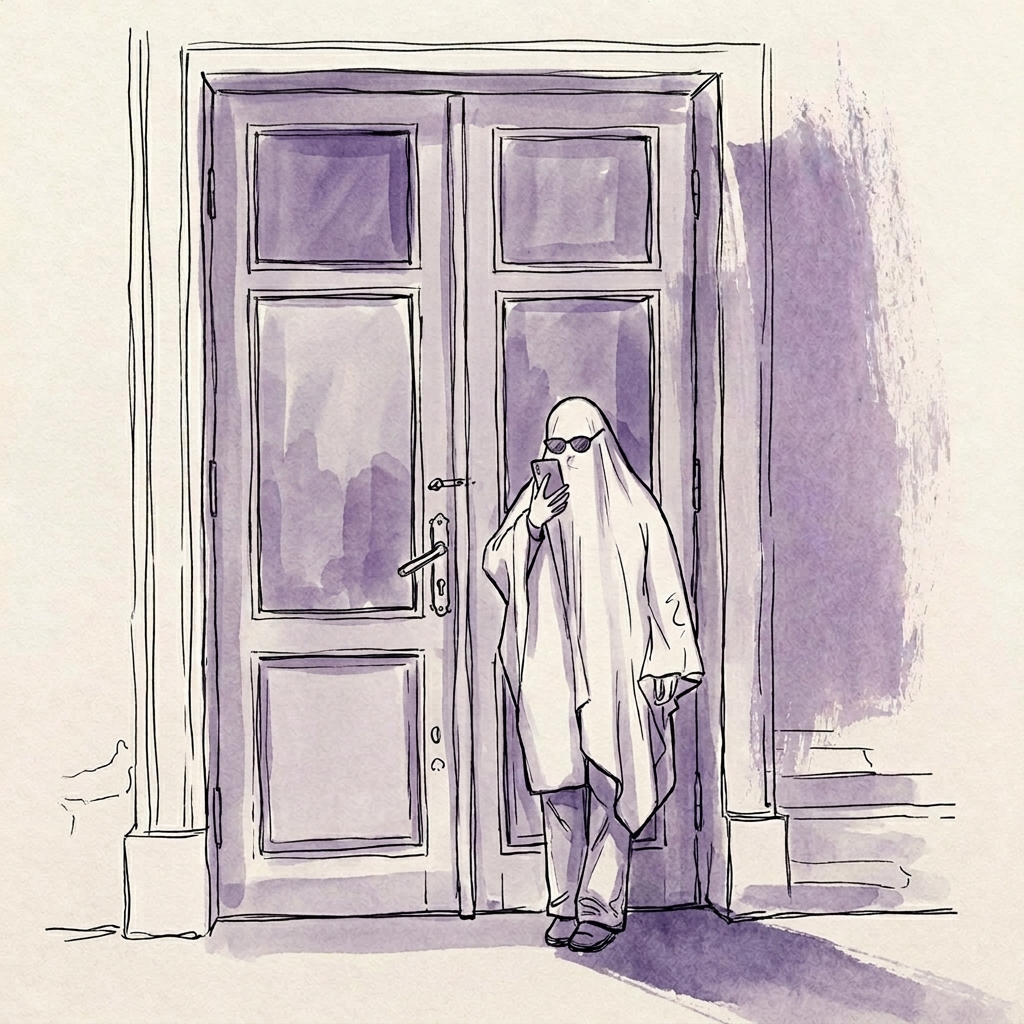
Author: Alaa Hassanien
Original text in Arabic
Translation revision and editing: Lucy Cunningham
A few weeks ago I was with a colleague of mine, walking through the city centre. We were talking about the everyday and the ordinary, before we decided to sit in a bar to continue those conversations about life, personal fears, and the blurry future. After several hours, I needed to get up to use the bathroom, and I said to her: I’ll leave my things with you, promise me you won’t go anywhere! She laughed and started teasing me about this small ritual of ours, because it’s a habit of mine; I carry what matters to me wherever I go, like my phone, my wallet, my important cards, even if I’m only going to chat with the bartender or use the bathroom for a few minutes. I think about how people can disappear, how anyone can simply vanish just like that. Continuing from that moment with my colleague, she surprised me by saying: I won’t go anywhere, but promise me you’ll come back! Because she believes that people can simply not return, that they can go inside to order a coffee and then be swallowed by the void, or fall into another time they never come back from. Then I laughed too, and our laughter was bitter. It was directed towards fear, as if to shrink it. I went on: the aliens won’t abduct me, I promise I’ll definitely be back.
From that day on, I’ve been thinking that I may have some kind of trauma from having been ghosted many times. Ghosting, the unilateral severing of contact without warning or explanation, accompanied me from early in my life, long before the term spread and entered household vernacular. The first person I loved in my adolescence, a vast and deep love that lasted for years, disappeared one day from my life. It was a deep friendship more than a romantic relationship, more so on his part. As for me, I never knew how to name what was between us or where its boundaries ended. Yet I knew one thing: I could not imagine my days without him. We lived on two different continents, but we were in daily, intense contact, until one day I woke up and there was no trace of him. He had disappeared from everywhere, deleted all his accounts on social media, then dissolved, after nearly three years of uninterrupted daily contact. I remember I was twenty-two at the time, and it was the first time in my life that someone had ghosted me, especially someone I loved. I didn’t even know the term to begin with, but I understood that something had broken inside me. Its effect on me was profound: my confidence in people shrank, my ability to form new friendships, and my desire to grow close to anyone again. For years afterward, I kept seeing him everywhere around me, in every face, and all those questions stayed with me: what happened? Is he at least still alive? It was then that I understood, for the first time, how a person can become: a ghost.
Many years later, I was ghosted again, this time by my oldest friend. We had met at university, in that phase where friendship seems easy, as though it were an inevitable fate, where geographical closeness and surplus time and similar wounds create bonds that seem unbreakable. After graduation, our relationship became digital because I moved to a different country, yet we remained in contact through messages and long daily calls. At the time, the distance between us seemed unimportant, yet something was happening inside that very distance: each of us was growing up outside of the other’s view, changing in diverging ways, like two pieces of a continent drifting in opposite directions. Every subsequent meeting between us was filled with misunderstanding, with the kind of silence that suppresses conflict, and with the attempt to close a gap that had suddenly grown beyond bridging. We remembered who we had been, but we no longer knew who we had become, or perhaps neither of us liked what the other had become.
What happened after that was that she, too, disappeared one day. She simply stopped replying to my messages, without explanation, without reproach, without a quarrel. And despite all the complications that had come over our relationship, I never imagined she would disappear like this. Her ghosting was an erasure of that relationship with retroactive effect, as though eight years could be crossed out simply by stopping to reply. It took me a long time to learn how to carry this wound without it weighing on my shoulders and settling in my body, and I was careful not to let it eat away at my self-respect. I told myself: what she did reflects her, not me. But the pain remained real, and the feeling that I hadn’t even deserved a sentence of farewell would return in moments I didn’t expect.
This made me think about ghosting in all its contexts. In dating, I have done it more times than I’m comfortable admitting, when the options seemed endless and the conversations shallow, where vanishing seemed like the easiest way out. I have also been on the receiving end of it many times, and each time I would realise how brutal the impact of ghosting can be. But with time and practice and effort, I learned to send a simple message, to have the difficult conversations, not only because I seek to be a better person, but because I realised that disappearing leaves a mark on me too, as though I were betraying my own idea of the person I wish to be.
In the contemporary age, ghosting has become woven into the fabric of our daily lives. No message, no call, no justification or reproach, no request for space. Silence alone remains, stretching and widening until it fills the place where a voice once was, and you are left to interpret that silence, to fill in the blank with your guesses and your doubts. It is an act so simple in its execution, devastating in its effect, complex in its implications. We hear about it in dating, but it happens, too, in friendships and family relationships– even in professional spaces. It is a mirror held to the way we flee from what is hard to say, and from responsibility toward those we have loved, in an age where the person themself has become disposable and replaceable.
The pain that strikes you when you are ghosted is not fleeting. Research reveals to us that social rejection activates the very same pain pathways in the brain that physical pain activates, that there is an ancient biological link between rejection and pain, and this explains why the disappearance of a person can leave you feeling tangible pain in your chest, in your entire body. But what makes ghosting exceptionally painful is perhaps the ambiguity, more than the rejection itself. Our brains require stories and meaning, and when they find none, they begin to manufacture it, replaying every conversation, searching for the mistake that was made, for the word spoken one too many times. And in the absence of answers, doubt creeps in, and a question returns from time to time: did I not even deserve an explanation?
But the pain that accompanies ghosting is not the sum of it, for there are four fundamental human necessities that come under threat; a sense of belonging; the sense of meaningful existence; control over one’s life; and self-respect. These are not indulgent needs, but are the foundations of psychological survival. The bond we share with others arose originally as a survival mechanism in evolutionary history, and our modern brains still inherit this function. When you are ghosted, your brain loses its social reference point, for there is no input, only a complete void. And in friendships, ghosting can be more devastating because friendships are built on the accumulation of years of trust and familiarity, upon a deep sense that this person knows you. When an old friend suddenly disappears, you feel that the entire shared past is erased, as though those many were not of sufficient value to warrant even one last conversation. Several studies have pointed out that a large proportion of people have been ghosted by a friend, and that the pain can be equal to or greater than what happens in a romantic relationship. And the paradox is that people view ghosting as more acceptable in friendships than elsewhere, as though friendships are less deserving of respect when it comes to endings.
Ghosting also has, I believe, a deep correlation with how we think about relationships. There are those who believe in the ‘destiny of relationships,’ meaning that relationships either succeed or they don’t, that if the person they are dating is not the one, then there is no point in making an effort. For them, ghosting makes complete sense. The other group believes in the ‘growth of relationships,’ meaning that relationships are built on effort and communication, and that the way a relationship ends matters. I think these people are less likely to ghost because they see value in communication, even if the final outcome is separation.
There is a further dimension to ghosting related to technology, as digital communication has created an illusion of constant connection, yet has made us increasingly replaceable. Dating apps, for example, have founded a sense that options are endless, and have made moving on to the next person effortless. The problem is that this mentality seeps into all of our relationships, and we begin to see others, even in our daily lives and immediate proximity as a set of options on an endless list, mere images on a screen. The moment they lose their shine, we can scroll past them to what comes next. And what is most dangerous is that when you meet people outside your social circles with no shared worlds and no shared acquaintances, you can disappear as though nothing ever happened.
This ease comes at a steep price; some research has found that ghosting can lead to higher levels of depression and anxiety symptoms, especially among those with a history of trauma. Ghosting then is not a passing slip, but an act with real psychological damage that may last for months or even years.
But what about those who implement the ghosting? When we hear their stories, a more complex picture emerges. A woman ghosted a man because his presence reminded her of what she lacked and made her feel incompetent. Another ghosted someone because she was broke and could not bear to explain her financial fragility. A man ghosted a woman because she had ignored his explicit boundaries and he felt that his words held no value. A woman ghosted someone she loved because the tension between her queer identity and her conservative family had reached a point she could no longer endure. A woman who was dating several people no longer had the energy to have the same difficult conversation over and over. And a woman in her sixties ghosted for the first time because she had decided she would no longer compromise.
These stories reveal that most of those who ghost are not monsters all the way through, but human beings too, who feel guilt and fear and exhaustion. They avoid confrontation because it seems harder than silence, because they do not know how to face what they feel. Ghosting in most cases does not happen out of a desire to cause harm, but as a flight from discomfort. And although this does not justify it, it helps us understand that it usually stems from emotional immaturity rather than deliberate cruelty, even if in some cases it stems from a desire for revenge or a wish to humiliate the other and damage their sense of self.
Yet there are cases in which ghosting is entirely necessary. In toxic, controlling or abusive relationships, when every attempt to set boundaries is dismissed and when there is a real threat to safety, complete disappearance may be the only safe escape. The concept of ‘no contact’ is not unknown even in psychology where the term is used specifically in cases of abuse. For partners incapable of respecting boundaries, attempting to end the relationship in a typical, communicative way often leads to further harm.
The problem lies in that the distinction between ghosting as self-protection and ghosting as avoidance of responsibility is often blurred, even for the offender. This owes to the wide grey area in which legitimate fear mingles with unjustified avoidance. And here is the crisis, we have no clear social rules about what is acceptable and what is not. Friendships and casual dating lack clarity. And technology has made this ambiguity worse, creating contradictory expectations. On one hand, we are always available, always at the beck and call of others. On the other hand, no one is obligated to anyone for anything, we are held to no account.
But what if there were a third path? What if we could be honest and boundaried, and at the same time warm and respectful? I think of a friend who realised after a beautiful first date that she did not feel the romantic spark, so she sat down and wrote an honest and considered message in which she explained that she had enjoyed herself but preferred that what was between them remain within the bounds of friendship. The reply came appreciative, and everything ended in a way that left both of them feeling seen and respected as people and not as just another option available for deletion.
In contrast, another friend sent a clear message instead of sudden disappearance when she felt she could not commit fully to the person she had started dating. He did not reply, perhaps feeling upset or rejected, or saw in his silence a kind of reclaiming of dignity. But she felt at peace nonetheless, because she had done what she believed was right. This tension between what we know to be right and what we feel capable of is the very heart of the crisis. Most of us know that honesty is better, but in that climactic moment, we begin to feel an enormous weight, a fear of the reaction, or an inability to bear the emotional discomfort. Then we choose silence or disappearance. We buy into the idea that it is for the best, even though it is most often for the worst– of the other party, even ourselves.
There is something we tend to overlook or even deny: when we ghost, we damage something in ourselves. For every time we choose avoidance over confrontation, we betray our values a little, we become less than what we know ourselves to be. When we ghost others, we ghost ourselves too. We become ghosts ourselves, living in the grey area between what we are and what we pretend to be. It is important here to speak about the manner of rejection itself. Many people begin by apologising when they turn someone down, the problem being that the apology creates a dynamic in which forgiveness is expected, as though not wanting to continue were a mistake requiring pardon. But not wanting a relationship is a legitimate right, not a mistake. What the situation truly needs is clarity and kindness. One can say, for example: ‘I enjoyed our time, but I don’t feel that we are compatible in the way I am looking for.’ This is honest, direct, and considerate.
And what of those who have been ghosted? The first step is to acknowledge to yourself that what you feel is real and has its justification. Ghosting is a loss without closure, it is natural to feel sadness, anger and confusion. There is something that helps here: naming what you feel without trying to change it, for the act of naming alone reduces the intensity. Then remind yourself that ghosting says more about the person doing it than it says about you. Try to reread what happened, from ‘was I not enough?’ to ‘they chose avoidance over honesty, and that reveals something about them, not about me.’ Try to fill the void by returning to other bonds. Go out and spend time with those who are present. This reminds you that you are not alone, and that there are those who did not choose absence. There is another step, the most debated one: consider reaching out one last time. Sometimes friendships end because life intervened and external forces pulled that person away, not because they decided to end it. Perhaps your friend is not ghosting you deliberately. Perhaps if you reach out with a simple, undemanding message, you may receive a reply that surprises you, or at least offers some form of closure, for no reply is itself; a reply.
But the greater question that arises is: what does ghosting say about us as a society? There are those who argue it is a manifestation of the decline of empathy, and I think there is a deep truth in that. Ghosting is not an isolated or individual act, but a symptom of a culture built on neglect and replacement, and fear of emotional confrontation. It is a reflection of how we deal with discomfort in every area of our lives, from politics to work to the dining room. And ghosting is connected to what can be called ‘the politics of neglect’: a culture that glorifies self-care and boundaries to the point of making it easy to justify withholding care from others. We have defaulted to rehearsed phrases like: boundaries are necessary, self-care is a priority, I don’t owe anyone anything. These can be true in their contexts, but an issue emerges when we confuse healthy boundaries with selfish avoidance, when we use the language of self-care to justify cruelty. The truth is that this is not a zero-sum game, and the choices are not always black or white. You can respect yourself and your boundaries and, at the same time, respect the dignity of others. The more precise question is about dignity itself, for dignity is not something we earn through achievement, but something we possess by virtue of our humanity. It is what we owe one another simply because we exist. When we ghost someone, we do not only deprive them of closure, but also of their basic dignity. We say implicitly that they do not even deserve acknowledgment of their existence.
But let us be clear on this point: not all forms of ghosting are equal. If you spoke with someone on an app for two days, never met and then disappeared, this in my view does not rise to the level of true ghosting because there was no real relationship yet formed. Context also matters: the duration of contact, the depth of the relationship, the nature of the expectations. All of these determine when ghosting is understandable and when it is cruel. The way we end our relationships matters as much as the way we begin them. Every relationship leaves a mark on our formation, and how we choose to end it says something about us, about our values, about the person we want to be. Sometimes ghosting may seem the easier solution, but it leaves in its path a hidden regret, a feeling that we let ourselves down. When we disappear from someone’s life without a word, we allow a part of ourselves to become a ghost.
What we are crying out for are not smarter ways of ending relationships, but a deeper shift in how we view relationships as a whole, in the role of care, in the meaning of dignity in a digital age. We require care at every step, in all our interactions, from politics to the way we bid farewell to those we choose to walk away from. This care, though it requires effort, costs less than we think, and gives more than we expect, granting us inner peace and integrity as well as the sense that we are living in alignment with our values.
In the end, ghosting is a mirror that reflects our deepest fears as human beings in the twenty-first century. It reveals how we deal with vulnerability, how we evade pain, how we fail to respect one another’s dignity in a world where a person has become a digital file that can be deleted at any moment, where someone can slip away to the bathroom of a bar and really never come back. But ghosting itself also reveals the possibility of an alternative route, one where we choose honesty over avoidance, care over neglect, dignity over cruelty. And in that small, repeated daily choice, perhaps we come upon a path that returns us to what we truly are: creatures fashioned for connection, searching for love and belonging in a world that has made them hard to attain but not impossible, if only we choose presence, honesty, humanity.

Poet, cultural journalist, and film critic — of Egyptian origin, raised in Saudi Arabia, based in France

A Scottish writer, editor, and journalist