
The Inheritance of Fatigue Within the Family
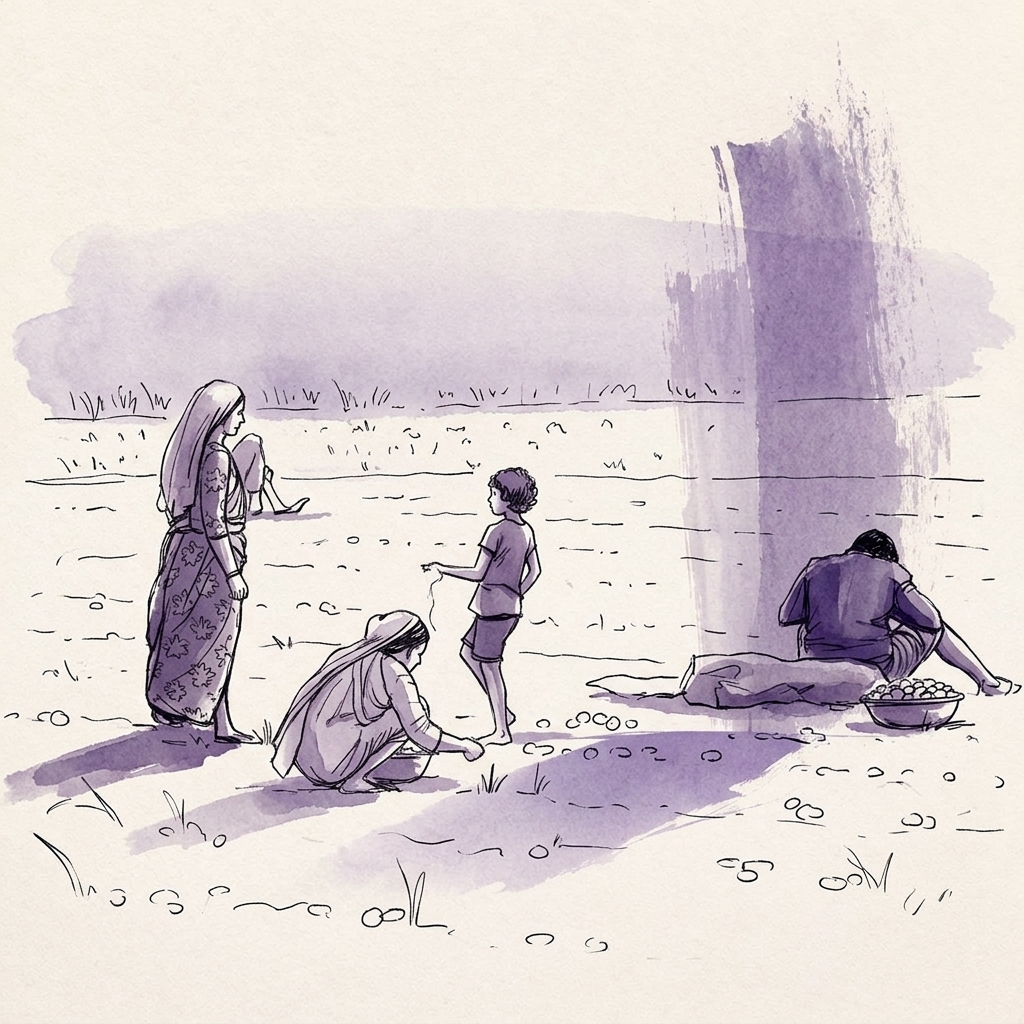
The struggles trickled down generation by generation.
Author: Haris Hussain
Editor: Salma Al-Sharqawi
As I am writing this piece, the voices of many of my friends echo in my ears: “Why do you always do so much?” or “When I think of overachieving, I think of you” but something inside me always held me back from diving deep into the topic and I would just smile back and change the subject. If I look back and reflect on my life, I believe I inherited this trait from my parents. My mother worked as a maid in a house of a rich family in Pakistan. Because of her hard work, and the social structure in Pakistan, where wealthy families rely on domestic help around the clock, we were given two rooms as the servant quarters in the top corner of the mansion the rich family used to live in. A place that became my early understanding of the word Home. A two room apartment that had two bells connected to the main house, bells that could ring at any moment and my mother would have to go downstairs and work.
My early childhood memories of my mother will always have her dupatta (headscarf) carrying the scent of sweat, never too strong for me because I loved her. Like every child, I was simply happy being around my mother, wrapping my arms around her when she would come back from work, always tired, always overworked. On the other hand, my father, who started working at the age of ten, knew nothing but how to use his energy to earn money for his family, to send his children to good schools and feed them properly. My early memories of my father are of him always coming back from work late at night in his blue shirt and black trousers, which were his uniform as a waiter in a small restaurant in the city we used to live in. I think what I remember most is the smell of the spices coming off his clothes when he would come back home, and this is how my parents live in my memory. A father who was always too tired to take me out to play cricket or football, and a mother who was always a bell away from leaving us for work.
No matter how bad it made me feel, my sisters would always try to be there for me, as I was the youngest of all four siblings and the only brother. My oldest sister, who would always feel too tired and fatigued to focus on her homework for school, was babysitting her three siblings because she knew, better than I did, how important it was for us to help our parents as they were doing everything they could for our future. Now that I look back, all of this feels too much for a child to understand, but the work never ended. If my parents were busy being the best parents and working day and night for our better future, I would give it all to be the best son ever. Always doing well at school, speaking fluent English, as speaking English in Pakistan somehow was seen as a very smart thing, not going out playing with friends and making sure to say the right thing. In a two-room house, a family of six, everyone overworking themselves in ways different from each other, no working hours defined, no labour rights ever talked about, just a 24/7 performance with only one thing to keep us going, “hope” — hope to have a better future, a better life, a bigger house, a good resting time and enough money to never feel the need to desire for anything. A future that we all looked up to so much that we greatly missed being happy in the present, or if I phrase it correctly, “too tired/too fatigued to be in the present.”
Later, when I won a scholarship, thanks to my good grades and a stellar CV of doing various things, I went to the US, where I saw the other side of the world, people defining the value of people who would do a lot. But the difference I could feel was that the hopeful promise of the future did not seem as far-fetched as it seemed back home, and that is where I came to understand the difference between countries like Pakistan and the US, a developing country and a developed country. But thanks to my pathological habit of overworking, I fit in just nicely. Having a perfect score in the semester, a research internship, volunteering in two different organizations, travelling to the other parts of America to exchange culture as it was a cultural exchange scholarship, running my own organization and on top of that managing a perfect smile. But one thing that you don’t realise when you do a lot is that you are only human and that you can slow down as well. But how can someone slow down when they know they don’t have the privilege to do so? Isn’t that the case between the lifestyles of poor countries and richer countries, or if we zoom in, low economic status and high economic status in society?
I was in fifth grade in my classroom studying Pakistan Studies, a subject that talks about the history of how my country came into being, and that is where I first learned the word colonialism. When the British came to the Indian Subcontinent and colonised it, life became difficult. As the people were subjected to the “Divide and Rule” policy, much of their energy was spent dividing themselves from one another, whether in terms of religion or caste, and the remaining energy was spent to keep up with the new regime which forced them into laborious labour and took their resources, dignity, and sense of control over their own lives.
Another significant turning point came when the British decided to leave the Indian Subcontinent, hastily drawing a line on the map that divided it into India and Pakistan. What followed was one of the largest migration events in history, with more than 15 million people displaced. Under-resourced and already divided communities were forced to move across borders, carrying uncertainty, loss, and fear. What remained was not just new nations, but an inheritance of exhaustion, carried quietly across generations in memory, identity, and everyday life.
People had to leave their homes and start a new life, with half of their family members killed during the migration, no land, no stable resources, just a lot of waiting and endless hard work. I think this is why my grandfather could never show much affection to his children, how leaving his home in India, and burying his sister with his own hands during the partition made his soul too weary to show any form of affection. I just remember him coming from his small farm back home and picking up a Urdu novel and spending the rest of his time reading until he would sleep and go do his routine all over again. He once told me how he had a big family of almost eleven people and when they made it to Pakistan it was just him and his older brother left alive, and how they had to live in refugee camps for months. Meanwhile my grandmother, who has always been a native to Pakistan, had to overwork herself to show the affection of both the mother and the father to her children and later to her grandchildren.
The struggles trickled down generation by generation. Now I, as an international student trying to make my way up the ladder, have to do twice the work to be seen and considered important, while someone just like me, but from a more economically stable society or country, will tell me to slow down and take it easy. The way I see it, this is my inheritance, both the hard work and the fatigue. It started when someone decided to displace my people from their lands generations ago, and trickled down in the form of my grandparents and then to my parents and then finally into my lap as a fallen fruit whose taste I am yet to know, once or if I am done working so hard to just have a simple, happy and safer life.
I have so much to say on this topic and share, but I would leave this discussion open for you as a reader, and place yourself in this world and see where you find yourself. And if you are way too tired/too fatigued to do that, you are not alone in it.
Poet, writer, and doctor from Pakistan
Writer and translator from Egypt
almost cried reading it. fills my heart with joy and happiness together
It’s a beautiful representation of a reality a lot of us have lived through. Easy to read and deep to feel. Thank you for this heartfelt essay.