Author: Abeer Ahmed
Original text in Arabic
Translation revision and editing: Amani Gebali
During fourth grade, while memorizing Surat Al-Balad, a verse caught my attention: “We have indeed created the human being in kabad.” I thought kabad meant liver, the organ lodged deep in the body, the body’s chemical foundry. One day, While reading a green-colored version of the Quran, in which comments and explanations are generally found on the margins, I learned that kabad meant strain, toil, affliction. Years later , what still intrigues me is the eloquence of the text and the presence of the preposition « in » in this sentence : « The human being was created inside hardship, steeped in it, not merely subjected to it. »
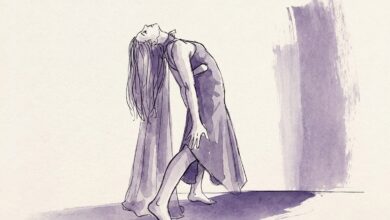
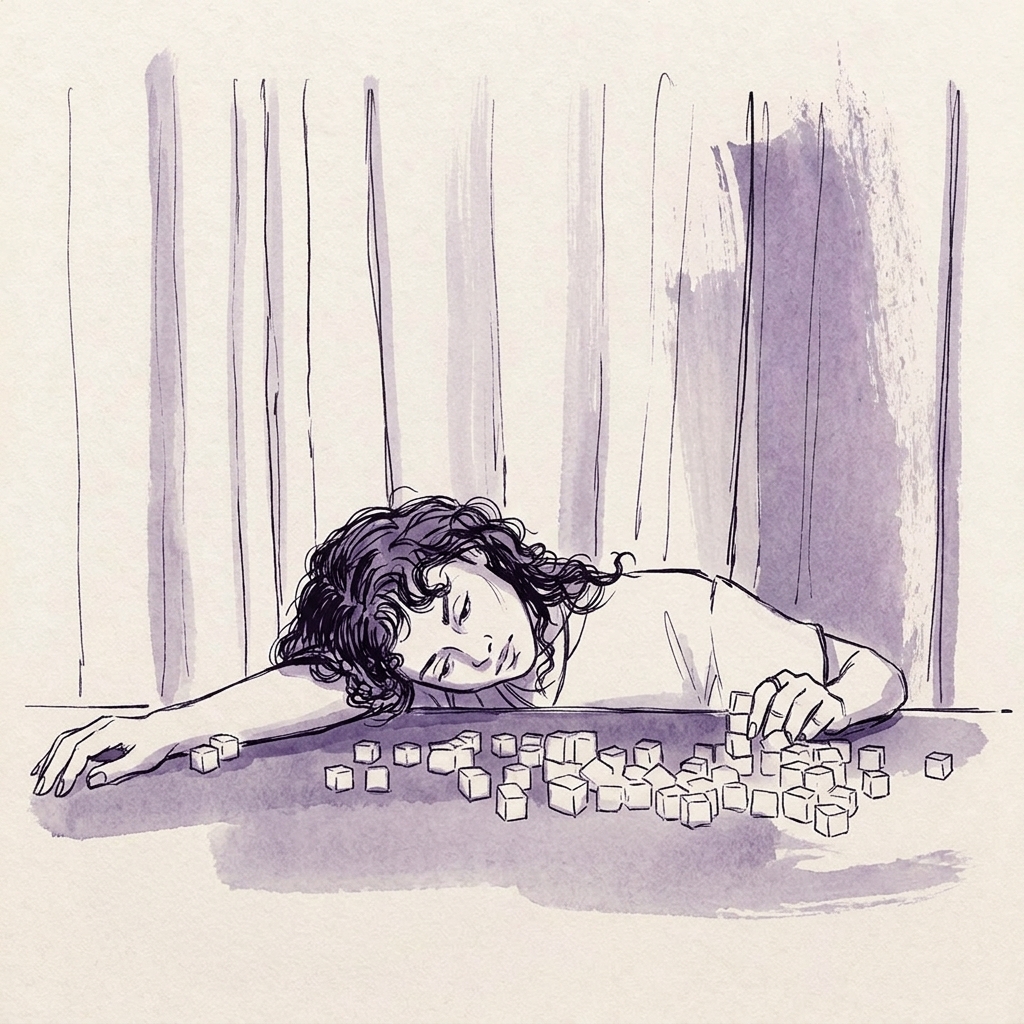
I understood early that fatigue is the origin. That clay, in its heaviness and viscosity, its malleability and its capacity to surrender to gravity, is the incarnation of burden.
Weariness is heavisome. A child rarely knows if they’re tired. He begins life with a sense of disconnection. He cries. His teeth break out through his gums. He struggles to stand, falls, rises, and falls again. At school, he meets shapes and colors and learns that he is not the best, that the other is not family, that love is not guaranteed. That, too, is Fatigue.
I wrote letters to girls who did not resemble me, memorized poems in pursuit of an impossible acceptance . No one resembled me. My distortions were my own. That, too, was strain.
Weariness is malleable. It clings to the spirit. You sit through fifty expensive therapy sessions, perhaps you are lucky enough to have insurance, and the doctor eventually tells you that compared to before, you have progressed. No doctor will ever tell you: « I have some good news ! Oh creature pledged to burden. Congratulations on your healing ». You succeed professionally. You complete your graduate studies. You launch projects. Life remains unstable, and you remain human, influenced by the discourse on wealth.
You join the gym. You willingly adopt an almost ceremonial lactose intolerance. You start drinking almond milk. You start using the air fryer to cook your meals.
You ask someone to weigh to the gram your micronutrients. You enter a relationship that appears suitable. In another, you repeat “I value clear communication” as a way to flee old wounds that once teared off your language faculty. Before sleep, the dispicable viscosity returns and you scroll through your life as if auditing a spreadsheet, looking like a customs officer inspecting declared goods :
☐ Mind and body
☐ Work
☐ Family
☐ Love
☐ Friendship
☐ Activities
☑ The burden
You resent the act. Your life is not a checklist, and there is no guarantee that what appears aligned truly is. Yet, deep down, you always knew how this gives you an artifical and illusiory sense of control. Filling in every box does not mend the way Weariness is built. In the end, it resembles a child’s sticky hand, carrying an unknown object, touching you without permission and leaving behind confusion and a flicker of disgust.
Your fatigue is malleable. More precisely, it is all forms at once. It is indeed exhausting to be alone and wearisome to belong to someone. It is exhausting to be unemployed and to be employed. To be poor and to be wealthy. In love and outside of it. During your moments of strength and when you collapse. In the temporary and the chronic. In noise and in silence. In choosing and in being subjected to the tyranny of choice. Your weariness is the face of a life you cannot decipher.
You confess that you are tired : To friends in a group chat who are unaware of what “going out” means to the weary. To those who left you and chose to return, gnawed by regret, but it was already too late,. To the appointments that dictate a human life: Chronic updates, vaccinations, routine screenings, the dentist, the dermatologist, the laser clinic. To traditions and social gatherings everyone complains about yet no one escapes : Birthdays, graduations, mariages , divorce, hatred, affection, death. To the cat meowing at your door asking for a tender touch on its back, and who will soil your doorstep : Nevertheless, the stain will dry, just like all your old longings for someone to extinguish your fatigue. To the plant you bought to prove to yourself you could nurture something smaller than your own heaviness, only for it to wither on the windowsill. You discard it and console yourself: This environment was unsuitable. When will you ever learn that you cannot sustain anything ? How many things and people will fade away at your window ?
To your devotion to a writer you follow, too tired to accept his death. Afterwards, you will probably kill those you love because of your procrastination.
To the clothes in the laundry basket, and the pockets filled with the pebbles of your burden : You empty them, yet you remain subjected to their heavy wheight. Even your garments will fade from the repeated washing of Strain.
To the books you bought hoping if only one could articulate everything. Yet fatigue halts you at the title.
To those who love us, especially them. They must grasp the magnitude of the weariness we inhabit. We are the weariness. And how does weariness speak? How does one speak when foam gathers at one’s mouth?
We are governed by gravity, Therefore, descent is natural. Physically, we resist it at every moment. What prevents collapse is not the disappearance of gravity but the presence of a counterforce.
Burden is our gravity. We do not abolish it. We manufacture mental counterweights : Meaning, obligation, desire, fear, devotion.
And is that not, too, another form of strain?
Perhaps strain is not an aberration. We were created in kabad. Surely every religion, and even non-belief, have their equivalent. Perhaps to be human is to be burdened. And I repeat what I once said:
Your weariness is not a passing season. Not a chemical reaction only. Not a foolish childhood trauma. Not the loss of someone irretrievable. Not unbelonging. Not the moment you perceived the futility of all you once believed in. Not fear, though fear may accompany it. Not being in the wrong place, as if anyone ever find themselves in the right one ! Not an undisclosed secret. None of these.
Your burden is you.
And as Bassam Hajjar* wrote:
“… and so I believe that all of this is weariness, destined to fade, as symptoms fade from all things—since they are merely symptoms, not the thing itself, even though for a while they convince it that they are its very essence. Such is the closeness of their dwelling that each becomes the other’s face…”
*Bassam Hajjar – Lebanese Poet
Writer and short story author from the United Arab Emirates.
Tunisian writer and translator, Professor of English, and vocal artist based in France.